Unlock instant, AI-driven research and patent intelligence for your innovation.

Parallel program analysis and branch prediction

a parallel program and branch prediction technology, applied in the field of parallel program analysis, can solve the problems of complex problems such as the ability to predict the behavior of programs executed on the computer, and the complexity of the problem is even mor

Inactive Publication Date: 2015-02-05
IBM CORP
View PDF2 Cites 15 Cited by
  • Summary
  • Abstract
  • Description
  • Claims
  • Application Information

AI Technical Summary

Benefits of technology

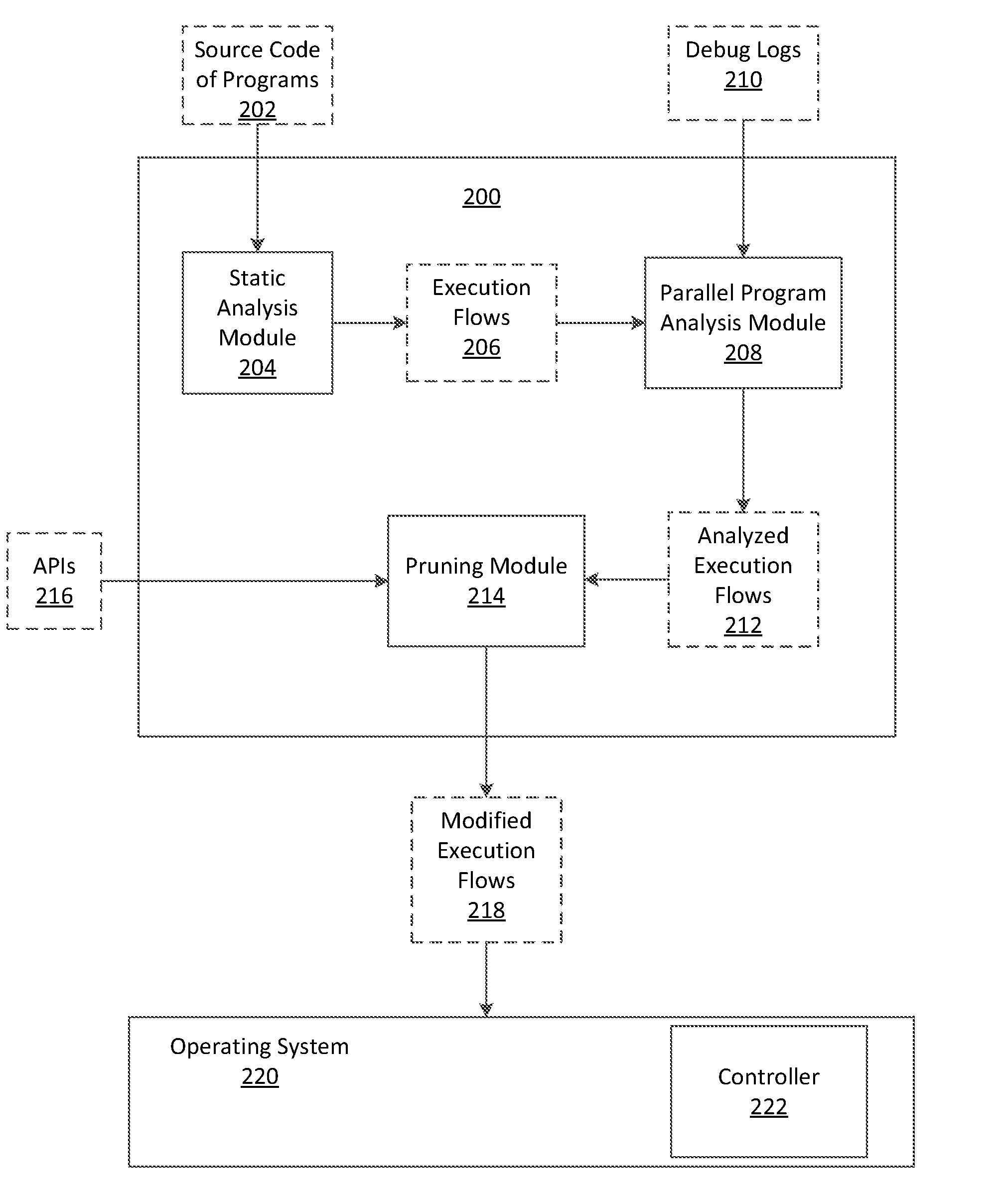
The present invention provides a method and system for predicting execution paths of a plurality of programs that run in parallel. This is achieved by generating first execution flows of the programs through a static analysis, identifying communication messages between execution flows and deducing that at least one conditional branch was taken in at least one given execution flow of the first execution flows by the target program. Based on this, at least one conditional branch that was not taken is removed and modified execution flows that were modified in accordance with the removal are output to indicate predicted execution paths of the target program. This can improve the efficiency and accuracy of parallel program execution.

Problems solved by technology

Predicting the behavior of the programs executed on a computer is relatively complicated due to a multitude of possible execution flows resulting from various conditional branches that can be taken and combinations of branches that can be taken by the programs.
The problem is even more complex when considering the realistic and practical scenario in which several programs and processes are executed simultaneously and in which the various programs and processes can affect the execution of other programs and processes.

Method used

the structure of the environmentally friendly knitted fabric provided by the present invention; figure 2 Flow chart of the yarn wrapping machine for environmentally friendly knitted fabrics and storage devices; image 3 Is the parameter map of the yarn covering machine
View more

Image

Smart Image Click on the blue labels to locate them in the text.
Viewing Examples
Smart Image
  • Parallel program analysis and branch prediction
  • Parallel program analysis and branch prediction
  • Parallel program analysis and branch prediction

Examples

Experimental program
Comparison scheme
Effect test

Embodiment Construction

[0017]Embodiments of the present invention described herein are directed to determining the most likely executed branches of programs that are run in parallel. In particular, preferred embodiments are directed to interrelated programs that send and receive messages between themselves and, as a result, affect the various processes run by the programs. The determination of the executed branches and, more importantly, the determination of branches that are likely not executed can provide insights that enable the improvement of the efficiency of executing the programs. For example, as noted below, in preferred embodiments of the present invention, unnecessary modules or tasks of an operating system, such as application programming interfaces, associated with unlikely branches can be removed from the operating system to conserve resources and expedite processing calls associated with the parallel execution of the programs. In addition, the embodiments can achieve this without in any way ...

the structure of the environmentally friendly knitted fabric provided by the present invention; figure 2 Flow chart of the yarn wrapping machine for environmentally friendly knitted fabrics and storage devices; image 3 Is the parameter map of the yarn covering machine
Login to View More

PUM

No PUM Login to View More

Abstract

Systems and methods for predicting execution paths of at least one target program of a plurality of programs that are run in parallel are described. In one method, execution flows of programs are generated by conducting a static analysis. In addition, the programs are executed to obtain debug logs from the programs. Further, communication messages transmitted between the execution flows are identified from the debug logs. A deduction that at least one conditional branch was taken in at least one given execution flow of the first execution flows by the target program is made based on the communication messages that are identified in the debug logs. Based on the deduction, at least one conditional branch that was not taken is removed from the given execution flow. In addition, modified execution flows that were modified in accordance with the removal are output to indicate predicted execution paths of the target program.

Description

BACKGROUND[0001]1. Technical Field[0002]The present invention relates to parallel program analysis, and, more particularly, to predicting execution flows of parallel programs.[0003]2. Description of the Related Art[0004]Predicting the behavior of the programs executed on a computer is relatively complicated due to a multitude of possible execution flows resulting from various conditional branches that can be taken and combinations of branches that can be taken by the programs. The problem is even more complex when considering the realistic and practical scenario in which several programs and processes are executed simultaneously and in which the various programs and processes can affect the execution of other programs and processes. There are many different types of programs which process in parallel among a plurality of hosts and processes. These programs communicate with each other while executing various processes and their behavior changes frequently as messages are exchanged be...

Claims

the structure of the environmentally friendly knitted fabric provided by the present invention; figure 2 Flow chart of the yarn wrapping machine for environmentally friendly knitted fabrics and storage devices; image 3 Is the parameter map of the yarn covering machine
Login to View More

Application Information

Patent Timeline
no application Login to View More
IPC IPC(8): G06F11/36
CPCG06F11/362G06F11/3612G06F8/433G06F8/443G06F11/3636G06F11/3466G06F9/30058G06F9/3806
Inventor KUSHIDA, TAKAYUKIMISHINA, TAKUYATAKAHASHI, HITOMITATEISHI, TAKAAKI
Owner IBM CORP