Unlock instant, AI-driven research and patent intelligence for your innovation.

Organic thin-film transistor sensor arrangements

a thin-film transistor and organic technology, applied in thermoelectric devices, instruments, material impedances, etc., can solve the problems of many sensors not being able to use certain environments, expensive labeling and detection equipment, and limited sampling detection methods

Active Publication Date: 2015-03-05
THE BOARD OF TRUSTEES OF THE LELAND STANFORD JUNIOR UNIV
View PDF4 Cites 0 Cited by
  • Summary
  • Abstract
  • Description
  • Claims
  • Application Information

AI Technical Summary

Problems solved by technology

Approaches to sample detection have been limited for a variety of reasons.
In many applications, sample detection has required expensive labeling and detection equipment.
In addition, while it is often desirable to detect samples in a variety of environments, many sensors are not amenable to use with certain environments.
For instance, detecting analytes has been challenging in environments susceptible to moisture.
Detection has been particularly challenging under conditions involving analytes that are in solution such as an aqueous solution, as often is the case for comprehensive environmental monitoring and biological sensing.
While OTFTs are useful for many applications, their manufacture and implementation for sensor applications has been challenging.
Generally, OTFTs have not been suitable for applications involving exposure to moisture and aqueous solutions due to high operating voltages, degradation and delamination under aqueous conditions, and in particular under conditions that expose a significant portion of the OTFT to a solution.
Dielectric materials used in OTFTs have generally been susceptible to the formation of pinholes, which introduce undesirable characteristics.
), which can present challenges to the implementation of certain materials.
Other challenges to the formation of OTFTs relate to processing characteristics, including those related to the ease, consistency and quality of the manufacture of dielectric layers for OTFTs.
For instance, many manufacturing approaches are characterized by undesirable moisture sensitivity, high reactivity, and rough surfaces.
Still other challenges to the implementation of OTFTs are related to compatibility with different gate and channel materials, and with organic semiconductors.

Method used

the structure of the environmentally friendly knitted fabric provided by the present invention; figure 2 Flow chart of the yarn wrapping machine for environmentally friendly knitted fabrics and storage devices; image 3 Is the parameter map of the yarn covering machine
View more

Image

Smart Image Click on the blue labels to locate them in the text.
Viewing Examples
Smart Image
  • Organic thin-film transistor sensor arrangements
  • Organic thin-film transistor sensor arrangements
  • Organic thin-film transistor sensor arrangements

Examples

Experimental program
Comparison scheme
Effect test

Embodiment Construction

[0019]The present invention is believed to be applicable to a variety of different types of sensor-based processes, devices and arrangements involving organic thin-film transistors. While the present invention is not necessarily so limited, various aspects of the invention may be appreciated through a discussion of examples using this context.

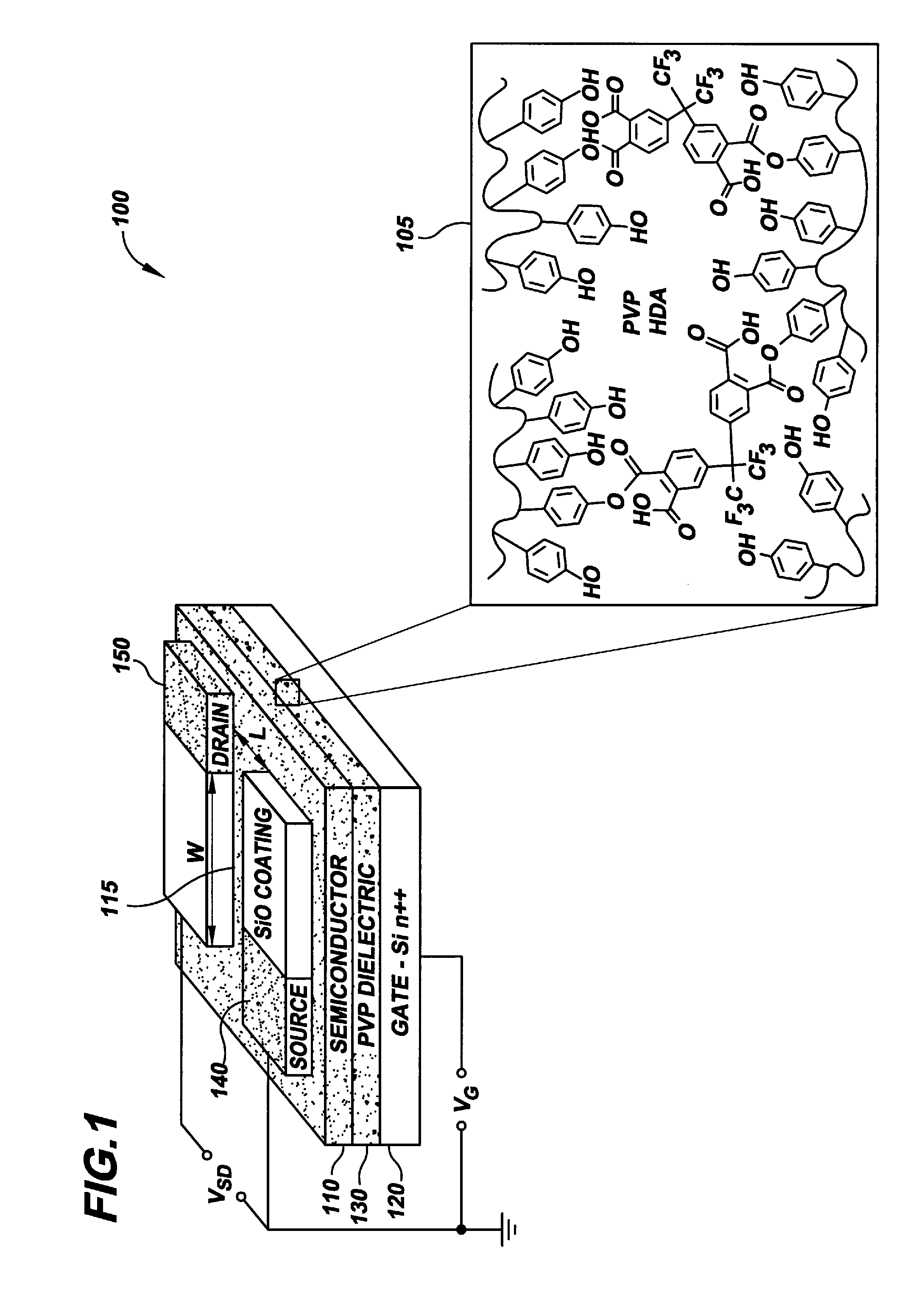
[0020]In connection with various example embodiments of the present invention, low-operating voltage organic thin-film transistor (OTFT) sensors exhibit stable operation (e.g., over a multitude of electrical cycles) under aqueous conditions. The OTFT sensors are implemented for environmental sensing, healthcare diagnosis, biological testing (e.g., national defense), chemical detection and research. In some applications, the OTFT sensors facilitate aqueous-phase sensing for samples in solution having concentrations as low as parts per billion such as trinitrobenzene, methylphosphonic acid, cysteine and glucose. In other applications, the OTFT se...

the structure of the environmentally friendly knitted fabric provided by the present invention; figure 2 Flow chart of the yarn wrapping machine for environmentally friendly knitted fabrics and storage devices; image 3 Is the parameter map of the yarn covering machine
Login to View More

PUM

PropertyMeasurementUnit
voltageaaaaaaaaaa
voltageaaaaaaaaaa
temperatureaaaaaaaaaa
Login to View More

Abstract

A sensor includes an organic thin-film transistor (OTFT) that operates under low voltage conditions in an aqueous environment. According to an example embodiment, an OTFT includes an organic channel that electrically connects source and drain electrodes, with a gate electrode separated from the channel by a dielectric layer. The channel, gate and dielectric layer are arranged to facilitate switching of the channel region to pass current between the source and drain electrodes, in response to a low voltage applied to the gate electrode, when the channel is exposed to an aqueous solution. The current that is passed is indicative of characteristics of the aqueous solution, and is used to characterize the same. For various implementations, the low voltage operation of the sensor facilitates such characterization with substantially no ionic conduction through an analyte in the aqueous solution.

Description

RELATED PATENT DOCUMENTS[0001]This patent document is a divisional under 35 U.S.C. §120 of U.S. patent application Ser. No. 11 / 781,749 filed on Jul. 23, 2007, which claims the benefit, under 35 U.S.C. §119(e), of U.S. Provisional Patent Application No. 60 / 832,838 filed Jul. 24, 2006, entitled: “Cross-Linked Organic Thin-Film Dielectrics;” each of these patent documents is fully incorporated herein by reference.FEDERALLY-SPONSORED RESEARCH OR DEVELOPMENT[0002]This invention was made with Government support under contract 0213618 awarded by the National Science Foundation. The U.S. Government has certain rights in this invention.FIELD OF THE INVENTION[0003]The present invention relates generally to semiconductor devices, and more particularly to sensor arrangements and approaches involving organic thin-film transistors.BACKGROUND[0004]The detection and analysis of samples has become increasingly important in a variety of fields and industries, including those relating to healthcare, e...

Claims

the structure of the environmentally friendly knitted fabric provided by the present invention; figure 2 Flow chart of the yarn wrapping machine for environmentally friendly knitted fabrics and storage devices; image 3 Is the parameter map of the yarn covering machine
Login to View More

Application Information

Patent Timeline
no application Login to View More
Patent Type & Authority Applications(United States)
IPC IPC(8): G01N27/02H01L51/05
CPCH01L51/0558G01N27/02H10K10/471H10K10/484
Inventor BAO, ZHENANROBERTS, MARK E.
Owner THE BOARD OF TRUSTEES OF THE LELAND STANFORD JUNIOR UNIV