Unlock instant, AI-driven research and patent intelligence for your innovation.

Clone detection method and clone function commonalizing method

a detection method and clone technology, applied in the field of methods of detecting clones from models, can solve problems such as wasteful detection, and achieve the effects of reducing the size of source cod

Inactive Publication Date: 2015-03-19
AISIN AW CO LTD
View PDF11 Cites 3 Cited by
  • Summary
  • Abstract
  • Description
  • Claims
  • Application Information

AI Technical Summary

Benefits of technology

The present invention is about a method for detecting clones in a model that is made up of a block diagram and a clone function commonalizing method. The goal is to better identify only the clones that can be commonalized, which can reduce the size of the source code. A computer program is recorded on a recording medium that helps to commonalize the functions of clones, making the source code smaller when coding the model.

Problems solved by technology

However, the diagnosis device according to JP 2012-38022 A is intended to exhaustively detect clones from the entire model, and thus it is not considered to reduce the size of the source code by commonalizing the functions of the detected clones.
Therefore, in the clone detection process, clones are detected with blocks inside and outside a subsystem excluding an input port and an output port connected, and even portions, function of which cannot be commonalized because of the absence of an input port and an output port, are detected as clones, which results in wasteful detection results.

Method used

the structure of the environmentally friendly knitted fabric provided by the present invention; figure 2 Flow chart of the yarn wrapping machine for environmentally friendly knitted fabrics and storage devices; image 3 Is the parameter map of the yarn covering machine
View more

Image

Smart Image Click on the blue labels to locate them in the text.
Viewing Examples
Smart Image
  • Clone detection method and clone function commonalizing method
  • Clone detection method and clone function commonalizing method
  • Clone detection method and clone function commonalizing method

Examples

Experimental program
Comparison scheme
Effect test

example 1

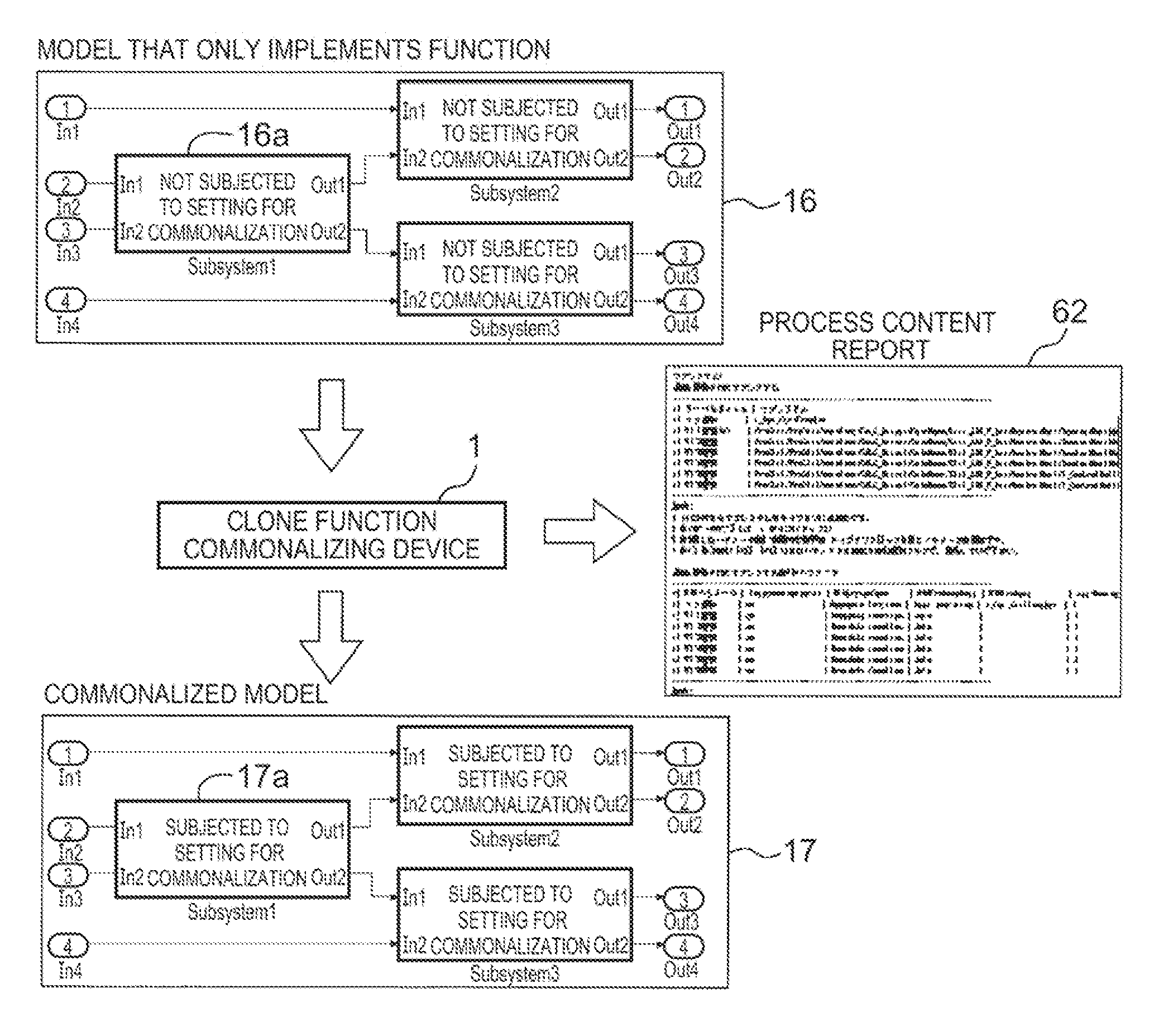
[0102]The model which had been manually processed for function commonalization in Comparative Example was processed for function commonalization by the clone function commonalizing device 1, and the model was coded. As a result, a code with 8018 lines was generated. Thus, the code was reduced by 269 lines compared to Comparative Example, which resulted in a reduction of 3.35%.

example 2

[0103]A comparison was made between the number of code lines generated in the case where a model that had not been processed for function commonalization at all was coded and the number of code lines generated in the case where a model that had been processed for function commonalization by the clone function commonalizing device 1 was coded. Then, the example resulted in a reduction in number of code lines of about 10%.

[0104]Thus, a reduction of more than 3% was achieved for a model manually processed for function commonalization as much as possible, not to mention the effect for a model that had not been processed for function commonalization at all. Thus, it turned out that the clone function commonalizing device 1 achieved function commonalization with higher accuracy than that achieved manually.

the structure of the environmentally friendly knitted fabric provided by the present invention; figure 2 Flow chart of the yarn wrapping machine for environmentally friendly knitted fabrics and storage devices; image 3 Is the parameter map of the yarn covering machine
Login to View More

PUM

No PUM Login to View More

Abstract

A clone detection method including a detection step of detecting at least a plurality of subsystems, functions of which can be commonalized, from a model constituted by a block diagram and having a plurality of subsystems each composed of an input port, an output port, and a block connected between the input port and the output port, the detection step being performed by a control section.

Description

INCORPORATION BY REFERENCE[0001]The disclosure of Japanese Patent Application No. 2013-190692 filed on Sep. 13, 2013 including the specification, drawings and abstract is incorporated herein by reference in its entirety.BACKGROUND OF THE INVENTION[0002]The present invention relates to a method of detecting clones from a model constituted by a block diagram and a clone function commonalizing method, for example, and more particularly to a method of detecting clones from a model constituted by a block diagram and a clone function commonalizing method by which portions with similar configurations due to copying of a block or the like can be detected.DESCRIPTION OF THE RELATED ART[0003]Hitherto, Simulink (registered trademark), which is one of MATLAB (registered trademark) series products of MathWorks, has been known as software for generating a source code for providing a command to a computer. When a user inputs to the Simulink information on a demand document and a design document as...

Claims

the structure of the environmentally friendly knitted fabric provided by the present invention; figure 2 Flow chart of the yarn wrapping machine for environmentally friendly knitted fabrics and storage devices; image 3 Is the parameter map of the yarn covering machine
Login to View More

Application Information

Patent Timeline
no application Login to View More
IPC IPC(8): G06F9/44
CPCG06F8/751G06F8/34
Inventor KUBO, TAKAYUKI
Owner AISIN AW CO LTD