
User scheduling and beamformer design method, apparatus, and storage medium based on two-stage beamformer for massive MIMO downlink
a beamformer and user technology, applied in the field of user scheduling and beamformer design methods, apparatuses, storage media for multi-user multi-input and multi-output (mimo) downlink, can solve the problems of severe sum rate performance degradation and insufficient sum rate performance, and achieve better date rate performance and feedback amount
- Summary
- Abstract
- Description
- Claims
- Application Information
AI Technical Summary
Benefits of technology
Problems solved by technology
Method used
Image

Examples
Embodiment Construction
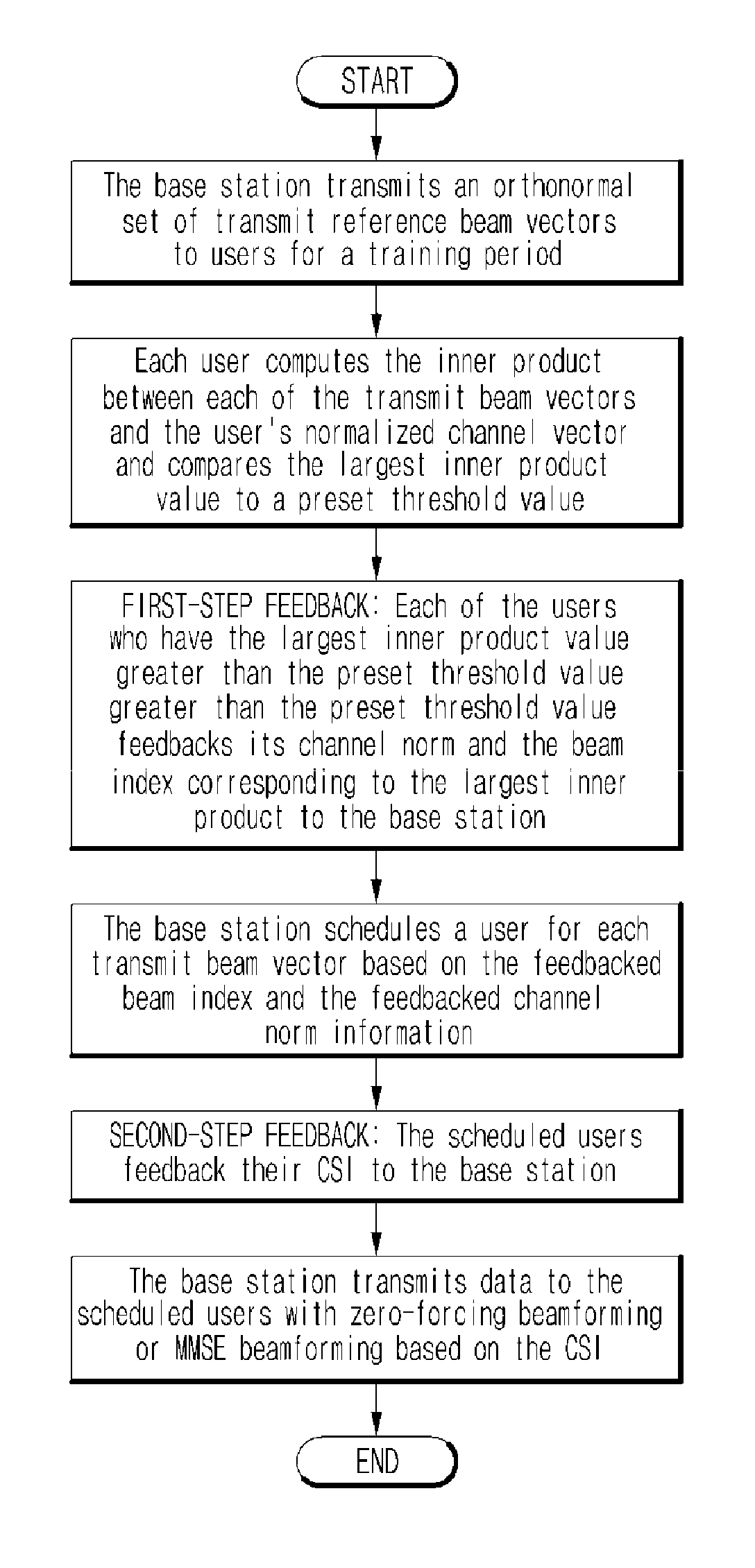
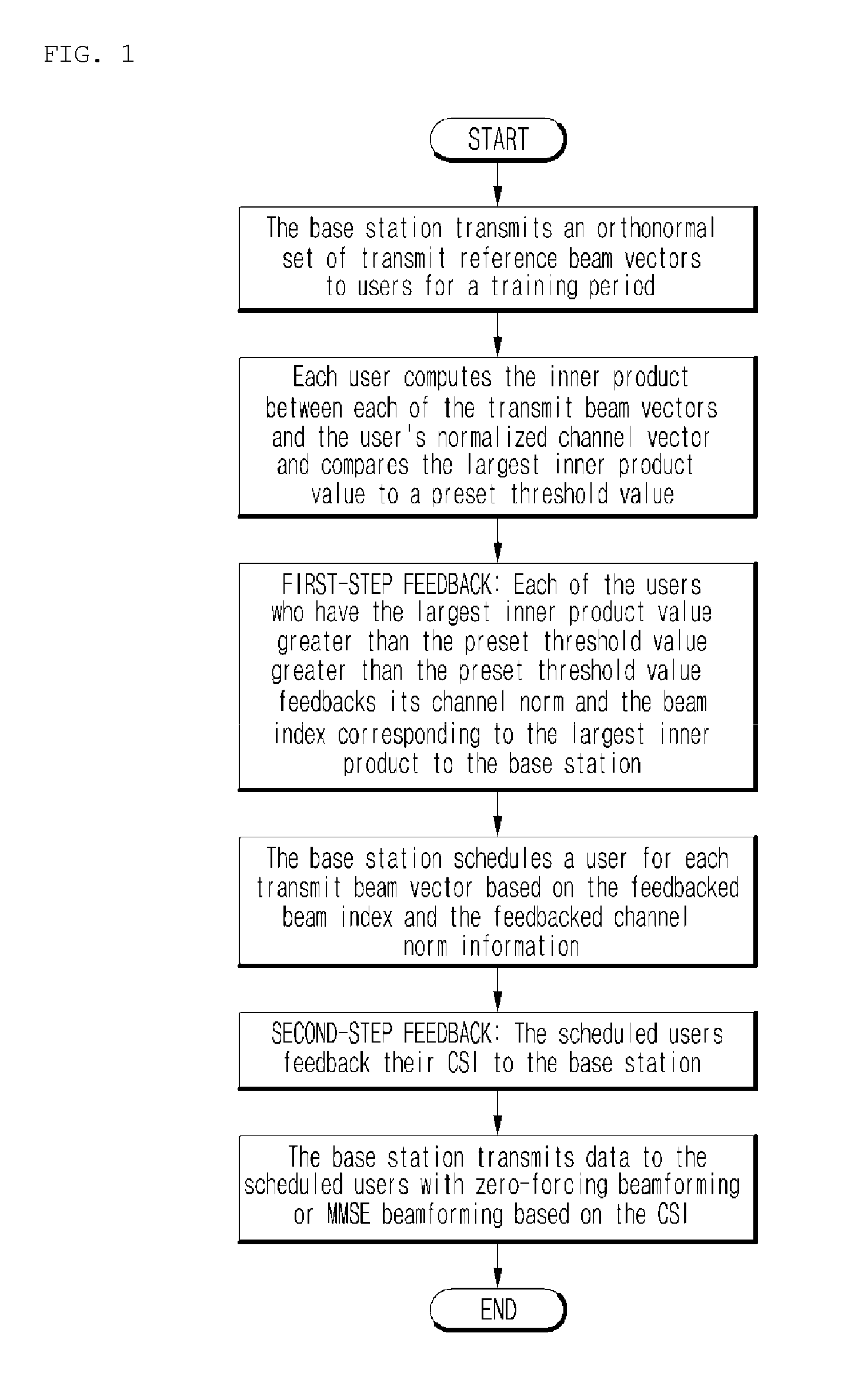
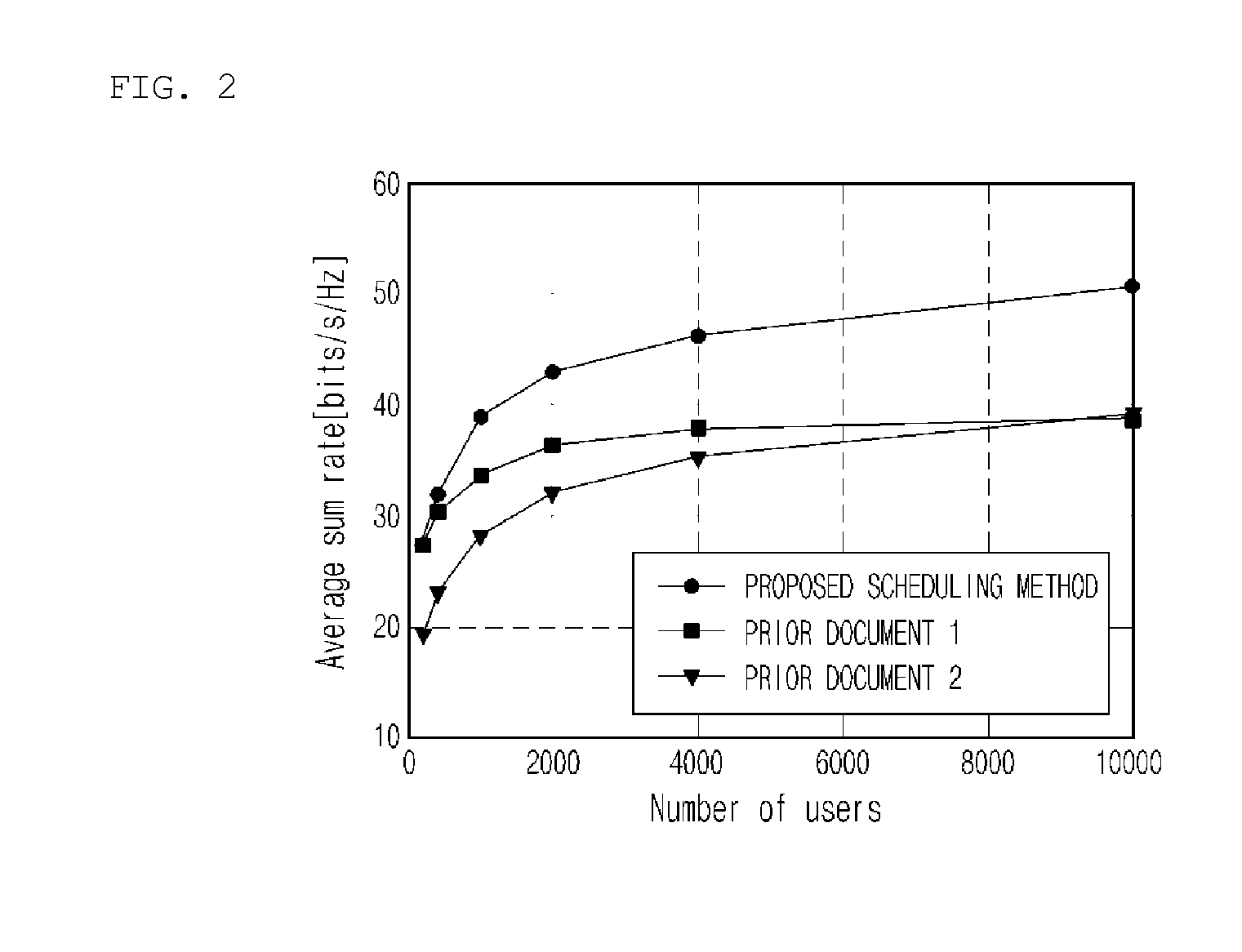
[0024]Embodiments of the present invention are described with reference to the accompanying drawing FIG. 1. In the following description of the present invention, detailed descriptions of known functions and configurations which are deemed to make the gist of the present invention obscure will be omitted.
[0025]Further, in the present specification, the term “user” denotes a user terminal, and thus the user may be construed as the user terminal. the method of the present invention is implemented by a processor of a base station.
[0026]For the explanation purpose, we consider the following multiple-input single-output (MISO) channel model:
ygk=hgkHx+ngk=hgkH[V1, . . . ,VG]diag(W1, . . . ,WG)d+ngk
where x is the transmit signal vector, ygk is the received signal at user k of group g, and ngk is the noise vector at user k of group g. Here, we assume two stage beamforming x=[V1, . . . , VG]diag(W1, . . . , WG)d, where {V1, . . . , VG} are the pre-beamformers separating different groups, {W...
PUM
 Login to View More
 Abstract
Description
Claims
Application Information
 Login to View More