AI technical title is built by Patsnap AI team. It summarizes the technical point description of the patent document.
a coherency manager and application technology, applied in the field of application coherency managers, can solve the problems of not developing an organized system to identify and verify the applicability and relevance of returned information, and becoming increasingly difficult to identify which pieces of data are linked based on topic, version, application or other criteria, etc., to achieve the effect of quick response to requests, easy and quick search, and quick access
Inactive Publication Date: 2015-11-26
CYBERNET SYST
View PDF3 Cites 3 Cited by
Summary
Abstract
Description
Claims
Application Information
AI Technical Summary
This helps you quickly interpret patents by identifying the three key elements:
Problems solved by technology
Method used
Benefits of technology
Benefits of technology
[0014]This invention resides in an application coherency manager (ACM) that can implement and manage the interdependencies of simulation, data, and platform information to simplify the task of organizing and executing large simulations composed of numerous models and data files. The ACM can also enforce a simulation configuration profile submission that includes the specification of the interdependency requirements between files (for example, ensuring that the same version of files are used).
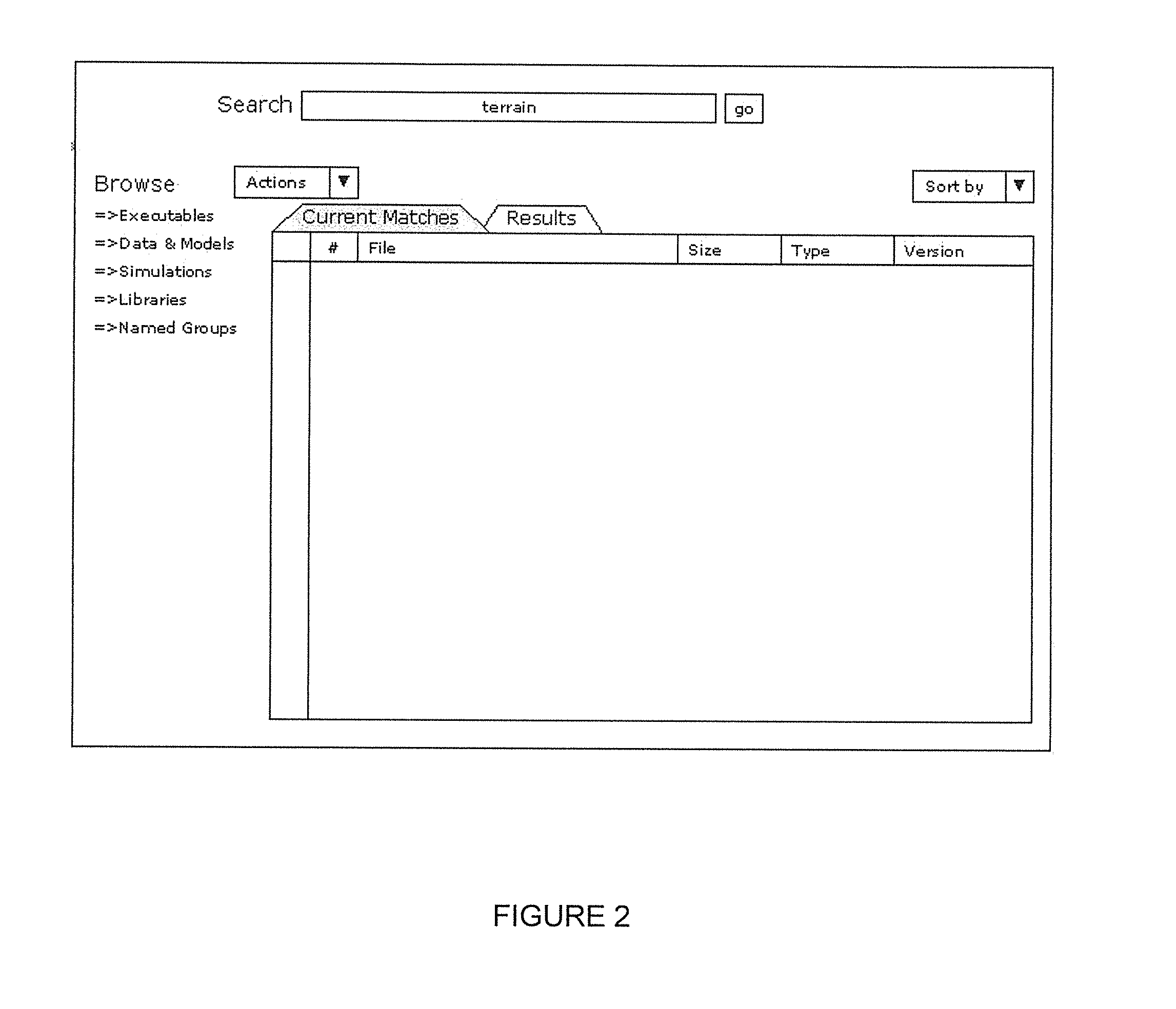
[0016]A general-purpose language serves as the basis for higher-level rules that are assembled using the GUI. The GUI allows the operator to easily and quickly search the distributed repositories to locate and assemble the appropriate simulation models, data files, or other information. The CCMs scan distributed file systems and databases to build a detailed knowledge of the files within the system. This information is stored in a database that can be quickly accessed by the data aggregator and manager to rapidly respond to requests for information. The invention is applicable to non-simulation type applications such as document control, source code control, image libraries, etc.
Problems solved by technology
With the proliferation of electronic data, files, and models, it is becoming increasingly difficult to identify which pieces of data are linked based on topic, version, application, or other criteria.
It is a challenge to verify that the collected models will interoperate properly and provide the desired results.
Furthermore, if there is a large number of models or data files, it is problematic to quickly and efficiently locate only those files that are relevant to the current application.
However, no organized system has been developed to identify and verify the applicability and relevance of the returned information (at least beyond general keyword searches) to the application at hand.
When the library of information becomes large, it becomes difficult to maintain insight into what modules are interoperable based on version, type, or application nature.
Similar issues can arise with non-simulation type applications.
However, no system tackles the issue of efficiently retrieving data, files, or models from a large, unstructured set of distributed databases or file systems.
Basani does discuss the concept of content management systems that monitor for changes in files to properly update knowledge of file systems, but again does not address the larger issue of determining type and version of files.
Method used
the structure of the environmentally friendly knitted fabric provided by the present invention; figure 2 Flow chart of the yarn wrapping machine for environmentally friendly knitted fabrics and storage devices; image 3 Is the parameter map of the yarn covering machine
View more
Image
Smart Image Click on the blue labels to locate them in the text.
Viewing Examples
Smart Image
Click on the blue label to locate the original text in one second.
Reading with bidirectional positioning of images and text.
Smart Image
Examples
Experimental program
Comparison scheme
Effect test
Embodiment Construction
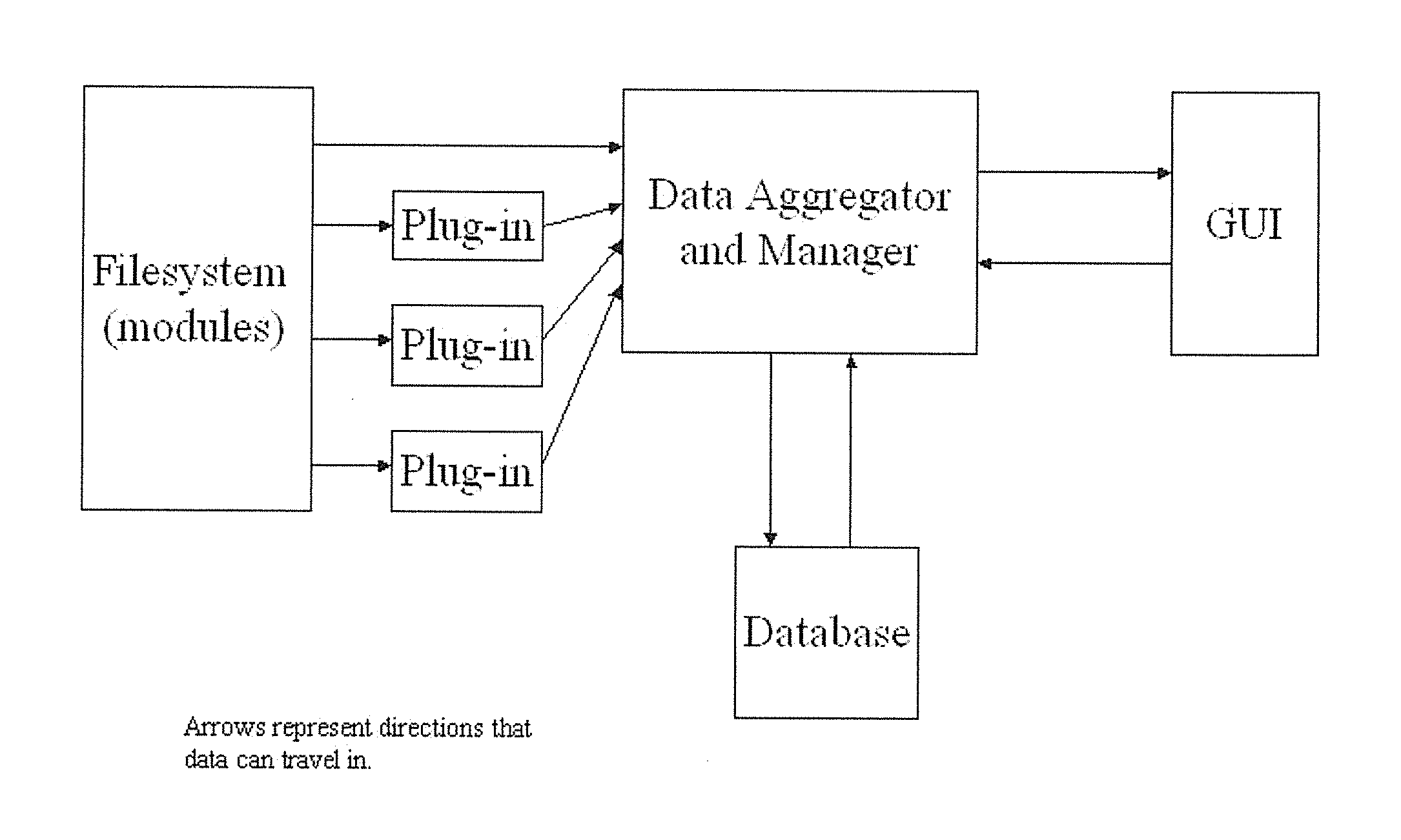
[0020]The invention described herein, the Application Coherency Manager or ACM. FIG. 1 is a drawing that depicts a layout of the ACM architecture, which includes the following components:[0021]A Data Aggregator and Manager (DAM) that manages the flow of information within the architecture.[0022]Plug-in Coherency Checking Modules (CCMs) that are capable of determining the types of, and compatibility between, files, data, and models. The CCMs adhere to an interface standard that allows new CCMs to be written and installed to identify new file and data types.[0023]An intelligent Graphical Users Interface (GUI) for improving the process of searching for and displaying results from a query.[0024]A database for storing processed information about the repositories and the results of previous searches.[0025]A file system (or file systems) or repository (repositories) where the raw data is stored.
[0026]The layout of FIG. 1 shows the main components of the system with arrows representing the ...
the structure of the environmentally friendly knitted fabric provided by the present invention; figure 2 Flow chart of the yarn wrapping machine for environmentally friendly knitted fabrics and storage devices; image 3 Is the parameter map of the yarn covering machine
Login to View More
PUM
Login to View More
Abstract
An application coherency manager (ACM) implements and manages the interdependencies of simulation, data, and platform information to simplify the task of organizing and executing large simulations composed of numerous models and data files. One or more file systems or repositories stories raw data in the form of files, data, or models, and a graphical users interface (GUI) enabling a user to enter and receive results from a query involving the files, data, or models. One or more coherency checking modules (CCMs) are operative to determine the types and versions of, and compatibility between, the files, data, or models. A database stores processed information about the file systems or repositories and the results of previous queries, and a data aggregator and manager (DAM) that manages the flow of information between the file system or repository, the GUI, the CCMs, and the database. The invention is applicable to simulation and non-simulation type applications such as document control, source code control, image libraries, etc.
Description
REFERENCE TO RELATED APPLICATIONS[0001]This application is a continuation of U.S. patent application Ser. No. 12 / 263,706, filed Nov. 3, 2008, which claims priority from U.S. Provisional Patent Application Ser. No. 60 / 984,569, filed Nov. 1, 2007, the entire content of both of which is incorporated herein by reference.FIELD OF THE INVENTION[0002]This invention is directed towards efficiently using large, distributed sets of data and files for various applications, including simulation, document control, or image archival. More particularly, the invention resides a method for crawling over a collection of files, data, or models, to identify the nature, version, and interoperability of each module.BACKGROUND OF THE INVENTION[0003]With the proliferation of electronic data, files, and models, it is becoming increasingly difficult to identify which pieces of data are linked based on topic, version, application, or other criteria. For example, managing a large simulation can require assembl...
Claims
the structure of the environmentally friendly knitted fabric provided by the present invention; figure 2 Flow chart of the yarn wrapping machine for environmentally friendly knitted fabrics and storage devices; image 3 Is the parameter map of the yarn covering machine
Login to View More
Application Information
Patent Timeline
Application Date:The date an application was filed.
Publication Date:The date a patent or application was officially published.
First Publication Date:The earliest publication date of a patent with the same application number.
Issue Date:Publication date of the patent grant document.
PCT Entry Date:The Entry date of PCT National Phase.
Estimated Expiry Date:The statutory expiry date of a patent right according to the Patent Law, and it is the longest term of protection that the patent right can achieve without the termination of the patent right due to other reasons(Term extension factor has been taken into account ).
Invalid Date:Actual expiry date is based on effective date or publication date of legal transaction data of invalid patent.
Login to View More
Patent Type & AuthorityApplications(United States)


 Login to View More
  Login to View More