

Hole opener and method for drilling
a technology of hole opener and hole opening, which is applied in the direction of drilling rods, drilling pipes, rotary drilling, etc., can solve the problems of increasing job costs, poor tool construction, constant and looming threat of cone loss, etc., and achieves the effect of improving the rigidity of the blad
- Summary
- Abstract
- Description
- Claims
- Application Information
AI Technical Summary
Benefits of technology
Problems solved by technology
Method used
Image

Examples
Embodiment Construction
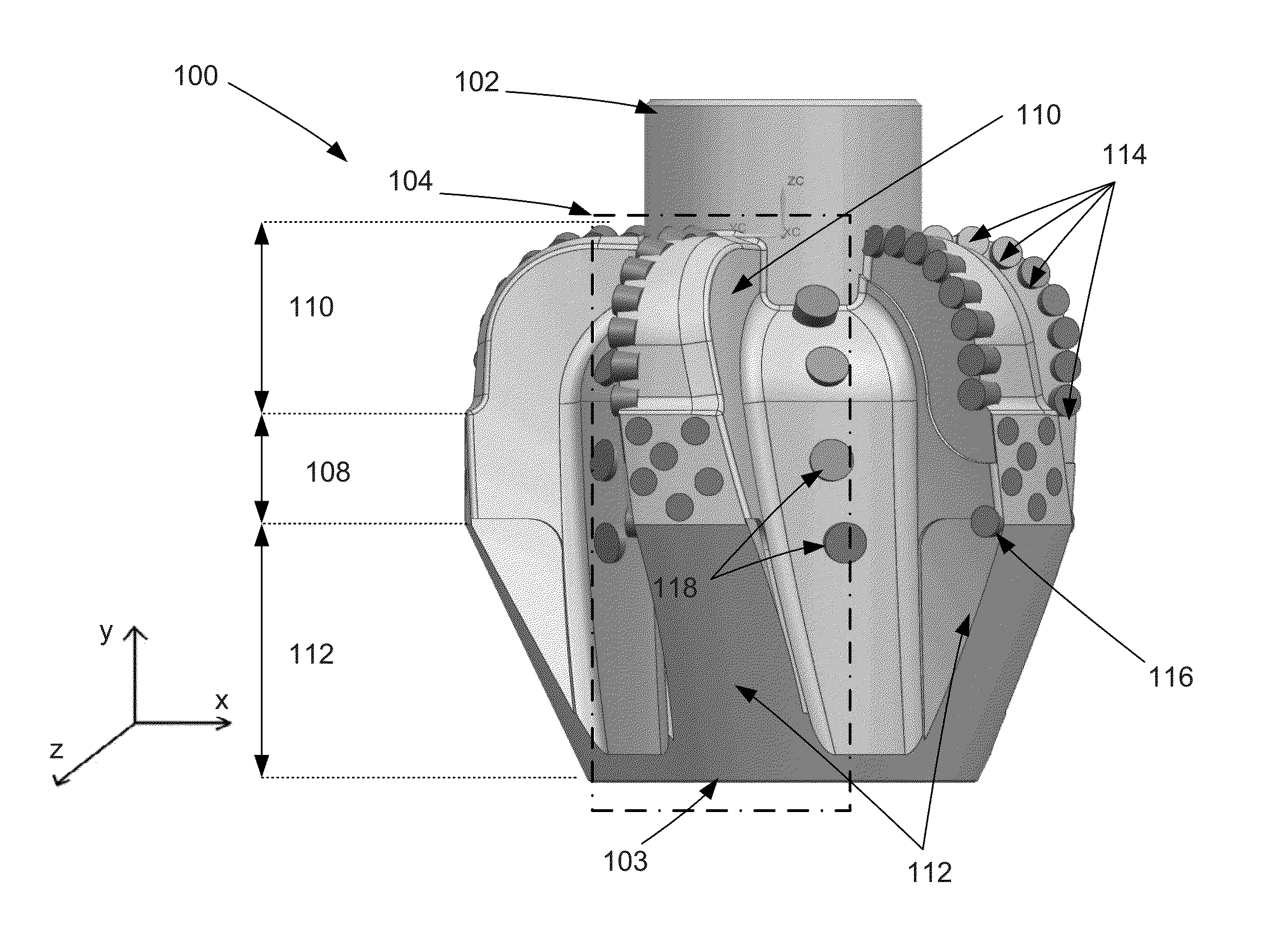
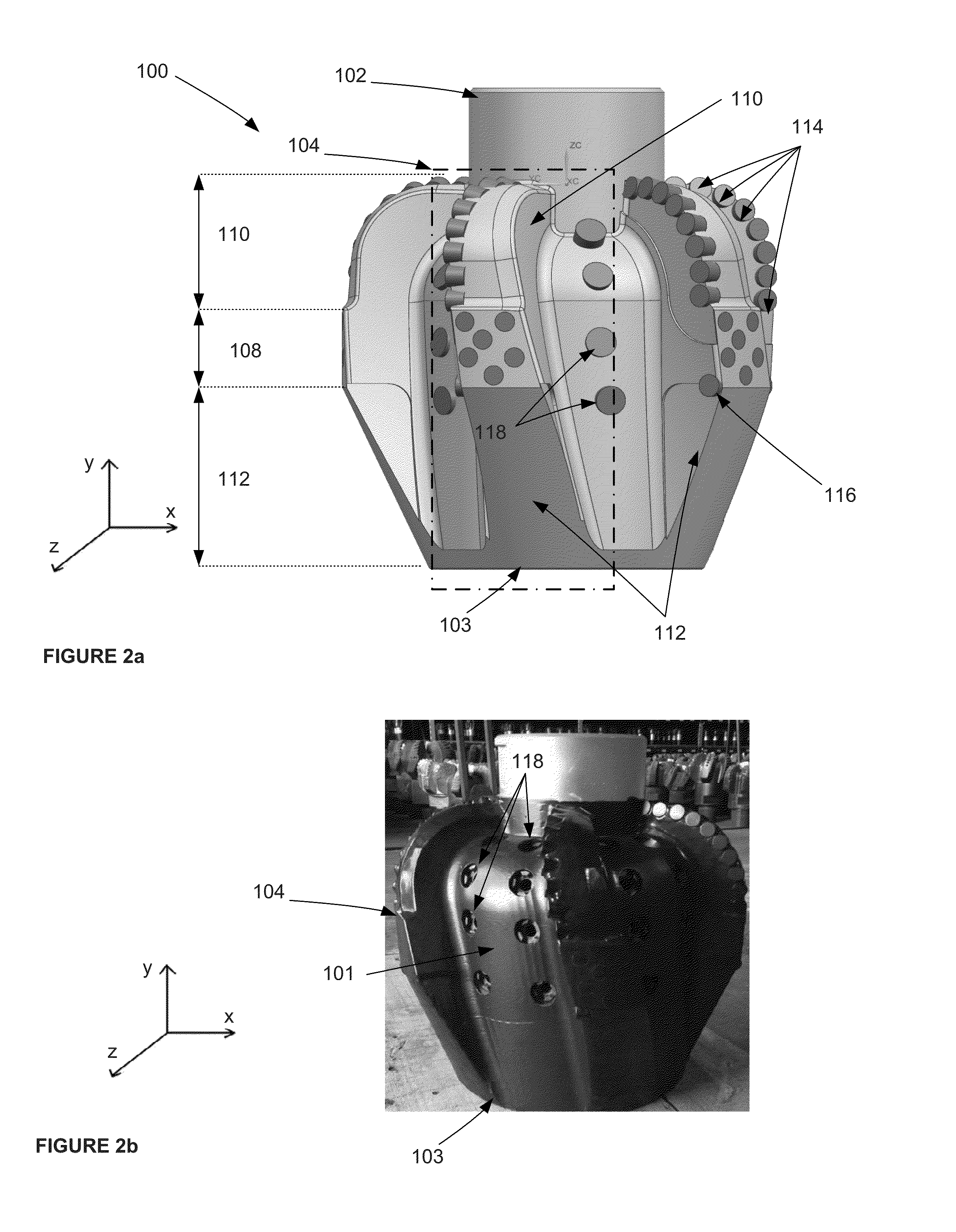
[0039]The embodiments describe a drill-bit for making holes in a hard structure such as a rock. The drill-bit has no moving parts and achieves both the rigidity and the fast rate of penetration into the rocks. In an embodiment, the drill-bit comprises a cone shaped central portion comprising a plurality of ribs protruding from the central portion and defining a plurality of blades. The blades are curved along a direction of a longitudinal axis of the cone to facilitate insertion into a hole when rotating in a first direction, and exit from the hole when rotating in a second direction opposite the first direction. Each blade comprises a plurality of polycrystalline diamond cutters (PDC) provided in a first position for cutting the hard structure as the drilling-bit rotates in the first direction, and a plurality of updrill PDC cutters provided in a second position for cleaning the hole as the drill-bit rotates in the second direction to exit the hole.
[0040]FIG. 2a is a side view of a...
PUM
 Login to View More
 Abstract
Description
Claims
Application Information
 Login to View More