
Multilayer structure comprising a layer of supramolecular material and method for the production thereof
a supramolecular material and multi-layer technology, applied in dendritic macromolecule adhesives, applications, other domestic articles, etc., can solve the problems of difficult manufacturing of multi-layer structures, affecting the production efficiency affecting the quality of complex geometry parts, etc., to achieve satisfactory spreading, facilitate the production of multi-layer structures, and facilitate the processing
- Summary
- Abstract
- Description
- Claims
- Application Information
AI Technical Summary
Benefits of technology
Problems solved by technology
Method used
Image

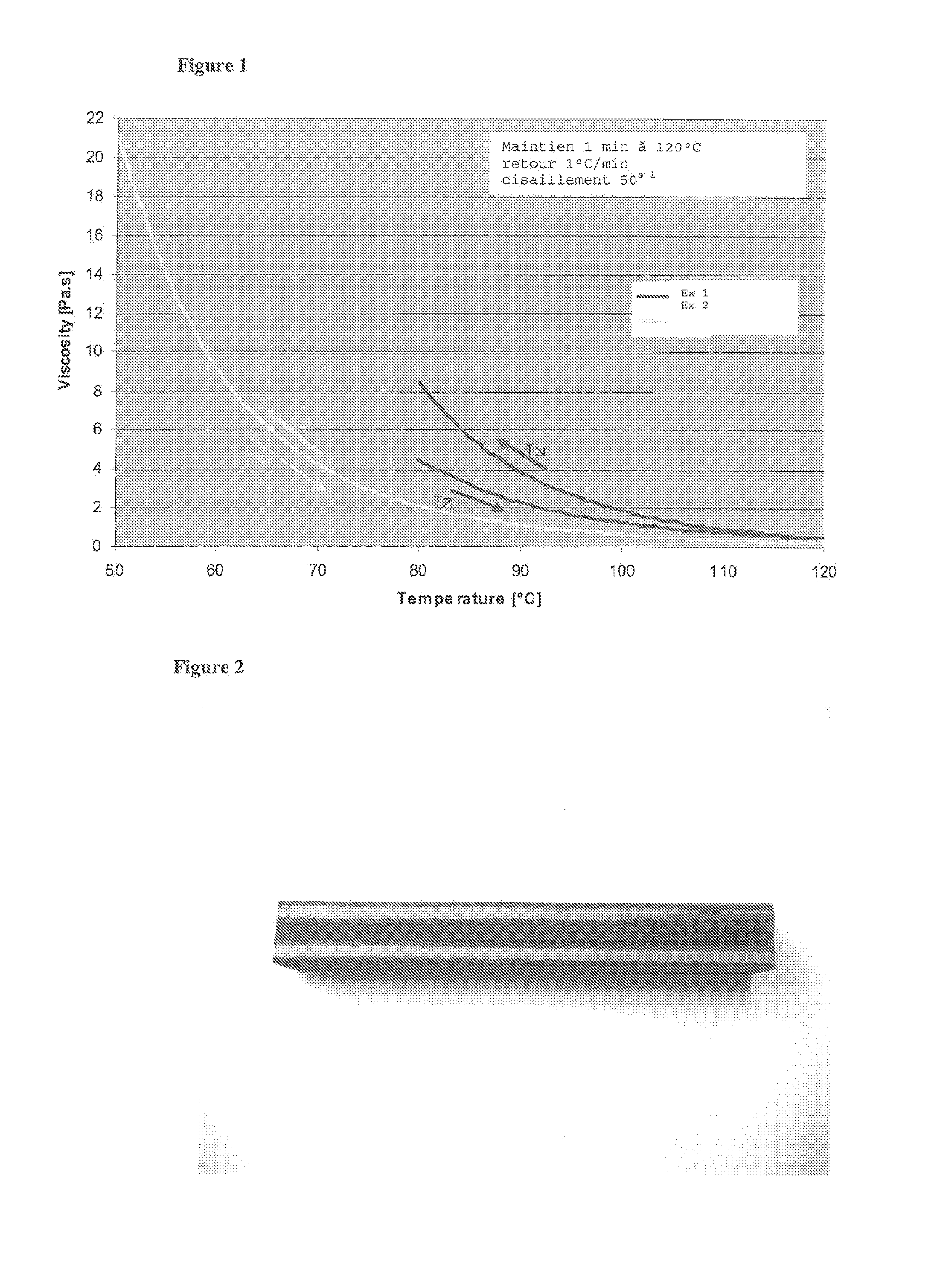
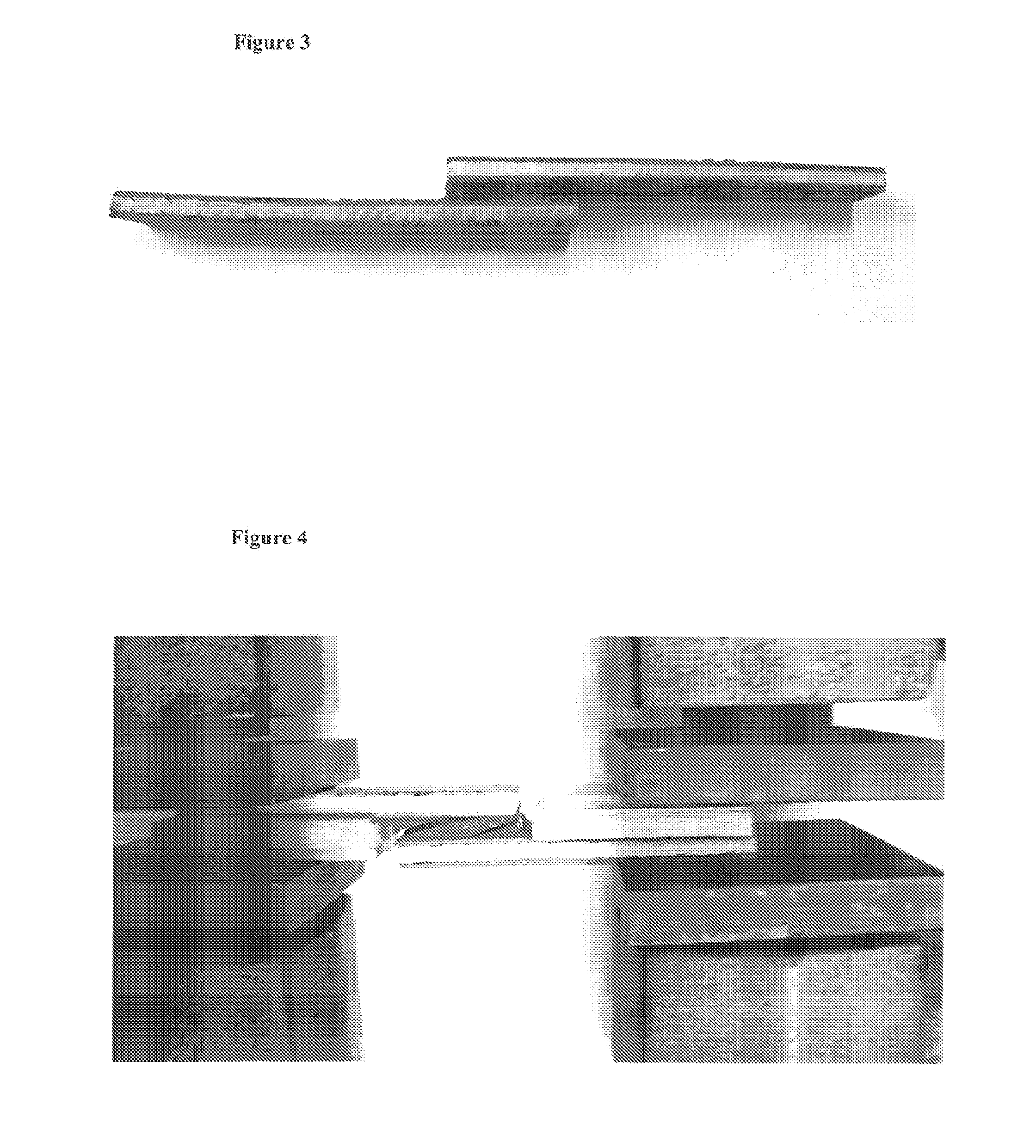
Examples
example 1
Process for the Synthesis of a Precursor of Supramolecular Material According to the Invention
[0104]1000 g of Pripol® 1040 from Croda (acid number 186), i.e. 3.32 mol of carboxylic acid, and 245 g of 2-aminoethylimidazolidone (UDETA) with a purity of 87.6% by weight, i.e. 1.66 mol of amine, are introduced into a Schott reactor with a working volume of 4000 ml placed on an electrical heating mantle and equipped with a temperature probe, a mechanical stirrer with a rotor of anchor type made of polytetrafluoroethylene, a dropping funnel, a reflux condenser, a Dean and Stark apparatus and a nitrogen inlet terminated by a dip pipe made of polytetrafluoro-ethylene. It is assumed that the impurities of the UDETA can contribute the equivalent of an additional 0.13 mol. The mixture is heated at 170° C. in order to remove the water of condensation. When the water of condensation is removed and trapped in the Dean and Stark apparatus, the medium is cooled to 80° C. At 80° C., 294 g of an epoxy...
example 2
Process for the Synthesis of a Precursor of Supramolecular Material According to the Invention
[0105]1000 g of Pripol® 1040 from Croda (acid number 186), i.e. 3.32 mol of carboxylic acid, and 245 g of 2-aminoethylimidazolidone (UDETA) with a purity of 87.6% by weight, i.e. 1.66 mol of amine, are introduced into a Schott reactor with a working volume of 4000 ml placed on an electrical heating mantle and equipped with a temperature probe, a mechanical stirrer with a rotor of anchor type made of polytetrafluoroethylene, a dropping funnel, a reflux condenser, a Dean and Stark apparatus and a nitrogen inlet terminated by a dip pipe made of polytetrafluoro-ethylene. It is assumed that the impurities of the UDETA can contribute the equivalent of an additional 0.13 mol. The mixture is heated at 170° C. in order to remove the water of condensation. When the water of condensation is removed and trapped in the Dean and Stark apparatus, the medium is cooled to 120° C. At 120° C., 414 g of epoxid...
example 3
Preparation of an Aluminum / Supramolecular Material Bilayer Structure Obtained from the Precursor of Example 1
[0106]The following assembly is produced: a rigid steel plate of 20 cm by 20 cm and with a thickness of 2 mm is available, to which a nonstick silicone film of the same dimensions is applied. A countermold is produced with a steel plate comparable to the preceding one to which an aluminum strip of the same dimensions and with a thickness of 0.5 mm is applied. A PVC seal with a diameter of 2.5 mm is subsequently positioned, in the form of a U, with a spacing between the branches of 18 cm, between the aluminum strip and the silicone film, in order to guarantee the leaktightness of the assembly. The assembly thus produced (steel plate / silicone film / PVC seal / aluminum strip / steel plate) is held in clamped position by clamps. The precursor obtained in example 1 is placed in a melting machine at 80° C. and then poured into the opening of the U formed by the PVC seal, between the alu...
PUM
| Property | Measurement | Unit |
|---|---|---|
| Temperature | aaaaa | aaaaa |
| Temperature | aaaaa | aaaaa |
| Thickness | aaaaa | aaaaa |
Abstract
Description
Claims
Application Information
 Login to View More