
Display device for holographic reconstruction
a display device and holographic reconstruction technology, applied in the field of holographic reconstruction, can solve the problems of insufficient holographic reconstruction of a preferably moving three-dimensional scene, the distance between the two spatial light modulators is much larger than the pixel pitch, and the requirements cannot be fulfilled in practi
- Summary
- Abstract
- Description
- Claims
- Application Information
AI Technical Summary
Benefits of technology
Problems solved by technology
Method used
Image

Examples
Embodiment Construction
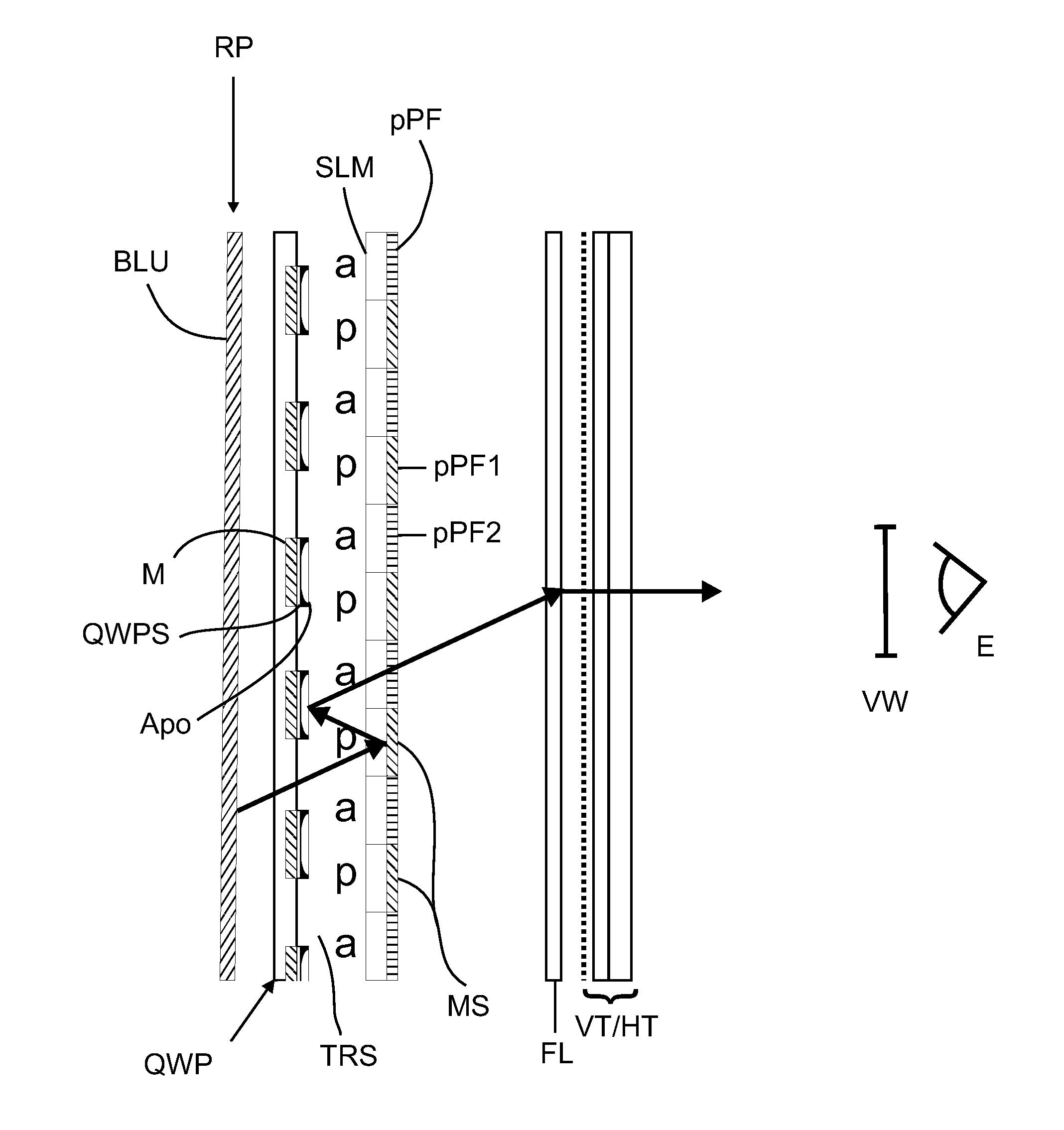
[0137]Like reference designations denote like components in the individual figures and accompanying description. In the following, the designations “in front of” and “behind” e.g. in front of the spatial light modulator device mean the light seen in regards to the propagation of the light.
[0138]The illumination unit can contain several specific modifications to be used preferably within a holographic display device. The illumination unit can be used for coherent light and for light which only shows reduced spatial and / or temporal coherence. Amplitude apodization and phase apodization can be used to optimize the intensity profile which propagates behind the entrance plane of the illumination device. Colour filters give the opportunity to optimize this for different colours separately. The specifications are dependent on the discrete embodiment.
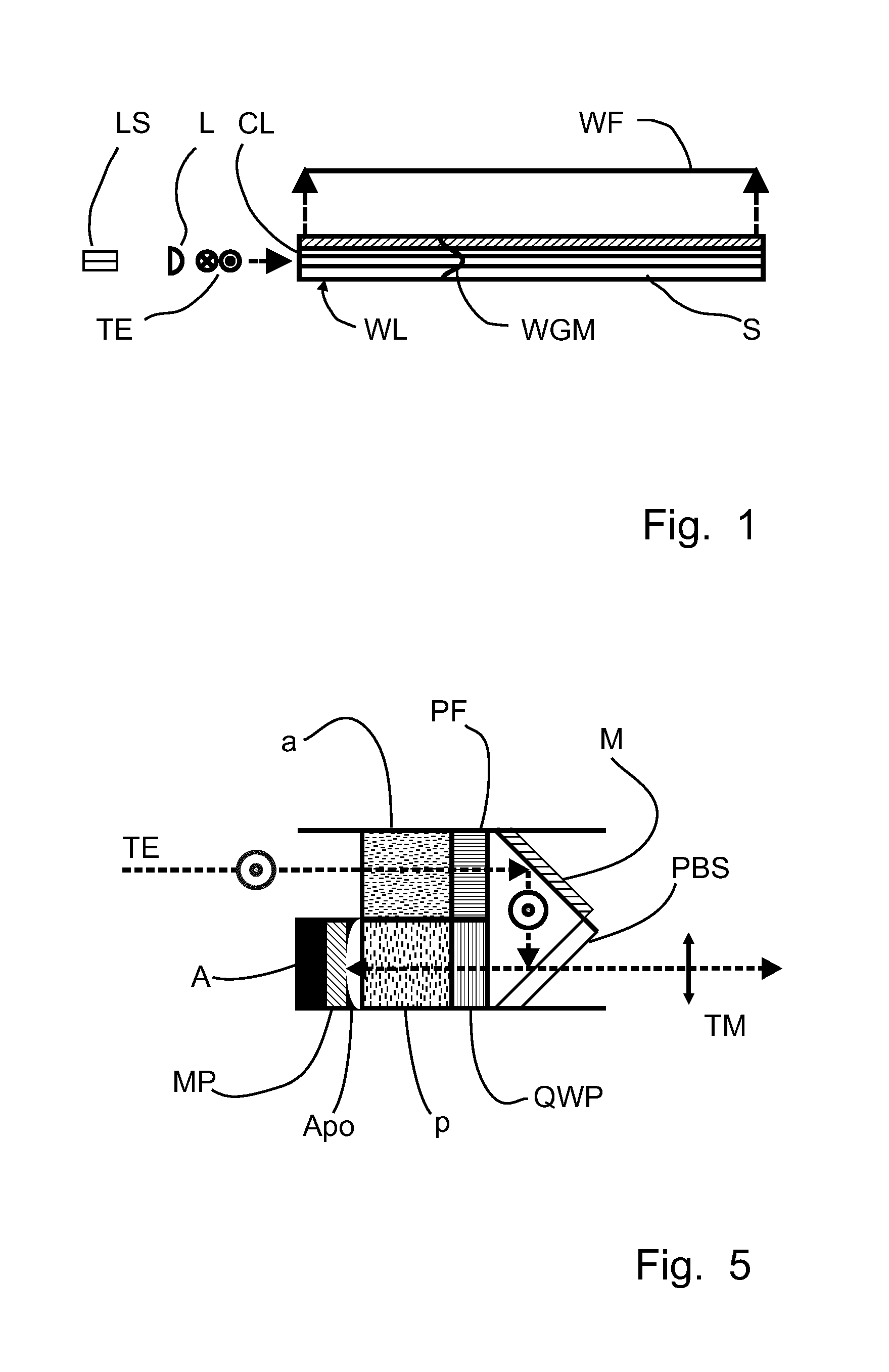
[0139]Now to an optical setup of an illumination unit, FIG. 1 illustrates a first embodiment of a flat illumination unit for a display device,...
PUM
| Property | Measurement | Unit |
|---|---|---|
| distance | aaaaa | aaaaa |
| thickness | aaaaa | aaaaa |
| thickness | aaaaa | aaaaa |
Abstract
Description
Claims
Application Information
 Login to View More