Unlock instant, AI-driven research and patent intelligence for your innovation.

Counterbalancing unmanned aerial vehicles during operations associated with cell towers

a technology of unmanned aerial vehicles and cell towers, applied in process and machine control, instruments, navigation instruments, etc., can solve the problems of service disruption, 10 times more dangerous than construction work, and dangerous and costly work on cell sites

Active Publication Date: 2016-12-29
ETAK SYST LLC
View PDF1 Cites 8 Cited by
  • Summary
  • Abstract
  • Description
  • Claims
  • Application Information

AI Technical Summary

Benefits of technology

This patent describes a method and device for using a drone to perform physical functions on a cell tower at a cell site. The drone is controlled to move and perform tasks by a human operator, while using a counterbalancing technique to keep the drone's weight distributed evenly. The technical effect of this invention is to provide a safer and more efficient way to perform various physical functions on cell towers, which can reduce downtime and improve overall cell network performance.

Problems solved by technology

This is both a dangerous and costly endeavor.
Also, OSHA estimates that working on cell sites is 10 times more dangerous than construction work, generally (see, e.g., www.propublica.org / article / cell-tower-work-fatalities-methodology).
Furthermore, the tower climbs also can lead to service disruptions caused by accidents.
There are limitations associated with UAVs, including emerging FAA rules and guidelines associated with their commercial use.
However, Rezvan does not contemplate performing any activity locally at the cell site, nor various aspects of UAV use.
However, Hannay does not contemplate performing any activity locally at the cell site, nor various aspects of constraining the UAV use.
However, adding one or more robotic arms, carrying extra equipment, etc. presents a significantly complex problem in terms of UAV stabilization while in flight, i.e., counterbalancing the UAV to account for the weight and movement of the robotic arms.
Research and development continues in this area, but current solutions are complex and costly, eliminating the drivers for using UAVs for performing cell tower work.
It has been determined that such an approach is moderately inaccurate during 3D modeling and combination with software due to slight variations in location tracking capabilities of systems such as Global Positioning Satellite (GPS).
With over 200,000 cell sites in the U.S., geographically distributed everywhere, site surveys can be expensive, time-consuming, and complex.
The conventional approaches are limited to ground coverage, not aerial coverage, as conventional drive tests are just that—driven by a vehicle on the ground.
Of course, the convention approach also requires tower climbs, is expensive, and inefficient.
Disadvantageously, this conventional approach with a separate third-party inspection firm is inefficient, expensive, etc.
Also, with over 200,000 cell sites, it is difficult to monitor activity, namely configurations, physical structure, surroundings, etc., and associated changes.
Conventional approaches require physical site surveys to obtain such information which with over 200,000 cells sites is expensive, time consuming, slow, etc.
In addition to the aforementioned safety issues, another large drawback of conventional tower climbs is the time and physical effort involved.
Conventional tower climbs can take well over an hour, lead the personnel to exhaustion, etc.

Method used

the structure of the environmentally friendly knitted fabric provided by the present invention; figure 2 Flow chart of the yarn wrapping machine for environmentally friendly knitted fabrics and storage devices; image 3 Is the parameter map of the yarn covering machine
View more

Image

Smart Image Click on the blue labels to locate them in the text.
Viewing Examples
Smart Image
  • Counterbalancing unmanned aerial vehicles during operations associated with cell towers
  • Counterbalancing unmanned aerial vehicles during operations associated with cell towers
  • Counterbalancing unmanned aerial vehicles during operations associated with cell towers

Examples

Experimental program
Comparison scheme
Effect test

Embodiment Construction

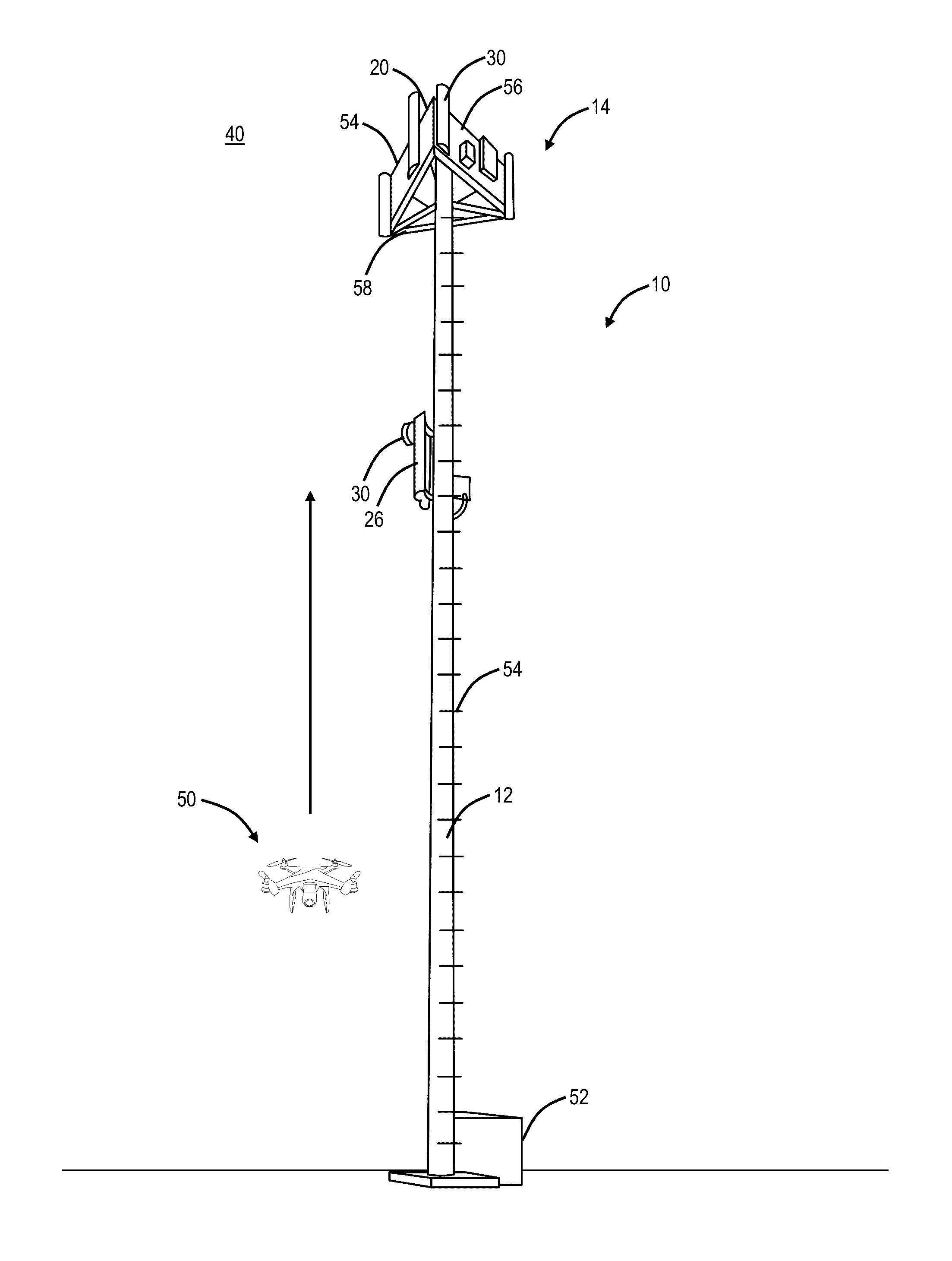
[0058]Again, in an exemplary embodiment, the present disclosure relates to counterbalancing techniques when using Unmanned Aerial Vehicles (UAVs) “drones” or the like to perform operations on cell towers. Specifically, UAVs can be used, as described herein, for various monitoring functions such as cell site audits and inspections. Also, UAVs can be adapted to perform physical functions replacing a technician and avoiding a tower climb. In various exemplary embodiments described herein, UAVs can be used at cell towers to bring equipment up (e.g., antennas), use robotic arms for manipulating and carrying objects, to connect to the cell tower for stabilization, to carry personnel up the cell tower, etc. In these various applications, the counterbalancing techniques ensure proper flight of the UAV avoiding sudden weight distribution changes in the UAV which negatively affect the flight.

[0059]Further, in an exemplary embodiment, the present disclosure relates to using Unmanned Aerial Veh...

the structure of the environmentally friendly knitted fabric provided by the present invention; figure 2 Flow chart of the yarn wrapping machine for environmentally friendly knitted fabrics and storage devices; image 3 Is the parameter map of the yarn covering machine
Login to View More

PUM

No PUM Login to View More

Abstract

Systems and methods using an Unmanned Aerial Vehicle (UAV) to perform physical functions on a cell tower at a cell site include flying the UAV at or near the cell site, wherein the UAV comprises one or more manipulable members; moving the one or more manipulable members when proximate to a location at the cell tower where the physical functions are performed to effectuate the physical functions; and utilizing one or more counterbalancing techniques during the moving ensuring a weight distribution of the UAV remains substantially the same.

Description

CROSS-REFERENCE TO RELATED APPLICATION(S)[0001]The present patent / application is continuation-in-part of and the content of each are incorporated by reference herein:Filing DateSerial No.TitleAug. 26, 201615 / 248,634USING DRONES TO LIFT PERSONNEL UP CELL TOWERSAug. 19, 201615 / 241,2393D MODELING OF CELL SITES TO DETECTCONFIGURATION AND SITE CHANGESJul. 15, 201615 / 211,483CLOSE-OUT AUDIT SYSTEMS AND METHODS FOR CELLSITE INSTALLATION AND MAINTENANCEJul. 8, 201615 / 205,313CELL TOWER INSTALLATION AND MAINTENANCESYSTEMS AND METHODS USING ROBOTIC DEVICESJun. 23, 201615 / 190,450CELL TOWER INSTALLATION SYSTEMS AND METHODSWITH UNMANNED AERIAL VEHICLESJun. 7, 201615 / 175,314WIRELESS COVERAGE TESTING SYSTEMS AND METHODSWITH UNMANNED AERIAL VEHICLESMay 31, 201615 / 168,503VIRTUALIZED SITE SURVEY SYSTEMS AND METHODSFOR CELL SITESMay 20, 201615 / 160,8903D MODELING OF CELL SITES AND CELL TOWERS WITHUNMANNED AERIAL VEHICLESApr. 18, 201615 / 131,460UNMANNED AERIAL VEHICLE-BASED SYSTEMS ANDMETHODS ASSOCIATED WI...

Claims

the structure of the environmentally friendly knitted fabric provided by the present invention; figure 2 Flow chart of the yarn wrapping machine for environmentally friendly knitted fabrics and storage devices; image 3 Is the parameter map of the yarn covering machine
Login to View More

Application Information

Patent Timeline
no application Login to View More
IPC IPC(8): B64C17/02G05D1/00G05D1/10B64C39/02B64D47/08
CPCB64C17/02B64C39/024G05D1/0094G05D1/101B64D47/08B64C27/06H04W24/04G05D1/0858H04B7/18504B64U2101/30B64U2201/202B64U70/90B64U2101/61B64U80/00B64U2101/64B64U10/60B64U50/34B64U10/14B64U60/50B64C39/022B64U10/13B64U30/20B64U2101/60
Inventor PRIEST, LEE
Owner ETAK SYST LLC