
Betulinic acid derivatives with HIV maturation inhibitory activity
a technology of betulinic acid and maturation inhibition, which is applied in the field of compounds useful against hiv, can solve the problems of affecting the effect of viremia and disease progression, and affecting the survival rate of patients, and achieving the effect of disease progression, and reducing the risk of viremia
- Summary
- Abstract
- Description
- Claims
- Application Information
AI Technical Summary
Benefits of technology
Problems solved by technology
Method used
Image

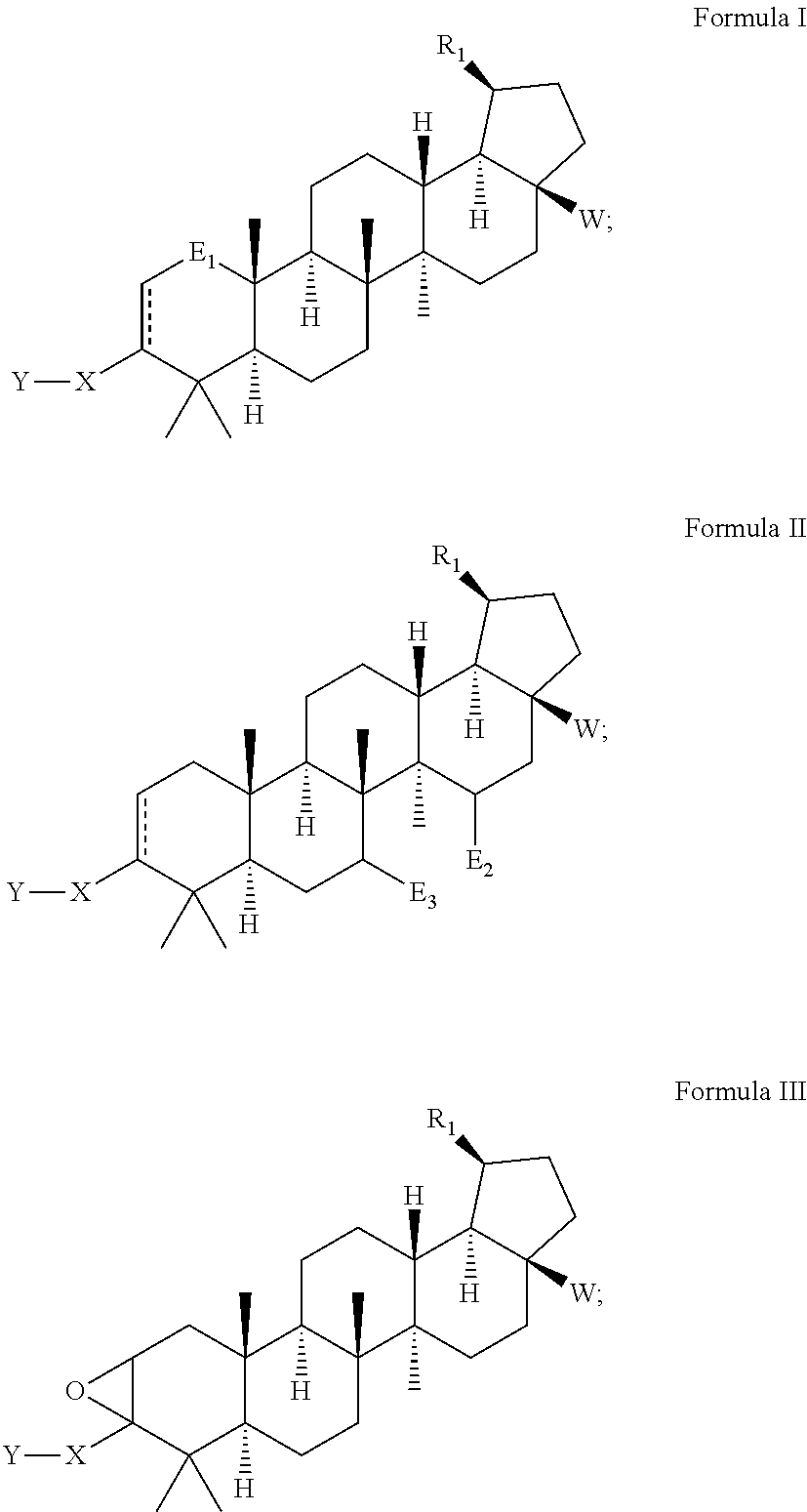
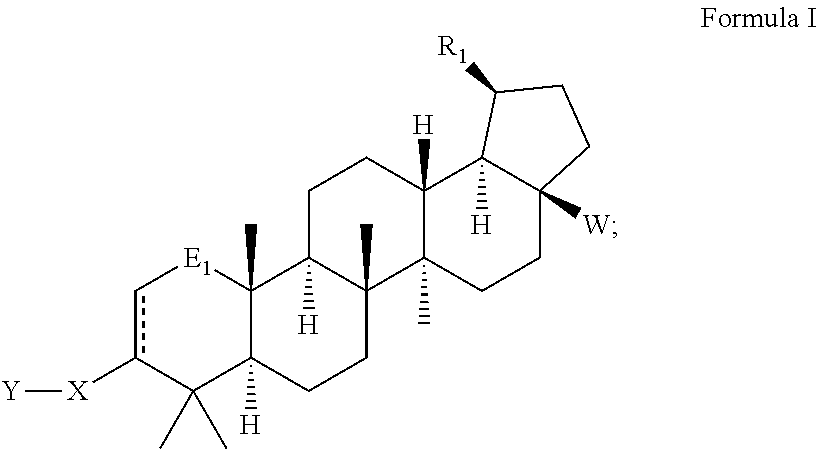
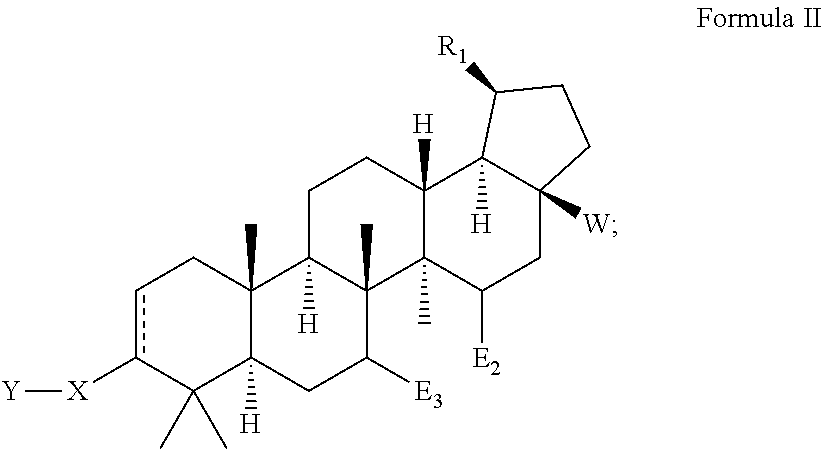
Examples
example 1
Preparation of (1R,3aS,4aS,4a1R,7aS,7a1R,8aR,12a5,12bR,14aR,14bR)-10-(4-carboxyphenyl)-4a1,6,6,7a1,9,9,12a-heptamethyl-1-(prop-1-en-2-yl)-2,3,3a,4,4a,4a1,7a,7a1,8,8a,9,12,12a,12b,13,14,14a,14b-octadecahydro-1H-cyclopenta[1,2]chryseno[4,5-def] [1,3]dioxepine-3a-carboxylic acid
[0295]
Step 1: Preparation of (1R,3aS,5S,5aR,5bR,6S,7aR,11aR,13aR)-5,6-dihydroxy-5a,5b,8,8,11a-pentamethyl-9-oxo-1-(prop-1-en-2-yl)icosahydro-1H-cyclopenta[a]chrysene-3a-carboxylic acid (7β, 15α-dihydroxybetulonic acid)
[0296]
Ingredients for SG-M2 medium are: Glucose monohydrate 22 g, Toasted Nutrisoy 5 g, Tastone154 5 g, K2HPO4 5 g, deionized water 1000 mL. After mixing, the pH was adjusted to 7.0, and then autoclaved. One culture vial (1 mL) of Bacillus megaterium (SC16644, ATCC14581) was used to inoculate a 500 mL flask containing 100 mL of sterile SG-M2 medium. The flask was shaken at 30° C. and 250 rpm. After 29 h of growth, the stage 1 culture was used to inoculate (0.4% inoculation) sixteen 4 L flasks each ...
example 2
Preparation of (1R,3aS,5S,5aR,5bR,6S,7aR,11aS,11bR,13aR,13bR)-9-(4-carboxyphenyl)-5,6-dihydroxy-5a,5b,8,8,11a-pentamethyl-1-(prop-1-en-2-yl)-2,3,3a,4,5,5a,5b,6,7,7a,8,11,11a,11b,12,13,13a,13b-octadecahydro-1H-cyclopenta[a]chrysene-3a-carboxylic acid
[0309]
[0310]To a solution of (1R,3aS,4aS,4a1R,7aS,7a1R,8aR,12aS,12bR,14aR,14bR)-10-(4-carboxyphenyl)-4a1,6,6,7a1,9,9,12a-heptamethyl-1-(prop-1-en-2-yl)-2,3,3a,4,4a,4a1,7a,7a1,8,8a,9,12,12a,12b,13,14,14a,14b-octadecahydro-1H-cyclopenta[1,2]chryseno[4,5-def][1,3]dioxepine-3a-carboxylic acid (0.02 g, 0.032 mmol) in THF (1 mL) was added HCl (1N) (0.5 mL, 0.500 mmol). The mixture was stirred at rt for 3 h, then was heated to 50° C. After heating the mixture for 15 h, it was cooled to rt. The mixture was diluted with 1 mL of 1,4-dioxane (solids had formed) and HCl (12M) (0.1 mL, 1.218 mmol) was added. The mixture was heated for 7.5 h then cooled to rt and concentrated. The residue was purified by prep HPLC (method 1). The fractions containing t...
example 3
Preparation of 4-((1R,3aS,5S,5aR,5bR,6S,7aR,11aS,11bR,13aR,13bR)-3a-((2-(1,1-dioxidothiomorpholino)ethyl)amino)-5,6-dihydroxy-5a,5b,8,8,11a-pentamethyl-1-(prop-1-en-2-yl)-2,3,3a,4,5,5a,5b,6,7,7a,8,11,11a,11b,12,13,13a,13b-octadecahydro-1H-cyclopenta[a]chrysen-9-yl)benzoic acid
[0311]
Step 1. Preparation of methyl 4-((1R,3aS,4aS,4a1R,7aS,7a1R,8aR,12aS,12bR,14aR,14bR)-3a-isocyanato-4a1,6,6,7a1,9,9,12a-heptamethyl-1-(prop-1-en-2-yl)-2,3,3a,4,4a,4a1,7a,7a1,8,8a,9,12,12a,12b,13,14,14a,14b-octadecahydro-1H-cyclopenta[1,2]chryseno[4,5-def] [1,3]dioxepin-10-yl)benzoate
[0312]To a solution of (1R,3aS,4aS,4a1R,7aS,7a1R,8aR,12aS,12bR,14aR,14bR)-10-(4-(methoxycarbonyl)phenyl)-4a1,6,6,7a1,9,9,12a-heptamethyl-1-(prop-1-en-2-yl)-2,3,3a,4,4a,4a1,7a,7a1,8,8a,9,12,12a,12b,13,14,14a,14b-octadecahydro-1H-cyclopenta[1,2]chryseno[4,5-def][1,3]dioxepine-3a-carboxylic acid (0.045 g, 0.070 mmol) in 1,4-dioxane (5 mL) was added TEA (0.029 mL, 0.209 mmol) followed by diphenyl phosphorazidate (0.023 mL, 0.105 mmo...
PUM
 Login to View More
 Abstract
Description
Claims
Application Information
 Login to View More