
Constructing graph models of event correlation in enterprise security systems
a graph model and event correlation technology, applied in the field of computer and network security, can solve the problems of high false-positive rate, target of attack, and major threat to enterprise information systems, and achieve the effect of reducing the false-positive ra
Patent Information
- Authority / Receiving Office
- US · United States
- Patent Type
- Applications(United States)
- Current Assignee / Owner
- Publication Date
- 2018-02-15
Smart Images
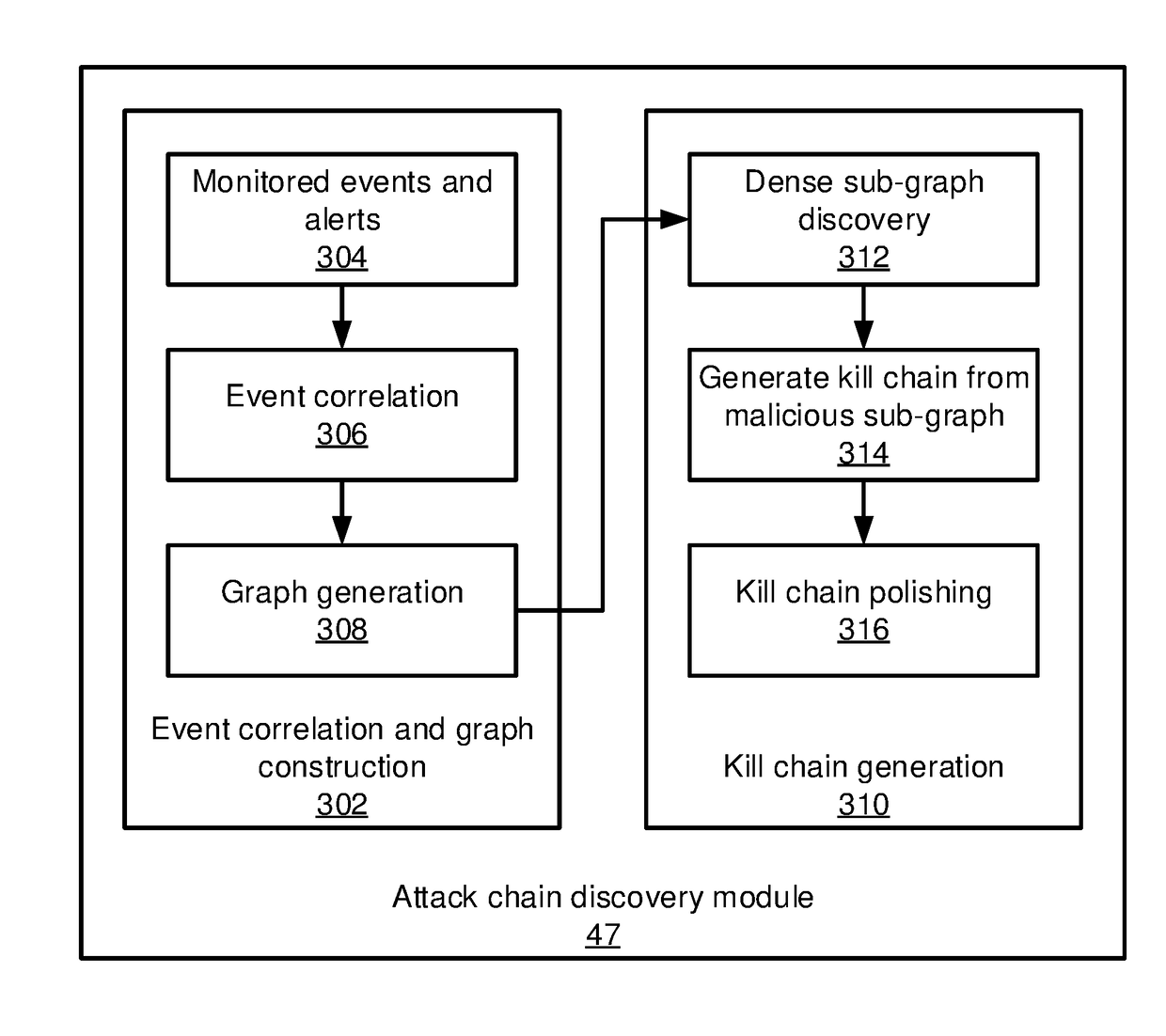
Figure 1 
Figure 2 
Figure 3
Abstract
Description
RELATED APPLICATION INFORMATION
[0001] This application is a continuation-in-part of co-pending application Ser. No. 15 / 098,861, filed on Apr. 14, 2016, which in turn claims priority to provisional application Ser. No. 62 / 148,232, filed on Apr. 16, 2015, both of which are incorporated herein by reference in their entirety. This application further claims priority to provisional application Ser. Nos. 62 / 407,573 and 62 / 407,576, filed on Oct. 13, 2016, both of which are incorporated herein in their entirety.BACKGROUNDTechnical Field
[0002] The present invention relates to computer and network security and, more particularly, to discovery of attack chains from system monitoring logs.Description of the Related Art
[0003] Enterprise networks are key systems in corporations and they carry the vast majority of mission-critical information. As a result of their importance, these networks are often the targets of attack. Communications on enterprise networks are therefore frequently monitored and a...
Examples
Embodiment Construction
[0014]In accordance with the present principles, the present embodiments provide a two-stage framework that takes massive system monitoring logs and record-level alert labels and recovers well-organized attack chains (also referred to herein as “kill chains”). The present embodiments thereby decrease the false positive rate of alert labels. The two-stage framework constructs an event correlation graph from the monitored log data and then generates kill chains from the event correlation graph.
[0015]In an advanced persistent threat (APT) graph, most attack steps are well-camouflaged as normal events whose malicious intent cannot be readily determined. At the same time, rule-based event detectors will generate false positives, marking innocuous events as being potentially malicious. It can be difficult for a system administrator to locate and recover real APT attacks from a high volume of false positives. The kill chains discovered by the present embodiments can be generated automatica...