Check patentability & draft patents in minutes with Patsnap Eureka AI!

Communication efficient sparse-reduce in distributed machine learning

Active Publication Date: 2018-09-13
NEC CORP
View PDF0 Cites 3 Cited by
  • Summary
  • Abstract
  • Description
  • Claims
  • Application Information

AI Technical Summary

Benefits of technology

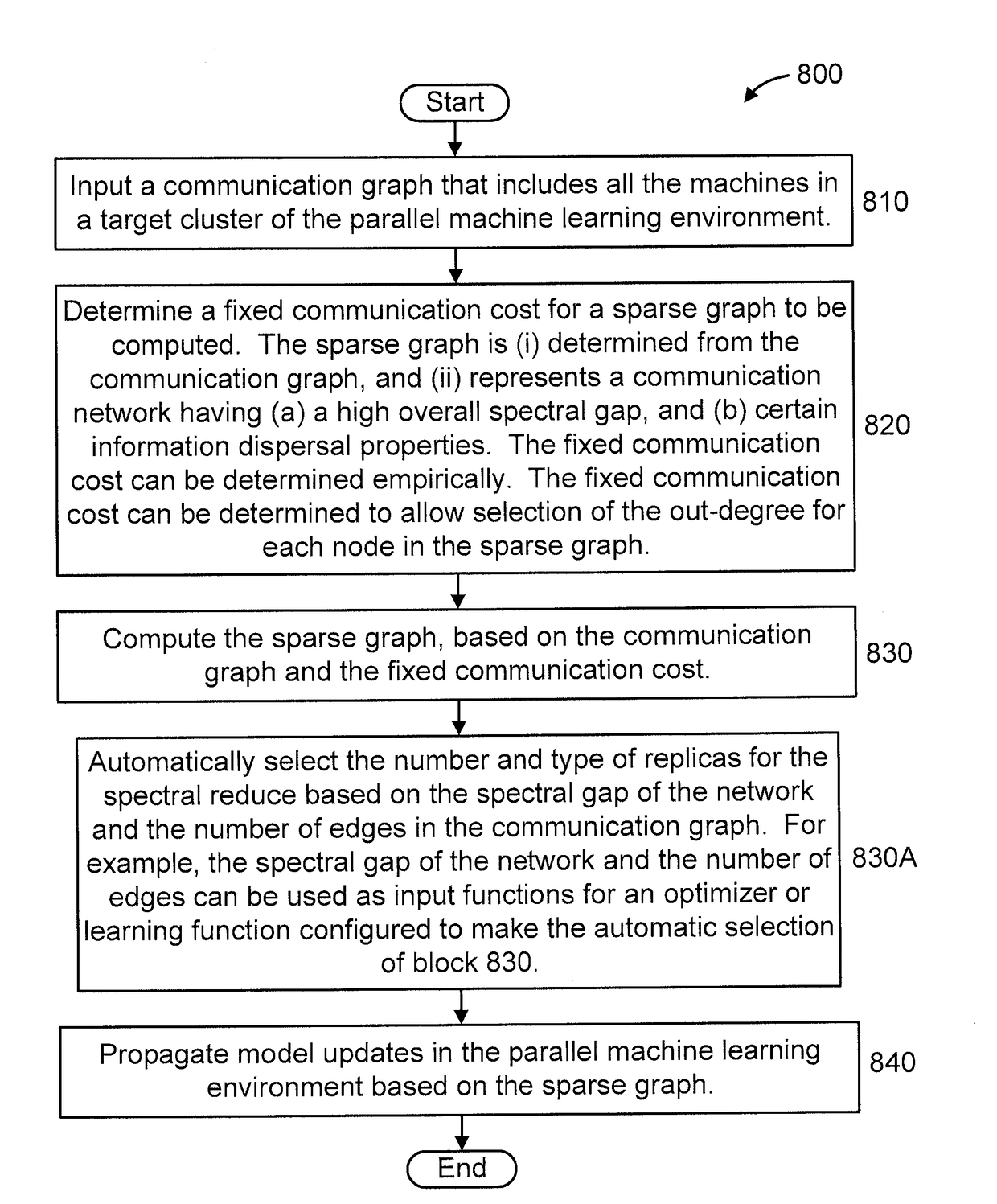
The present invention provides a computer-implemented method for sparse communication in a parallel machine learning environment. The method involves determining a cost to create a sparse graph based on a communication graph that includes all the machines in the environment. The sparse graph is designed to have certain properties that allow for efficient communication between nodes. The method also includes creating the sparse graph based on the communication graph and a fixed cost, and then using the topology of the sparse graph to initiate the propagation of intermediate output in the parallel machine learning environment. The technical effect is that this method improves the efficiency of communication in a parallel machine learning environment, reducing the time it takes for information to disperse between nodes.

Problems solved by technology

However, if the network of nodes is sparsely connected, the convergence may be slow due to stale updates being passed around.
However, there are savings in network and CPU costs (fewer updates), that may result in an overall speedup.
However, this style of synchronization suffers from several problems.
First, barrier primitives are slow and removing such a primitive (asynchronous) breaks down correctness semantics.
Second, most barrier implementations synchronize with all processes and may be slow to synchronize a subset of workers.
Third, using a barrier with the bulk-synchronous processing paradigm described suffers from mixed-version issues; that is, in absence of receive side synchronization, there may be torn-reads and over-writes.
This is because a barrier gives no information if the recipient has seen or processed the gradient and additional expensive synchronization may be required.
Finally, using a barrier also causes network resource spikes since all workers will send intermediate values at the same time.
Additionally, adding extra barriers before / after push and reduce does not product a strongly consistent BSP that can incorporate model updates from all replicates since the actual send operation may be synchronous and there is not guarantee that receives receive these messages when they perform a reduce.
Unless a blocking receiver is added after every send, the consistency is not guaranteed.
However, this introduces a significant synchronization overhead.

Method used

the structure of the environmentally friendly knitted fabric provided by the present invention; figure 2 Flow chart of the yarn wrapping machine for environmentally friendly knitted fabrics and storage devices; image 3 Is the parameter map of the yarn covering machine
View more

Image

Smart Image Click on the blue labels to locate them in the text.
Viewing Examples
Smart Image
  • Communication efficient sparse-reduce in distributed machine learning
  • Communication efficient sparse-reduce in distributed machine learning
  • Communication efficient sparse-reduce in distributed machine learning

Examples

Experimental program
Comparison scheme
Effect test

Embodiment Construction

[0024]In an embodiment, the present invention relates to fine-grain synchronization in data-parallel jobs for distributed machine learning.

[0025]In another embodiment, the present invention relates to fine-grained synchronization for data-parallel tasks in a big data processing environment.

[0026]In yet another embodiment, the present invention relates to communication efficient sparse-reduce in distributed machine learning. This embodiment can involve providing a methodology to determine the underlying sparse network

[0027]Hence, embodiments of the present invention will be initially described with respect to fine-grained synchronization in data parallel jobs in a big data processing environment. Thereafter, embodiments of the present invention will be described with respect to fine-grained synchronization in data parallel jobs for distributed machine learning. Thereafter still, embodiments of the present invention will be described with respect to communication efficient sparse-redu...

the structure of the environmentally friendly knitted fabric provided by the present invention; figure 2 Flow chart of the yarn wrapping machine for environmentally friendly knitted fabrics and storage devices; image 3 Is the parameter map of the yarn covering machine
Login to View More

PUM

No PUM Login to View More

Abstract

A method is provided for sparse communication in a parallel machine learning environment. The method includes determining a fixed communication cost for a sparse graph to be computed. The sparse graph is (i) determined from a communication graph that includes all the machines in a target cluster of the environment, and (ii) represents a communication network for the target cluster having (a) an overall spectral gap greater than or equal to a minimum threshold, and (b) certain information dispersal properties such that an intermediate output from a given node disperses to all other nodes of the sparse graph in lowest number of time steps given other possible node connections. The method further includes computing the sparse graph, based on the communication graph and the fixed communication cost. The method also includes initiating a propagation of the intermediate output in the parallel machine learning environment using a topology of the sparse graph.

Description

RELATED APPLICATION INFORMATION[0001]This application claims priority to provisional application Ser. No. 62 / 506,660 filed on May 16, 2017, incorporated herein by reference. This application is a continuation-in-part of U.S. patent application Ser. No. 15 / 480,874, filed on Apr. 6, 2017, entitled “Fine-Grain Synchronization in Data-Parallel Jobs for Distributed Machine Learning”, incorporated herein by reference. This application is also related to another continuation-in-part of U.S. patent application Ser. No. 15 / 480,874, filed on Apr. 6, 2017, entitled “Fine-Grain Synchronization in Data-Parallel Jobs for Distributed Machine Learning”, filed concurrently herewith, incorporated herein by reference.BACKGROUNDTechnical Field[0002]The present invention relates to information processing, and more particularly to fine-grain synchronization in data-parallel jobs for distributed machine learning.Description of the Related Art[0003]Big-data processing involves multiple parallel workers, or...

Claims

the structure of the environmentally friendly knitted fabric provided by the present invention; figure 2 Flow chart of the yarn wrapping machine for environmentally friendly knitted fabrics and storage devices; image 3 Is the parameter map of the yarn covering machine
Login to View More

Application Information

Patent Timeline
no application Login to View More
IPC IPC(8): H04L12/24G06F15/18G06F9/52G06N20/00
CPCH04L41/16H04L41/12G06F15/18G06F9/52G06F15/76G06F9/522G06N20/00
Inventor KADAV, ASIMKRUUS, ERIK
Owner NEC CORP
Features
  • R&D
  • Intellectual Property
  • Life Sciences
  • Materials
  • Tech Scout
Why Patsnap Eureka
  • Unparalleled Data Quality
  • Higher Quality Content
  • 60% Fewer Hallucinations
Social media
Patsnap Eureka Blog
Learn More