Check patentability & draft patents in minutes with Patsnap Eureka AI!

Systems, methods, and devices for sterilizing antiseptic solutions

a technology of antiseptic solutions and sterilization methods, applied in the field of sterilization, can solve the problems of reducing the overall concentration of active drug molecules, reducing the antiseptic effect, and inefficient process of convection ovens, so as to achieve efficient sterilization of antiseptic solutions and maintain the antiseptic

Inactive Publication Date: 2019-02-14
CAREFUSION 2200 INC
View PDF2 Cites 0 Cited by
  • Summary
  • Abstract
  • Description
  • Claims
  • Application Information

AI Technical Summary

Benefits of technology

[0007]Aspects of the present invention overcome the above identified problems, as well as others, by providing systems, methods, and devices for efficiently sterilizing antimicrobial solutions while maintaining antimicrobial efficacy as an antiseptic and purity of the active drug moiety to comply with regulatory requirements.

Problems solved by technology

Degrading the antimicrobial molecules creates undesired impurities as well as lowers the overall concentration of the active drug moiety.
Furthermore, a convection oven, which utilizes air to conduct heat, is an inefficient process because the initial heating of the solution from room temperature (also referred herein as “ramp up” time) and eventual cooling down of the solution back to room temperature (also referred herein as “cool down” time) is relatively long.
It is the industry belief that high temperature sterilization is not suitable due to the expected degradation.

Method used

the structure of the environmentally friendly knitted fabric provided by the present invention; figure 2 Flow chart of the yarn wrapping machine for environmentally friendly knitted fabrics and storage devices; image 3 Is the parameter map of the yarn covering machine
View more

Image

Smart Image Click on the blue labels to locate them in the text.
Viewing Examples
Smart Image
  • Systems, methods, and devices for sterilizing antiseptic solutions

Examples

Experimental program
Comparison scheme
Effect test

examples

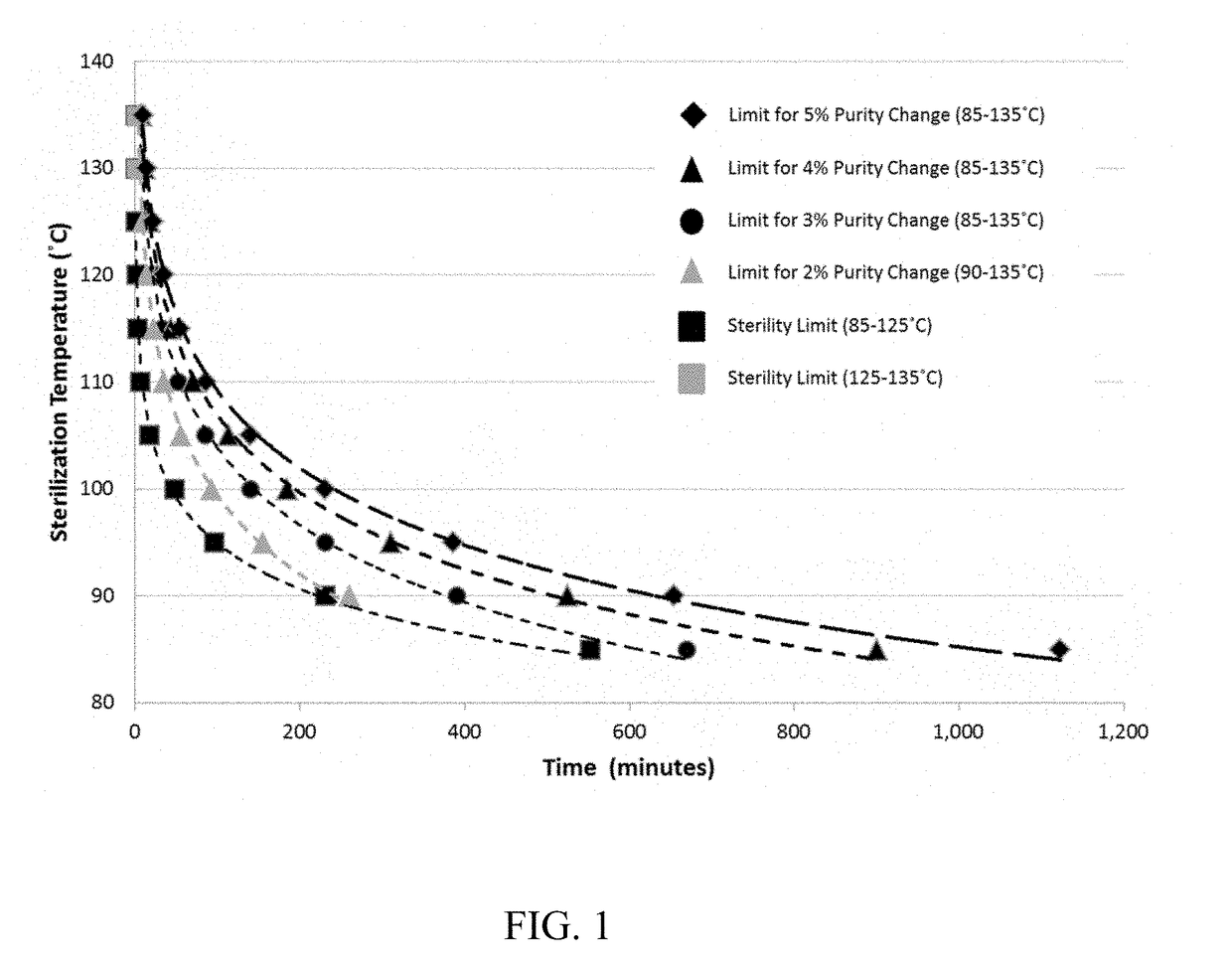
[0040]A sample of antiseptic solution of 70% v / v isopropanol, 30% v / v water, and 2.0% w / v chlorhexidine gluconate contained in a glass ampoule was tested in each of the following examples. An inoculum of greater than 1,000,000 but less than 10,000,000 test spores of Geobacillus stearothermophilus were inserted and sealed into the container. In the following examples, a 10 mL sample of antiseptic solution at room temperature was placed in either a water or oil bath (water bath for temperatures of ≤95° C.; oil bath for temperatures≥100° C.) having a preset temperature (i.e., the sterilization temperature). The ampoule containing chlorhexidine gluconate solution and test spores was placed in the heating medium. The sample with test spores was removed at a particular time (i.e., the sterilization time), allowed to cool to room temperature, then tested and incubated over a seven day period for bacterial growth. Samples of antiseptic solution also stored at the preset temperature were tes...

the structure of the environmentally friendly knitted fabric provided by the present invention; figure 2 Flow chart of the yarn wrapping machine for environmentally friendly knitted fabrics and storage devices; image 3 Is the parameter map of the yarn covering machine
Login to View More

PUM

PropertyMeasurementUnit
temperatureaaaaaaaaaa
timeaaaaaaaaaa
temperatureaaaaaaaaaa
Login to View More

Abstract

A method for sterilizing an antiseptic solution includes providing a container containing the antiseptic solution, the antiseptic solution having an initial purity, selecting a sterilization temperature from about 85° C. to about 135° C. and an sterilization time from about 1 minute to about 19 hours, heating the antiseptic solution to the selected sterilization temperature, maintaining the temperature for the selected sterilization time, and terminating the heating of the antiseptic solution when the sterilization time expires. After terminating the heating, the antiseptic solution has a post-sterilization purity. The sterilization temperature and the sterilization time are selected such that after terminating the heating, the antiseptic solution is sterile and has a post-sterilization purity of at least about 92% and the percentage point change in purity from the initial purity to the post-sterilization purity is at most about 5%.

Description

CROSS-REFERENCE TO RELATED APPLICATION[0001]This application is a Continuation of U.S. patent application Ser. No. 14 / 150,488, filed Jan. 8, 2014. The disclosure of the priority application is hereby incorporated in its entirety by reference.FIELD OF THE INVENTION[0002]Aspects of the present invention relate to the field of sterilization, and in particular, to sterilization of topical antiseptic solutions.BACKGROUND OF THE INVENTION[0003]In the United States there are currently no regulations regarding the sterilization requirements of topical antiseptic solutions. Therefore, antiseptic solutions currently sold in the United States generally do not undergo a sterilization process. In other jurisdictions, however, such as European Union (EU) countries, some degree of sterilization is required. A known antiseptic solution containing 2% w / v chlorhexidine gluconate in 70% v / v isopropanol in water, manufactured by CareFusion Corp., is sterilized for EU countries using a known sterilizati...

Claims

the structure of the environmentally friendly knitted fabric provided by the present invention; figure 2 Flow chart of the yarn wrapping machine for environmentally friendly knitted fabrics and storage devices; image 3 Is the parameter map of the yarn covering machine
Login to View More

Application Information

Patent Timeline
no application Login to View More
Patent Type & Authority Applications(United States)
IPC IPC(8): A61L2/00A01N43/40A01N47/44A01N25/02A01N31/02
CPCA01N47/44A01N43/40A61L2/0023A61P31/02A01N25/02A01N31/02
Inventor DEGALA, SATISHMCGINLEY, CHRISTOPHER MATTHEWTHURMOND, KENNETH BRUCE
Owner CAREFUSION 2200 INC
Features
  • R&D
  • Intellectual Property
  • Life Sciences
  • Materials
  • Tech Scout
Why Patsnap Eureka
  • Unparalleled Data Quality
  • Higher Quality Content
  • 60% Fewer Hallucinations
Social media
Patsnap Eureka Blog
Learn More