Process for Monitoring an Air Conditioning System of a Railway Vehicle and Railway Vehicle Comprising an Air Conditioning System Implementing This Process

a technology of air conditioning system and air conditioning system, which is applied in the direction of refrigeration components, transportation and packaging, light and heating equipment, etc., can solve the problems of reduced and possible maintenance operations. , to achieve the effect of reducing the maintenance cost of air conditioning system and limited risk of untimely failure of air conditioning system

US20190071103A1Active Publication Date: 2019-03-07ALSTOM TRANSPORT TECH SAS
0 Cites 2 Cited by

Patent Information

Authority / Receiving Office
US · United States
Patent Type
Applications(United States)
Current Assignee / Owner
Publication Date
2019-03-07

Smart Images

  • Figure 1
    Figure 1
  • Figure 2
    Figure 2
  • Figure 3
    Figure 3
Patent Text Reader

Abstract

A process for supervising an air conditioning system of a railway vehicle. The process comprising the following steps: a) after starting the air conditioning system, measuring physical properties relative to the refrigerant; b) from the physical properties measured during step a), calculating thermodynamic properties; c) from the thermodynamic properties calculated during step b), calculating the density, optionally averaged, of the refrigerant inside each component of the air conditioning system; d) using manufacturer data, which includes the dimensions of each component of the air conditioning system, calculating the passage volume of the refrigerant inside each component of the air conditioning system; e) using the values calculated in steps c) and d) to calculate the total mass of refrigerant contained inside the air conditioning system; and f) comparing the total mass of refrigerant calculated in step e) with the total mass of refrigerant originally contained inside the air conditioning system.
Need to check novelty before this filing date? Find Prior Art

Description

CROSS-REFERENCE TO RELATED APPLICATIONS

[0001] This application claims the benefit of FR Application No. 17 58158, filed Sep. 5, 2017, which is incorporated herein by reference in its entirety.FIELD OF THE INVENTION

[0002] The present invention relates to a process for supervising an air conditioning system of a railway vehicle. The invention also relatives to a railway vehicle comprising an air conditioning system implementing this process.BACKGROUND OF THE INVENTION

[0003] In a known manner, modern railway vehicles intended to carry passengers are generally equipped with air conditioning systems in order to improve traveler comfort. These air conditioning systems, also known under the name HVAC, which stands for “Heating, Ventilation and Air Conditioning”, are typically based on a thermodynamic refrigeration cycle using a refrigerant.

[0004] US 2007 / 0163276 A1 discloses a process for evaluating the quantity of refrigerant circulating in an air conditioning system. The system traditionally...

Examples

Embodiment Construction

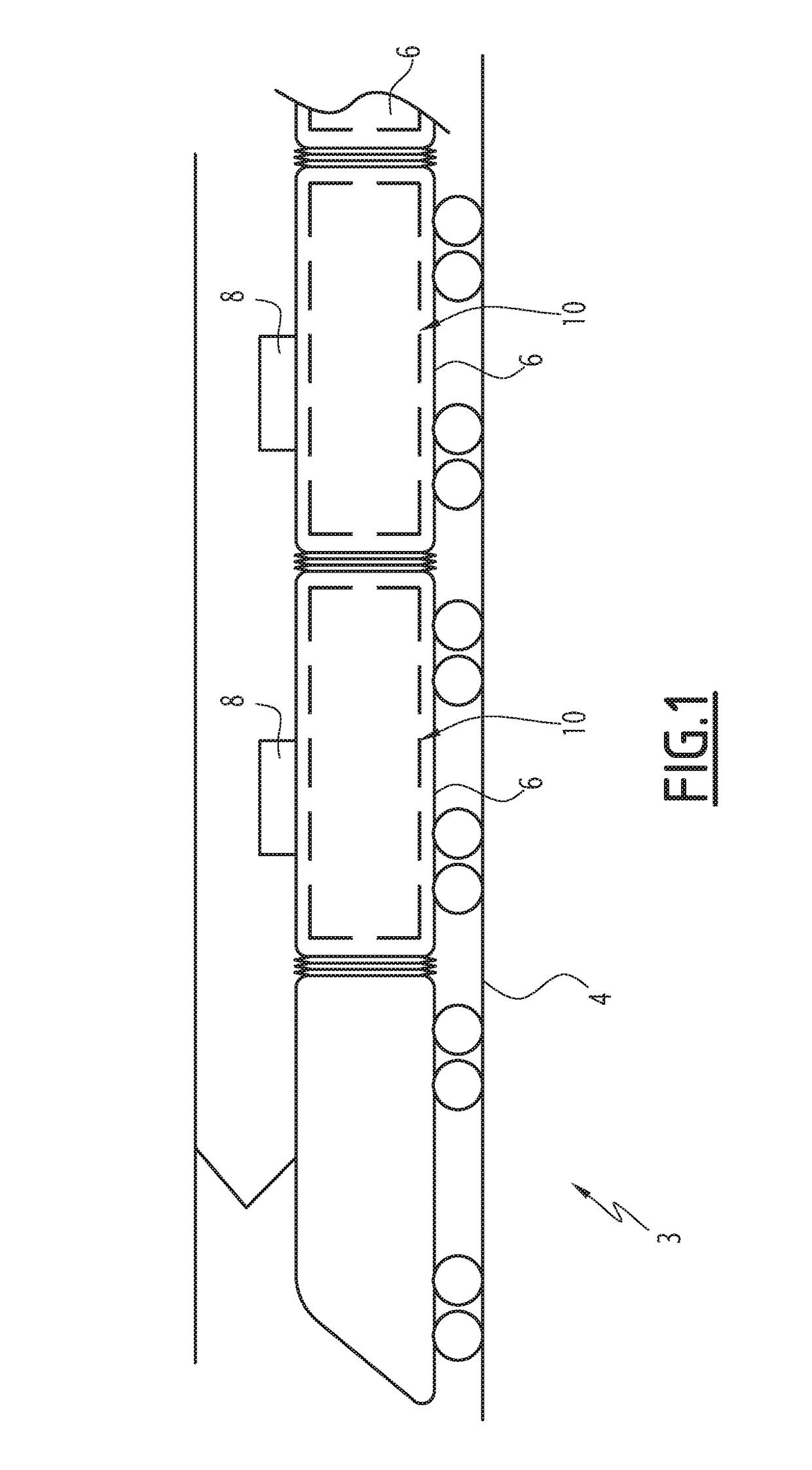
[0051]FIG. 1 shows a railway vehicle 2, for example a passenger train or an urban rail transport vehicle, such as a tram or a subway.

[0052]In a known manner, the vehicle 3 is suitable for rolling on a railroad track 4 and to that end comprises railway wheels and at least one engine capable of propelling the vehicle 2.

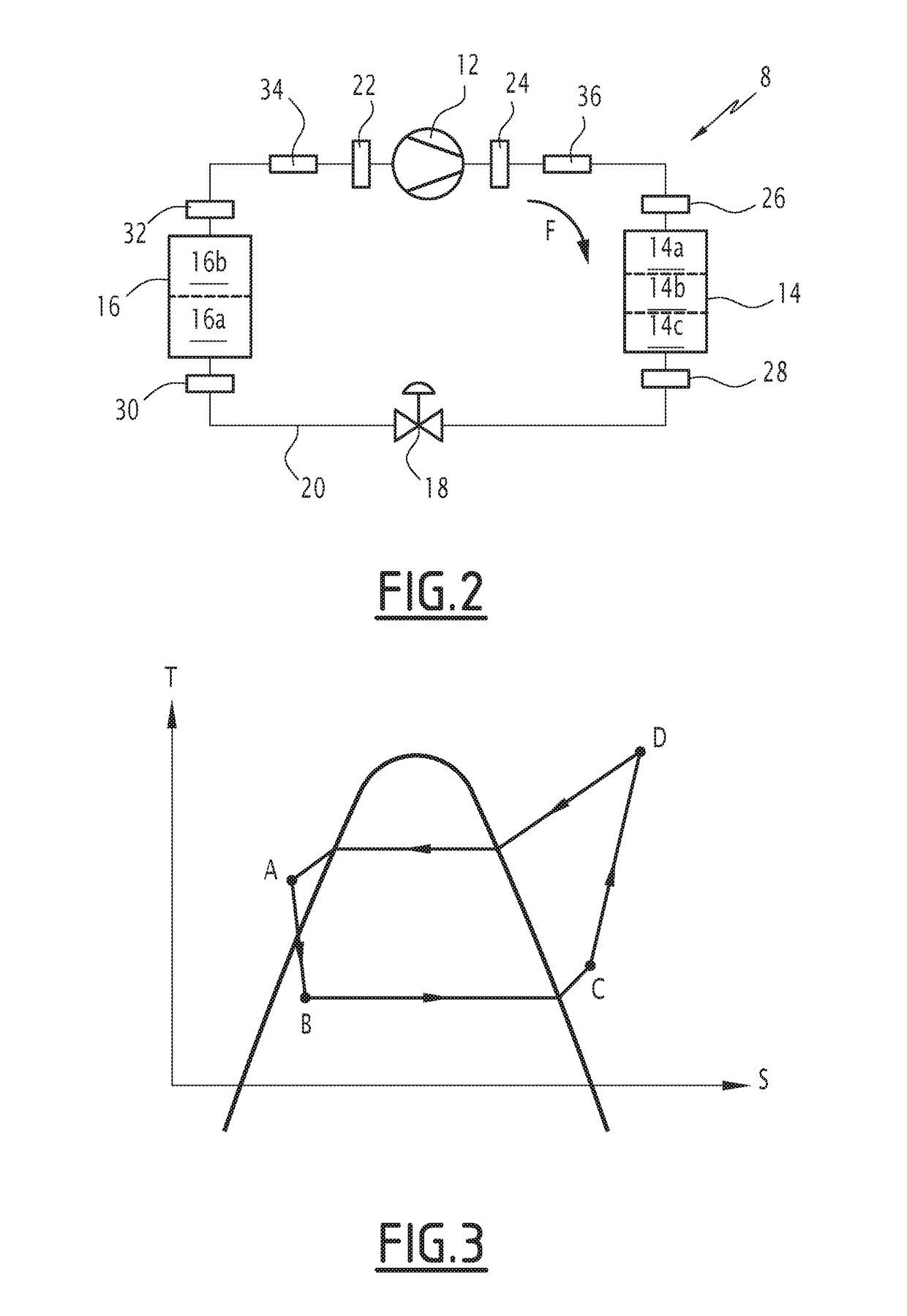
[0053]The vehicle 3 comprises one or several railway cars 6 intended to receive passengers. Each car 6 is equipped with an air conditioning system 8 that is configured to provide air conditioning to a space 10 inside the car 6. “Air condition” here means that the system 8 is capable of bringing the temperature of the air inside the space 10 to a predefined setpoint temperature.

[0054]In the illustrated example, each air conditioning system 8 is received in a dedicated equipment cabinet, here housed on the roof of the corresponding car 6. Other arrangements are, however, possible.

[0055]In this example, the space 10, also called zone 10, takes up all of the useful space of...