
Ion analysis device and ion dissociation method
a technology of ion dissociation and ion analysis device, which is applied in the field of ion analyzer, can solve the problems of inability to obtain sufficient information for structural analysis for such ions, inability to easily produce cid methods, and inability to exhibit high dissociation efficiency techniques, so as to achieve accurate structural analysis, increase the number of ion charges or the amount of internal energy, and high dissociation efficiency
- Summary
- Abstract
- Description
- Claims
- Application Information
AI Technical Summary
Benefits of technology
Problems solved by technology
Method used
Image

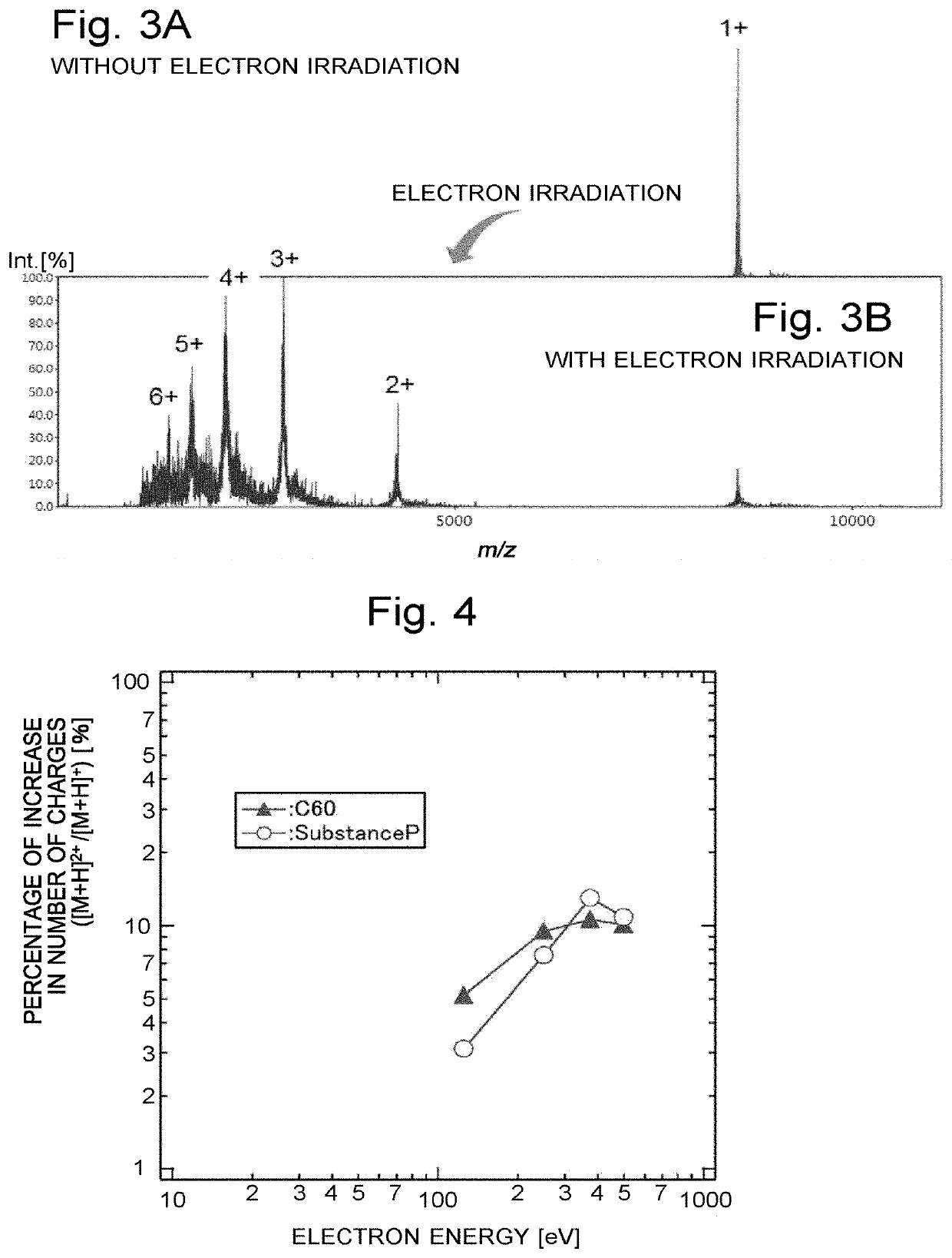
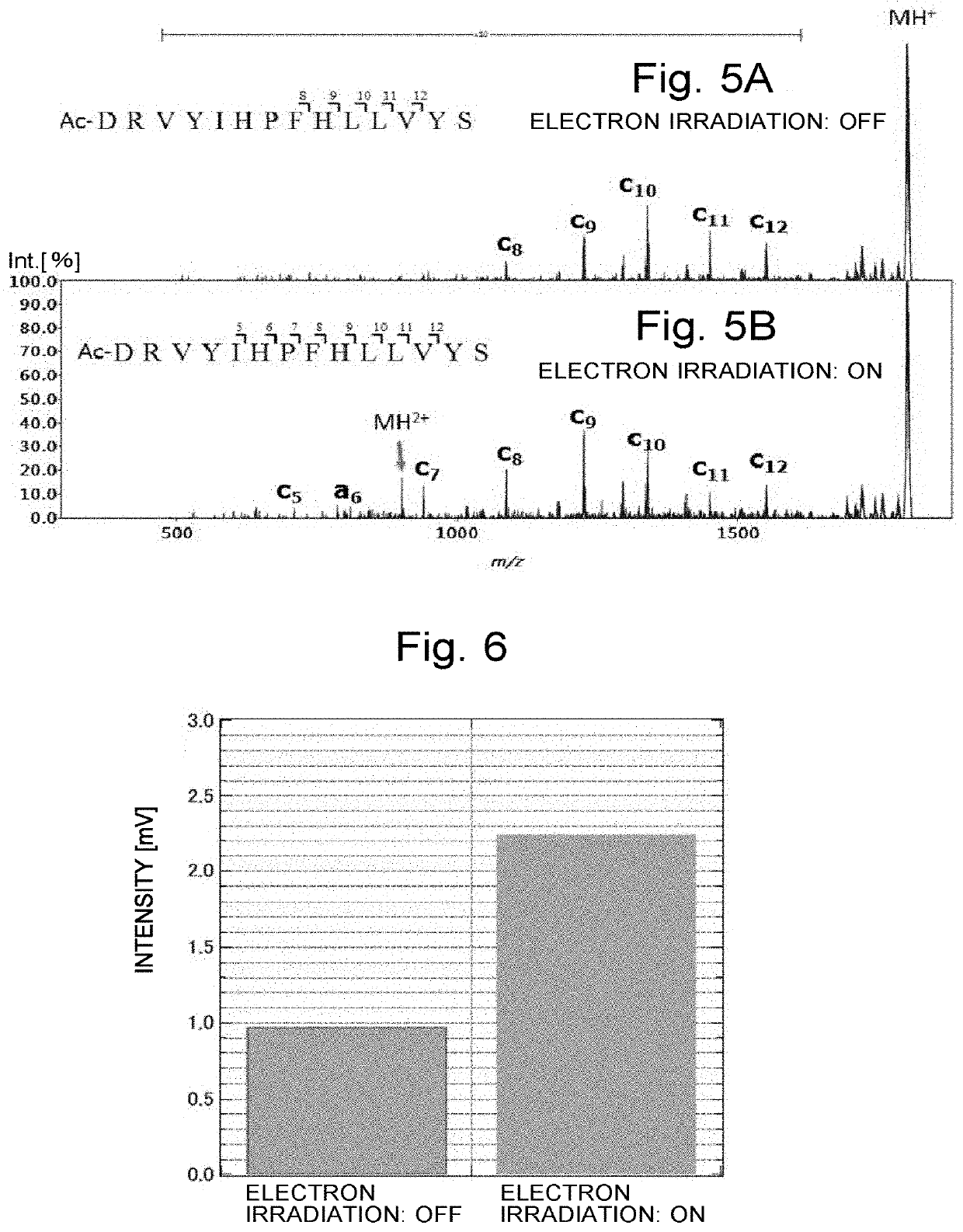
Examples
first embodiment
[0090]The configuration and operation of an ion trap time-of-flight mass spectrometer as the first embodiment of the present invention are hereinafter described with reference to the attached drawings.
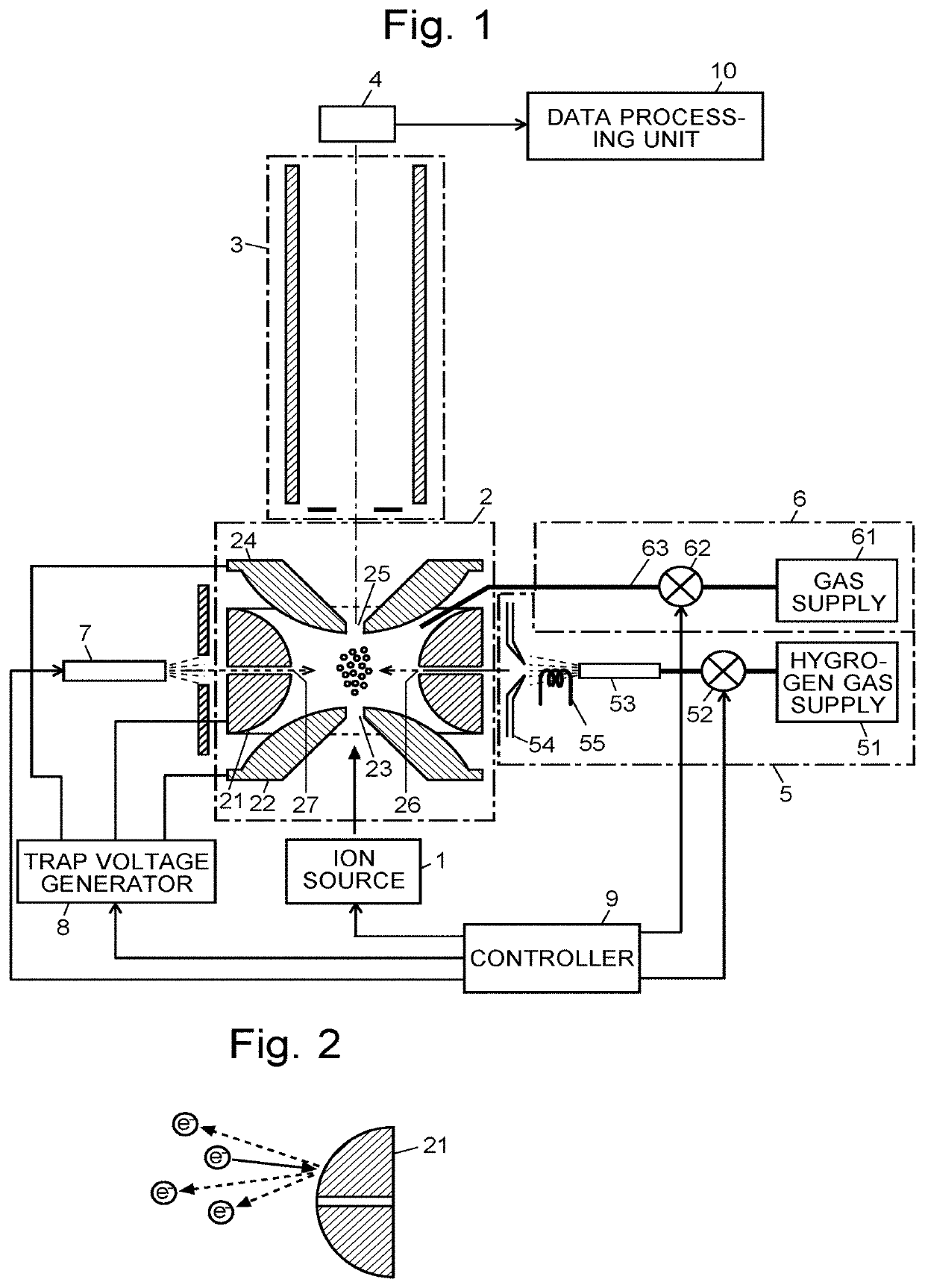
[0091]FIG. 1 is a schematic configuration diagram of the ion trap time-of-flight mass spectrometer according to the present embodiment.
[0092]The mass spectrometer according to the present embodiment has the following components contained in a vacuum chamber (not shown) maintained in a vacuum state: an ion source 1 for ionizing a component in a target sample; an ion trap 2 for capturing ions generated by the ion source 1 by the effect of a radio-frequency electric field; a time-of-flight mass separator 3 for separating the ions ejected from the ion trap 2 according to their mass-to-charge ratios m / z; and an ion detector 4 for detecting the separated ions. The mass spectrometer according to the present embodiment further includes: a hydrogen radical irradiator 5 for introducing hydrogen ...
second embodiment
[0115]An ion trap time-of-flight mass spectrometer as the second embodiment of the present invention is hereinafter described with reference to FIGS. 7, 8A and 8B.
[0116]FIG. 7 is a schematic configuration diagram of the ion trap time-of-flight mass spectrometer according to the second embodiment. The same components as used in the ion trap time-of-flight mass spectrometer according to the first embodiment shown in FIG. 1 are denoted by the same reference signs. A comparison of FIGS. 1 and 7 shows that the ion trap time-of-flight mass spectrometer according to the second embodiment does not include the hydrogen radical irradiator 5 for performing the ion dissociation by the HAD method. Both the increase in the number of charges and the dissociation of the ion are achieved by an injection of electrons from the electron irradiator 7.
[0117]That is to say, in the ion trap time-of-flight mass spectrometer according to the second embodiment, after a precursor ion having a specific mass-to-...
PUM
 Login to View More
 Abstract
Description
Claims
Application Information
 Login to View More