
Automatic analyzer
a technology of automatic analysis and analyzer, applied in the direction of material analysis, instruments, etc., can solve the problems of air suction, adverse influence on analysis, and inability to obtain accurate analysis results, so as to reduce user's work burden, improve user's operation efficiency, and prevent a reduction of throughput
- Summary
- Abstract
- Description
- Claims
- Application Information
AI Technical Summary
Benefits of technology
Problems solved by technology
Method used
Image

Examples
embodiments
First Embodiment
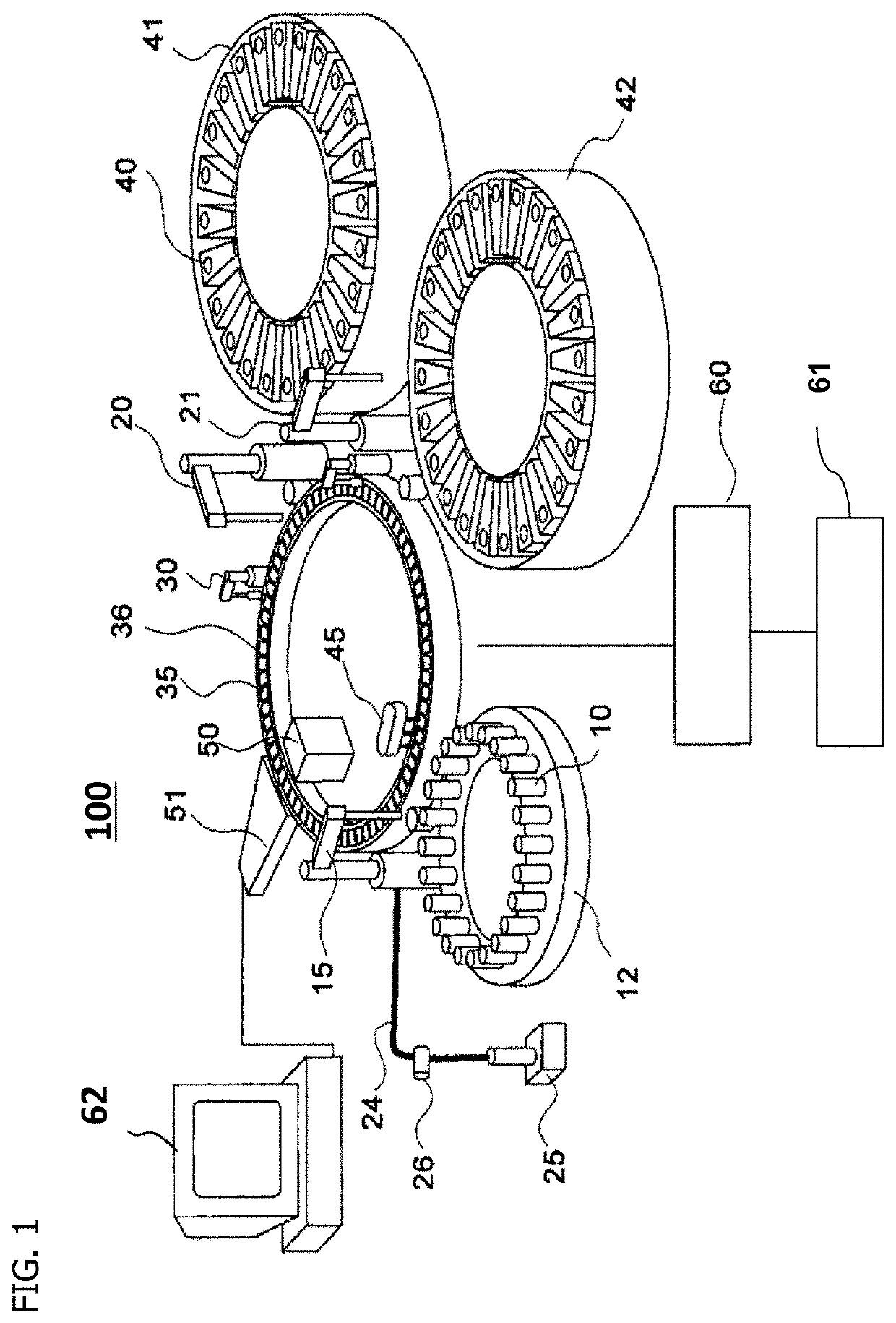
[0039]An example of an automatic analyzer to which a first embodiment of the present invention is applied will be described first while FIG. 1 is taken by way of example.
[0040]FIG. 1 is a schematic configuration diagram of an automatic analyzer 100 to which the first embodiment of the present invention is applied. In FIG. 1, the automatic analyzer 100 includes a sample disk 12, a first reagent disk 41, a second reagent disk 42, and a reaction disk 36. The sample disk 12 can mount sample containers 10 each holding a sample. The first reagent disk 41 and the second reagent disk 42 can mount reagent containers 40 each containing a reagent. Reaction containers 35 are disposed on a circumference of the reaction disk 36.
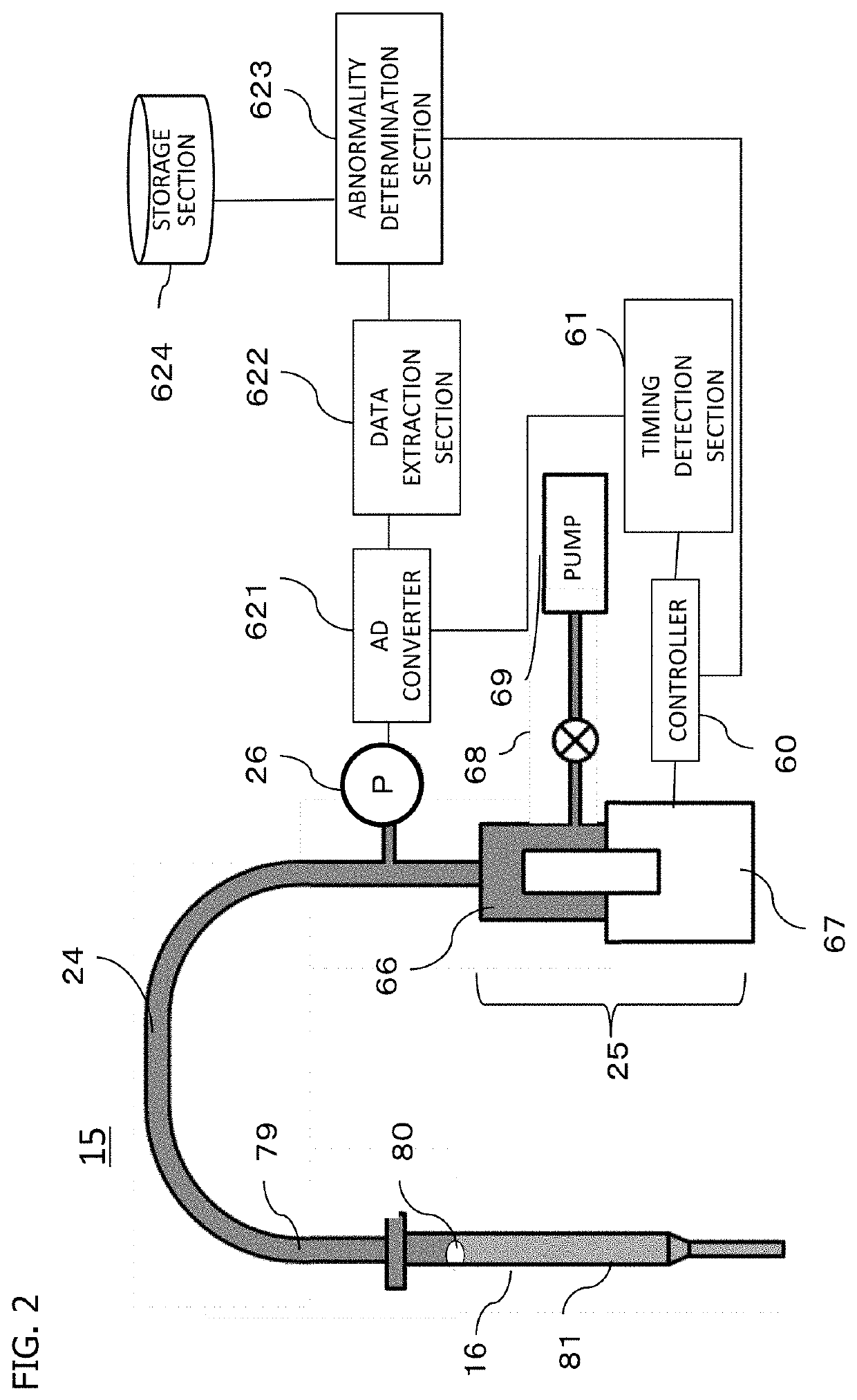
[0041]The automatic analyzer 100 further includes a sample dispensing mechanism 15, a first reagent dispensing mechanism 20, a second reagent dispensing mechanism 21, a stirring device 30, a container washing mechanism 45, a light source 50, a spectral sens...
second embodiment
[0127]A second embodiment of the present invention will next be described.
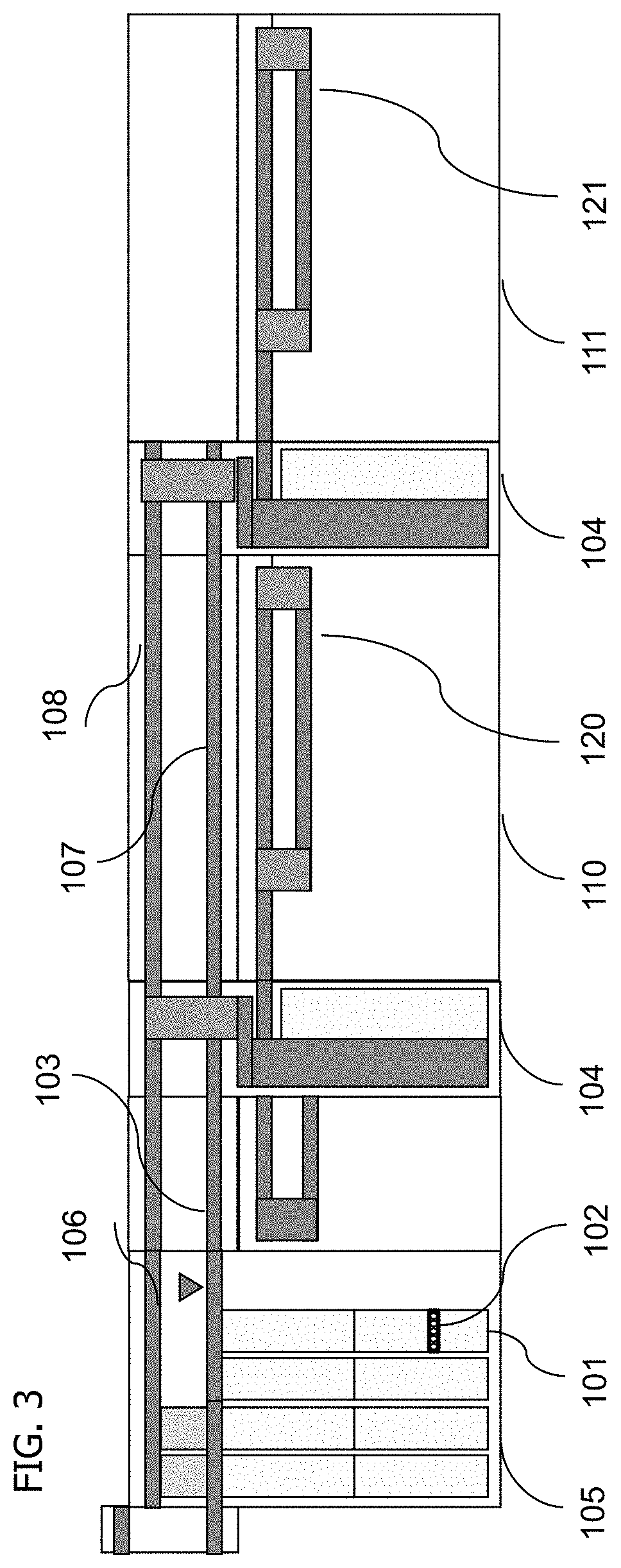
[0128]The second embodiment of the present invention is an example in which a system (combined system) includes the first unit 110 and the second unit 111 that are the analysis section of the automatic analysis system shown in FIG. 3, and in which the first unit 110 and the second unit 111 each use the same bubble detection method (bubble detection method by the change of the internal pressure of the sample probe 16 using the pressure sensor 26 similar to that according to the first embodiment). In other words, the first and second units 110 and 111 each determine that bubbles are present at the surface of the liquid on the basis of the change of the internal pressure of the probe after the probe contacts the bubbles. The dispensing mechanism for each probe is provided with the liquid level detection mechanism. For example, the first and second units 110 and 111 are both biochemical analysis units, or one of t...
third embodiment
[0148]A third embodiment of the present invention will next be described.
[0149]The third embodiment of the present invention is an example in which a system (combined system) includes the first unit 110 and the second unit 111 that are the analysis section of the automatic analysis system shown in FIG. 3, and in which the first unit 110 and the second unit 111 use different bubble detection methods (the bubble detection method by the change of the internal pressure of the sample probe 16 using the pressure sensor 26 similar to that according to the first embodiment and the bubble detection method by picking up an image of the liquid level by an imaging section). In other words, the second unit 111 determines that bubbles are present at the surface of the liquid in a non-contact manner. For example, one of the first and second units 110 and 111 is a biochemical analysis unit and the other is an immunoanalysis unit.
[0150]It is noted that the third embodiment will be described in the c...
PUM
| Property | Measurement | Unit |
|---|---|---|
| pressure | aaaaa | aaaaa |
| air suction | aaaaa | aaaaa |
| pressure sensor | aaaaa | aaaaa |
Abstract
Description
Claims
Application Information
 Login to View More