Check patentability & draft patents in minutes with Patsnap Eureka AI!

Systems and methods for approximating musculoskeletal dynamics

a technology of musculoskeletal dynamics and system and method, applied in the field of prosthetics, can solve the problems of lack of real-time software that can calculate the interactions between bones and muscles, limited use and function of prosthetics, and better, more interactive prosthetic devices

Active Publication Date: 2020-08-20
WEST VIRGINIA UNIVERSITY
View PDF0 Cites 6 Cited by
  • Summary
  • Abstract
  • Description
  • Claims
  • Application Information

AI Technical Summary

Benefits of technology

This approach results in precise and efficient approximation of musculoskeletal dynamics, enabling prosthetic limbs to move naturally with low computational cost and high accuracy, as demonstrated by the comparison with spline models, which are faster and require less memory.

Problems solved by technology

Currently, prosthetics are limited in use and function due to their lack of incorporation of human generated signals (muscle activation and sensory information, for example).
A limiting factor in the development of better, more interactive prosthetic devices is the lack of real-time software that can calculate the interactions between bones and muscles.
The development of such software is difficult because the musculoskeletal interactions are extremely complex and hard to describe, as they span multiple dimensions.
Simulations of this dynamic system are computationally costly for applications that require real-time full limb movement.
However, this method is computationally costly, and it requires a dedicated software application to model and to update these geometric transformations.
The joint dynamics were described using inverse solutions, but without the muscle level description, which is the main limitation.

Method used

the structure of the environmentally friendly knitted fabric provided by the present invention; figure 2 Flow chart of the yarn wrapping machine for environmentally friendly knitted fabrics and storage devices; image 3 Is the parameter map of the yarn covering machine
View more

Image

Smart Image Click on the blue labels to locate them in the text.
Viewing Examples
Smart Image
  • Systems and methods for approximating musculoskeletal dynamics
  • Systems and methods for approximating musculoskeletal dynamics
  • Systems and methods for approximating musculoskeletal dynamics

Examples

Experimental program
Comparison scheme
Effect test

Embodiment Construction

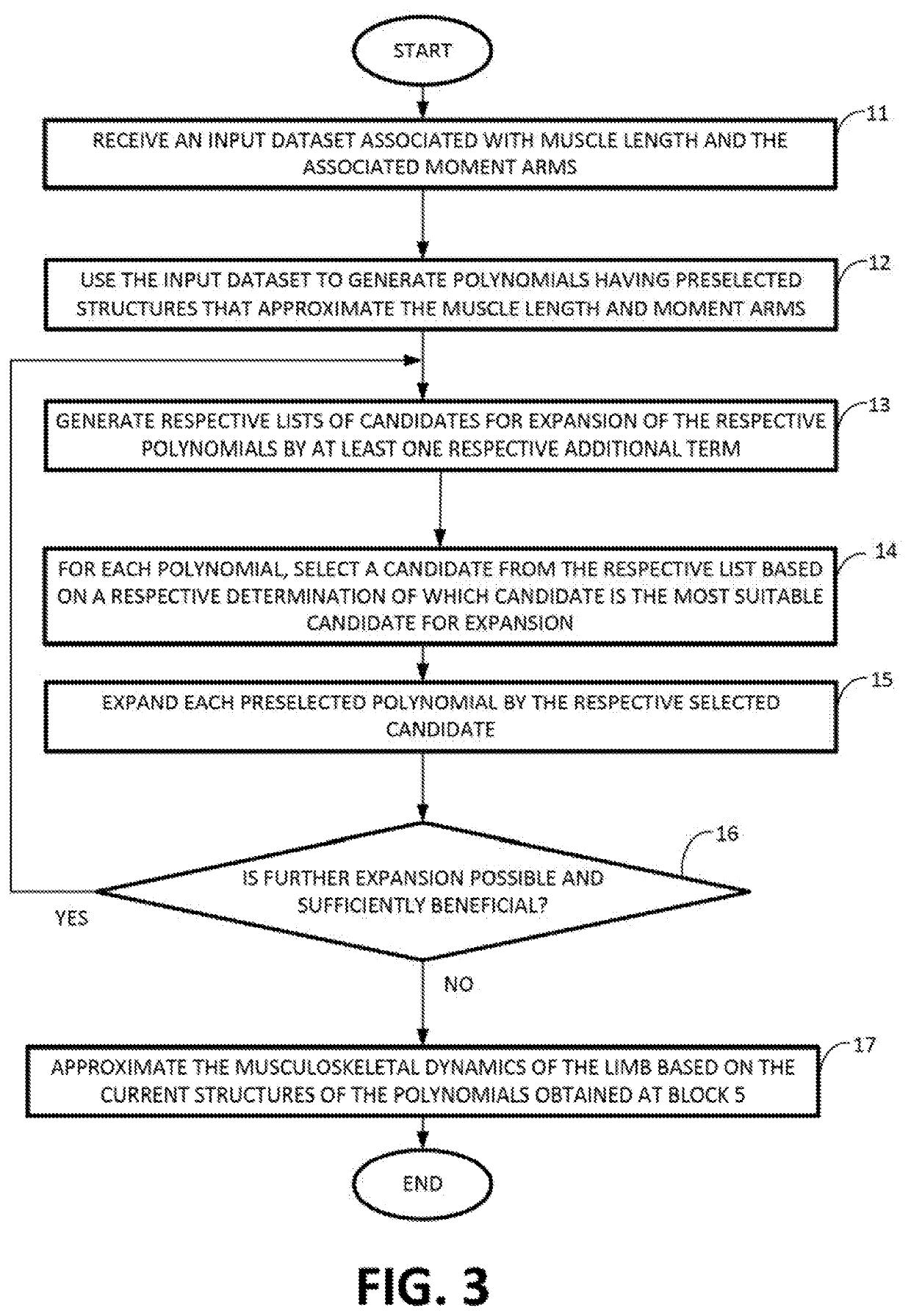
[0025]In accordance with representative embodiments of the present disclosure, the approximation method includes the steps of acquiring or receiving an input dataset associated with muscle lengths and moment arms for a plurality of physiological postures of a body limb, preselecting respective polynomials that approximate the muscle moment arms and lengths, generating respective lists of one or more candidates for expanding each respective polynomial, selecting a respective candidate for expanding each polynomial based on respective estimates of which of the candidates is the most suitable candidate, expanding the respective polynomials by the respective selected candidates, determining whether further expansion of the polynomials is possible and would be sufficiently beneficial to warrant expansion. If so, the process returns to the step of generating respective lists of candidates for expansion followed by the step of selecting the respective suitable candidates. If not, the muscu...

the structure of the environmentally friendly knitted fabric provided by the present invention; figure 2 Flow chart of the yarn wrapping machine for environmentally friendly knitted fabrics and storage devices; image 3 Is the parameter map of the yarn covering machine
Login to View More

PUM

No PUM Login to View More

Abstract

An approximation method and system are provided for more quickly controlling a prosthetic or other device by reducing computational processing time in a muscle model that can be used to control the prosthetic. For a given muscle, the approximation method can quickly compute polynomial structures for a muscle length and for each associated moment arms, which may be used to generate a torque for a joint position of a physics model. The physics model, in turn, produces a next joint position and velocity data for driving a prosthetic. The approximation method expands the polynomial structures as long as expansion is possible and sufficiently beneficial. The computations canbe performed quickly by expanding the polynomial structures in a way that constrains the muscle length polynomial to the moment arm polynomial structures, and vice versa.

Description

CROSS-REFERENCE TO RELATED APPLICATIONS[0001]This application claims priority to and the benefit of the filing date of a U.S. provisional application having Ser. No. 62 / 559,711, filed on Sep. 18, 2017, entitled “APPROXIMATION OF COMPLEX MUSCULOSKELETAL DYNAMICS,” which is hereby incorporated by reference herein in its entirety.FIELD OF THE INVENTION[0002]The present invention generally relates to prosthetics, and more particularly, to systems and methods for controlling prosthetics, for example, artificial prosthetic arms and legs.BACKGROUND OF THE INVENTION[0003]Currently, prosthetics are limited in use and function due to their lack of incorporation of human generated signals (muscle activation and sensory information, for example). Instead, most prosthetics are statically fixed in one posture, preventing real world interactions between the prosthetic limb and the environment. A limiting factor in the development of better, more interactive prosthetic devices is the lack of real-t...

Claims

the structure of the environmentally friendly knitted fabric provided by the present invention; figure 2 Flow chart of the yarn wrapping machine for environmentally friendly knitted fabrics and storage devices; image 3 Is the parameter map of the yarn covering machine
Login to View More

Application Information

Patent Timeline
no application Login to View More
Patent Type & Authority Applications(United States)
IPC IPC(8): G16H30/20A61F2/70
CPCA61B5/0488A61F2/70G16H30/20A61F2002/0894A61F2002/704A61F2/50B25J9/16G16H50/50A61F2/582A61F2/72A61F2002/6827G06F3/015G06F3/011A61F2002/6872B25J9/1075A61B5/1107A61B5/4519A61H2230/605A61F2002/5066A63B2230/605A61B5/389
Inventor SOBINOV, ANTONYAKOVENKO, SERGIYGRITSENKO, VALERIYAHARDESTY, RUSSELLBOOTS, MATTHEW
Owner WEST VIRGINIA UNIVERSITY
Features
  • R&D
  • Intellectual Property
  • Life Sciences
  • Materials
  • Tech Scout
Why Patsnap Eureka
  • Unparalleled Data Quality
  • Higher Quality Content
  • 60% Fewer Hallucinations
Social media
Patsnap Eureka Blog
Learn More