
Bone-bonded artificial tooth structure
a bone-bonded, artificial tooth technology, applied in the field of artificial tooth structure, can solve the problems of inability to place the implant into the atrophied alveolar bone, complicated surgical procedures, and inability to perform type of alveolar bone reconstruction through bone augmentation, etc., to achieve good support strength and eliminate the long time needed for osseointegration. occurrence, the effect of good support strength
- Summary
- Abstract
- Description
- Claims
- Application Information
AI Technical Summary
Benefits of technology
Problems solved by technology
Method used
Image

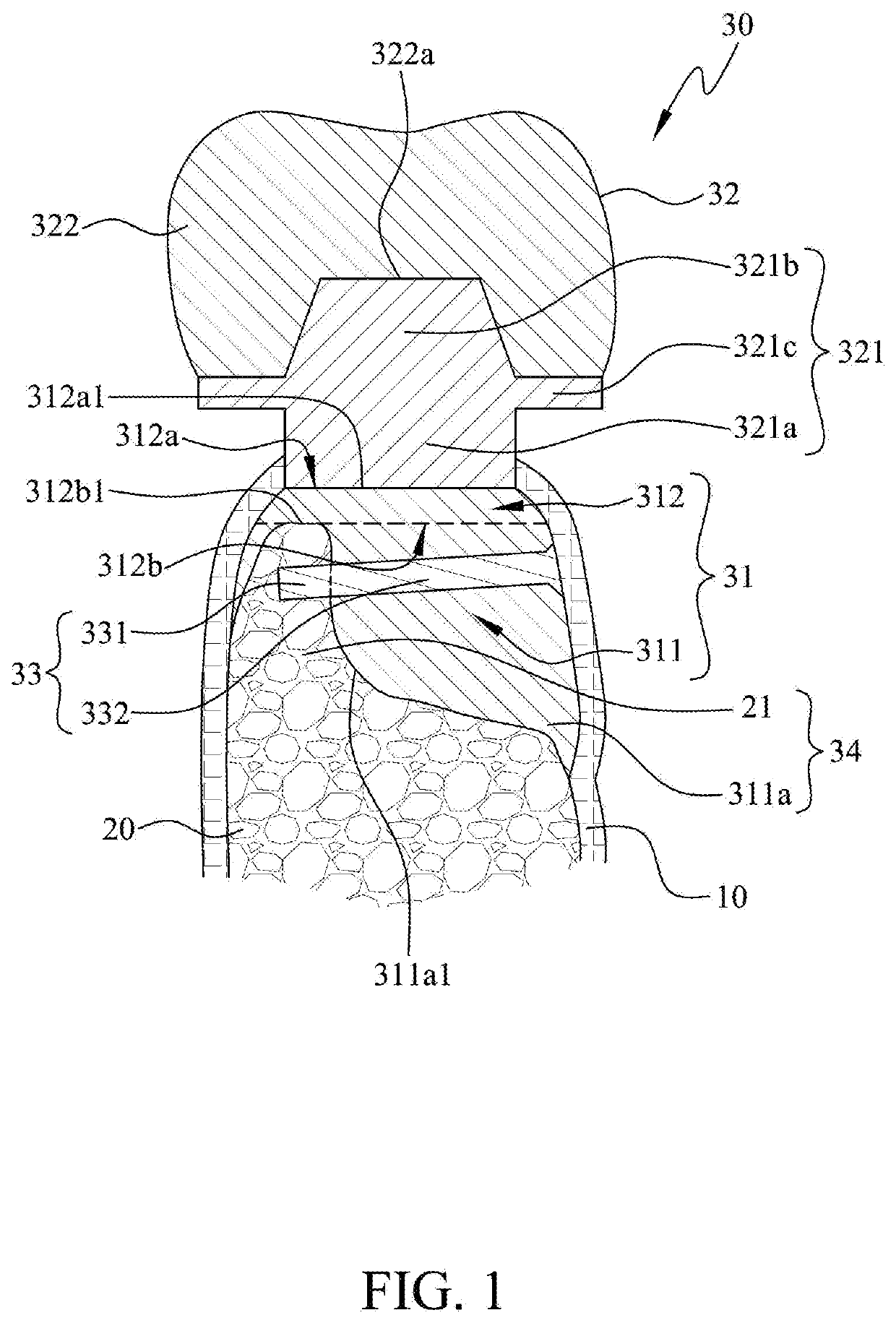
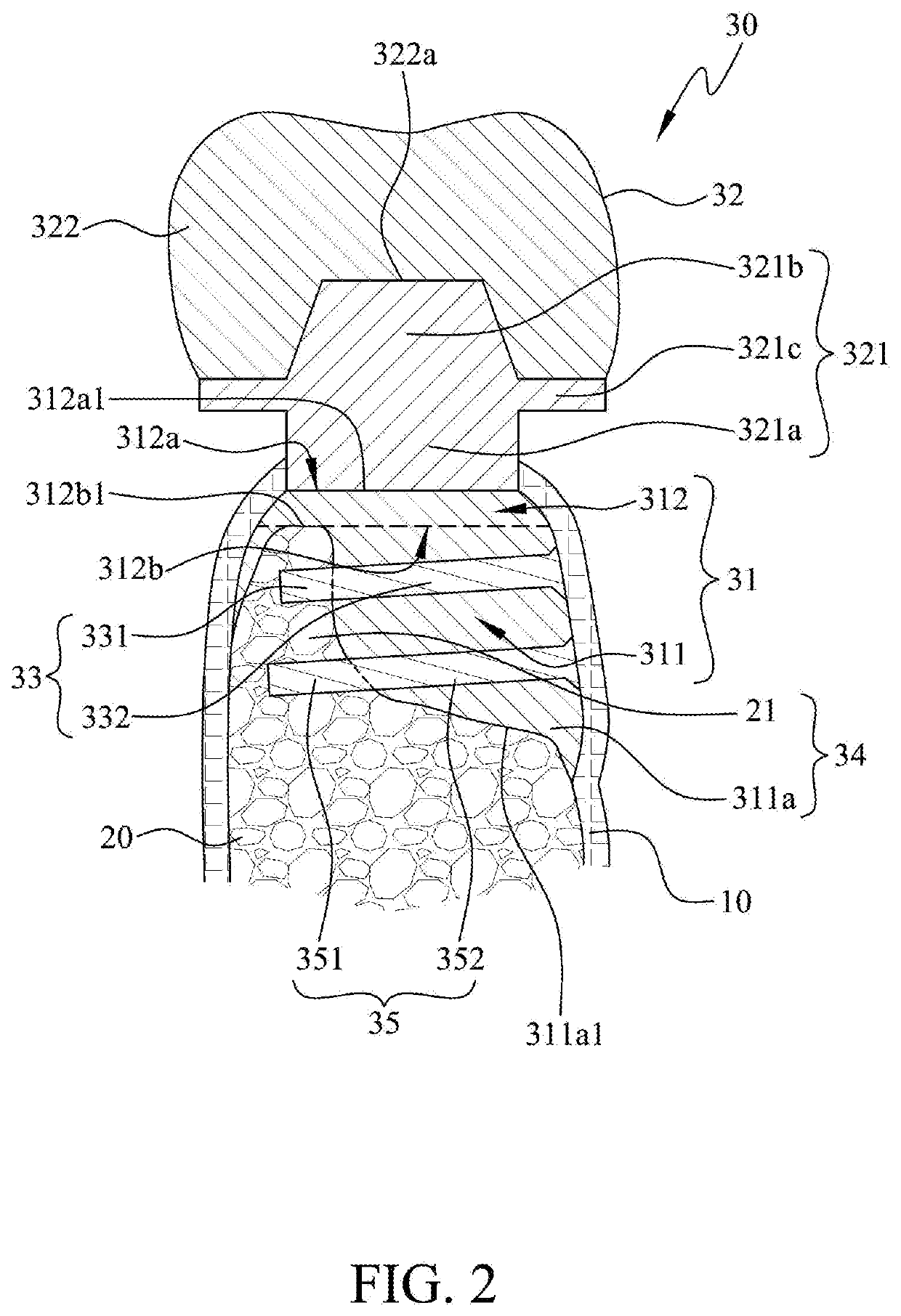
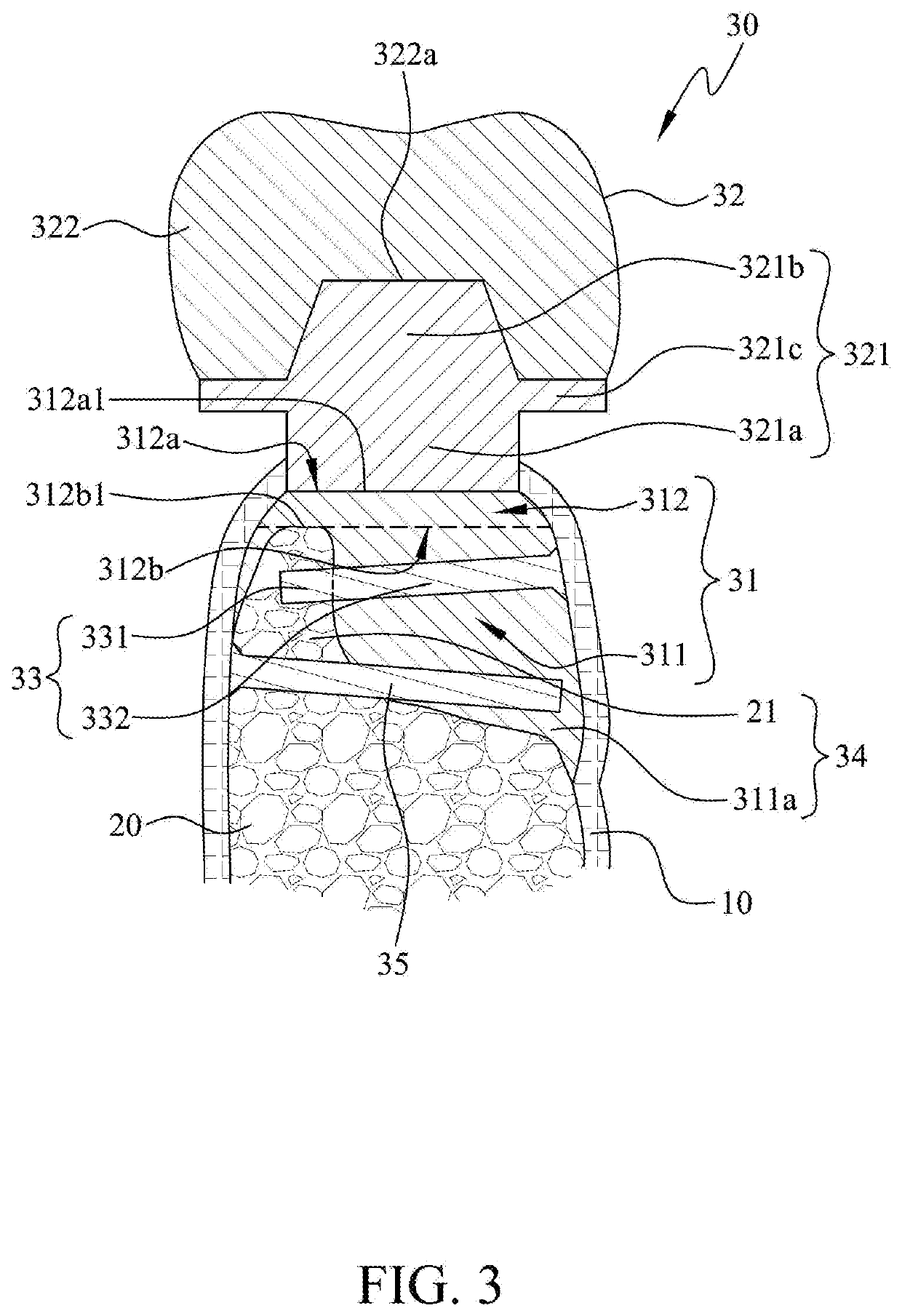
Examples
first embodiment
[0042]In the first embodiment as shown in FIG. 1, the bone-bonded artificial tooth structure 30 includes a base portion 31, a tooth portion 32 and a dental anchor 33. The base portion 31 is designed to be entirely fixed below the gum 10 and is divided into a lower connecting section 311 that located lower than a highest point of the narrowed bone top 21, and an upper connecting section 312 that located higher than the highest point of the narrowed bone top 21. The lower connecting section 311 is formed of a single independent connecting body 311a, which defines a 3D surface 311a1 completely corresponding to a configuration of a side wall surface of the narrowed bone top 21. The 3D surface 311a1 has one side in contact with the narrowed bone top 21, so that the narrowed bone top 21 and the lower connecting section 311 together form a locked part 34 that has an overall thickness larger than that of the narrowed bone top 21. More specifically, the 3D surface 311a1 of the lower connecti...
fourth embodiment
[0049]Please refer to FIG. 5 that shows the present invention configured for a patient having a missing tooth that is originally misaligned with other teeth. In this case, the abutment 321 can be changed in its shape to meet the patient's particular teeth condition. As shown in FIG. 5, the first end 321a of the abutment 321 is similarly formed as a bottom portion for contacting with the connecting surface 312a1, while the second end 321b of the abutment 321 is formed into a top portion slightly inclined relative to the first end 321a, such that the crown 322 of the tooth portion 32 mounted on the abutment 321 is also inclined in a direction to match the original teeth occlusion. Thus, the bone-bonded artificial tooth structure 30 according to the present invention can also be applied to misaligned original teeth.
fifth embodiment
[0050]Please refer to FIGS. 6A and 6B that show the present invention. In this embodiment, the base portion 31 is formed by 3D printing to have a substantially T-shaped independent connecting body 311a, which includes a vertical section 311a2 formed below the upper connecting section 312 and a horizontal section 311a3 formed at a lower end of the vertical section 311a2. As shown in FIG. 6B, when the first anchoring section 331 of the dental anchor 33 is inserted into the narrowed bone top 21 of the alveolar bone 20, the second anchoring section 332 of the dental anchor 33 is set outside of the independent connecting body 311a of the base portion 31 and located below the horizontal section 311a3 to abut against an underside of the horizontal section 311a3.
[0051]However, it is understood the description that the second anchoring section 332 of the dental anchor 33 is in contact with the underside of the horizontal section 311a3 is only illustrative to facilitate easy explanation of th...
PUM
 Login to View More
 Abstract
Description
Claims
Application Information
 Login to View More