The method for preparing dicarbamate compounds from diamines and the catalyst thereof
Active Publication Date: 2022-01-06
KOREA RES INST OF CHEM TECH
View PDF2 Cites 0 Cited by
Summary
Abstract
Description
Claims
Application Information
AI Technical Summary
This helps you quickly interpret patents by identifying the three key elements:
Problems solved by technology
Method used
Benefits of technology
Benefits of technology
[0033]When using a catalyst according to the present invention, a dicarbamate compound can be obtained at high yield from a diamine compound. Moreover, a method of preparing dicarbamate according to the present invention uses a heterogeneous catalyst, making it easy to separate the
Problems solved by technology
However, since phosgene is highly toxic and corrosive and inconvenient to handle, an environmentally friendly method for producing isocyanate by first preparing carbamate and then thermally decomposing the carbamate thus obtained has recently been proposed to replace the phosgene method.
However, the selenium compound used above is a homogeneous catalyst, and thus it is not easy to separate the catalyst from the reaction mixture, and there are problems related to the high toxicity of selenium (Patent Document 02).
U.S. Pat. No. 3,979,427 discloses the use of a palladium or rhodium catalyst and a cocatalyst including a metal halide such as iron chloride for increasing the reaction rate when preparing carbamate using a nitro or amine compound, but the cocatalyst, which is used in excess, is difficult to separate after reaction and may cause the device to corrode (Patent Document 03).
U.S. Pat.
Method used
the structure of the environmentally friendly knitted fabric provided by the present invention; figure 2 Flow chart of the yarn wrapping machine for environmentally friendly knitted fabrics and storage devices; image 3 Is the parameter map of the yarn covering machine
View more
Image
Smart Image Click on the blue labels to locate them in the text.
Viewing Examples
Smart Image
Click on the blue label to locate the original text in one second.
Reading with bidirectional positioning of images and text.
Smart Image
Examples
Experimental program
Comparison scheme
Effect test
Example
Examples 2 and 3 and Comparative Examples 1 to 3
[0076]A catalytic reaction for synthesizing toluene dicarbamate from toluene diamine was carried out in the same manner as in Example 1, and the synthesis yields of toluene dicarbamate using palladium supported on different carriers were compared, and the results thereof are shown in Table 1 below.
[0077]In the following Table 1, “HY” represents Y-zeolite, and “C” represents activated carbon.
[0078]As is apparent from Table 1, when synthesizing toluene dicarbamate using Pd / CeO2 as the catalyst, the maximum yield of 77.9% was obtained for a reaction time of 5 hr, which was about 15% higher than when using Pd / SiO2 exhibiting the second-highest activity, indicating that the yield was increased by about 24% or more based ...
Example
[0081]Toluene dicarbamate was synthesized under the same conditions as in Example 1, with the exception that the reaction time was changed. The synthesis yields of toluene dicarbamate depending on the reaction time were compared, and the results thereof are shown in Table 2 below.
[0082]As is apparent from Table 2, when the reaction time was increased up to 10 hr in the state in which the reaction conditions were fixed at 10 atm, toluene dicarbamate was capable of being produced at a high yield of 95.57%.
Synthesis of Methylene Diphenyl Dicarbamate (MDC) from Methylenedianiline (MDA)
[0083]0.5 mmol of methylenedianiline, 16 ml of methanol, 30 mg of 2.5 wt % Pd / CeO2, and 37 mg of NaI were placed in a 100 ml high-pressure reactor, after which a CO / O2 mixed gas (CO / O2=4) was allowed to flow thereto so that the pressure was set to 1...
the structure of the environmentally friendly knitted fabric provided by the present invention; figure 2 Flow chart of the yarn wrapping machine for environmentally friendly knitted fabrics and storage devices; image 3 Is the parameter map of the yarn covering machine
Login to View More
PUM
Property
Measurement
Unit
Temperature
aaaaa
aaaaa
Temperature
aaaaa
aaaaa
Time
aaaaa
aaaaa
Login to View More
Abstract
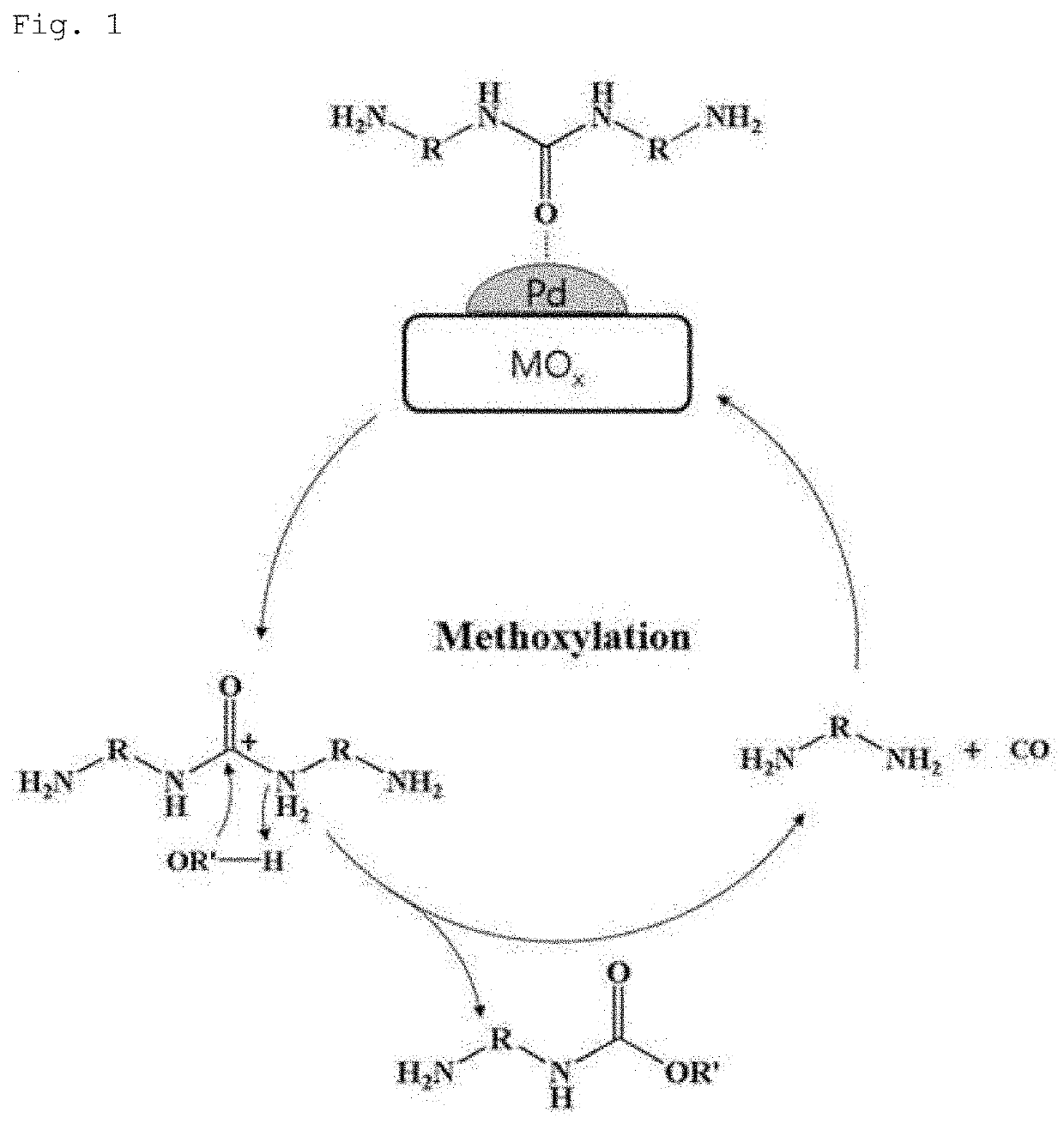
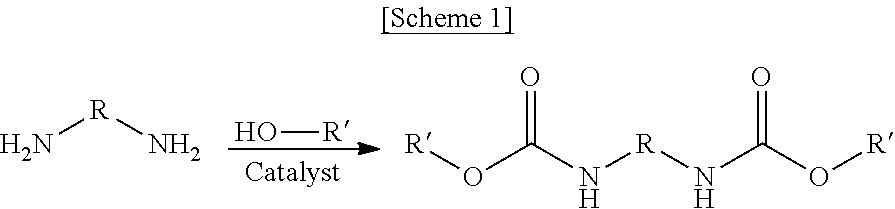
The present invention relates to a method of directly preparing a dicarbamate compound from a diamine compound, and more particularly to a method of directly preparing a dicarbamate compound by reacting a diamine compound with an alcohol compound in the presence of a mixed gas of carbon monoxide (CO) and oxygen (O2) using a Pd/MOx catalyst configured such that a palladium (Pd) active metal is supported on a metal oxide or metalloid oxide carrier.
Description
TECHNICAL FIELD[0001]The present invention relates to a method of directly preparing a dicarbamate compound from a diamine compound, and more particularly to a method of directly preparing a dicarbamate compound by reacting a diamine compound with an alcohol compound in the presence of a mixed gas of carbon monoxide (CO) and oxygen (O2).BACKGROUND ART[0002]A dicarbamate compound, which is a compound represented by R—(NHCOOR′)2, may be converted into a diisocyanate compound through thermal decomposition. Therefore, dicarbamate is used as a raw material or an intermediate of pesticides, pharmaceuticals or polyurethane.[0003]Carbamates (urethane compound) such as alkyl carbamate are organic compounds that are conventionally useful as raw material for pharmaceuticals, pesticides, etc., as raw material for purification chemistry, as analytical reagents for alcohols, or as an industrial material having a wide range of end uses. Moreover, the use of alkyl carbamate as a raw material for th...
Claims
the structure of the environmentally friendly knitted fabric provided by the present invention; figure 2 Flow chart of the yarn wrapping machine for environmentally friendly knitted fabrics and storage devices; image 3 Is the parameter map of the yarn covering machine
Login to View More
Application Information
Patent Timeline
Application Date:The date an application was filed.
Publication Date:The date a patent or application was officially published.
First Publication Date:The earliest publication date of a patent with the same application number.
Issue Date:Publication date of the patent grant document.
PCT Entry Date:The Entry date of PCT National Phase.
Estimated Expiry Date:The statutory expiry date of a patent right according to the Patent Law, and it is the longest term of protection that the patent right can achieve without the termination of the patent right due to other reasons(Term extension factor has been taken into account ).
Invalid Date:Actual expiry date is based on effective date or publication date of legal transaction data of invalid patent.


 Login to View More