Propylene composition, process for preparing the same, polypropylene composition, and molded articles
Inactive Publication Date: 2001-10-09
JNC CORP
View PDF34 Cites 152 Cited by
Summary
Abstract
Description
Claims
Application Information
AI Technical Summary
This helps you quickly interpret patents by identifying the three key elements:
Problems solved by technology
Method used
Benefits of technology
Benefits of technology
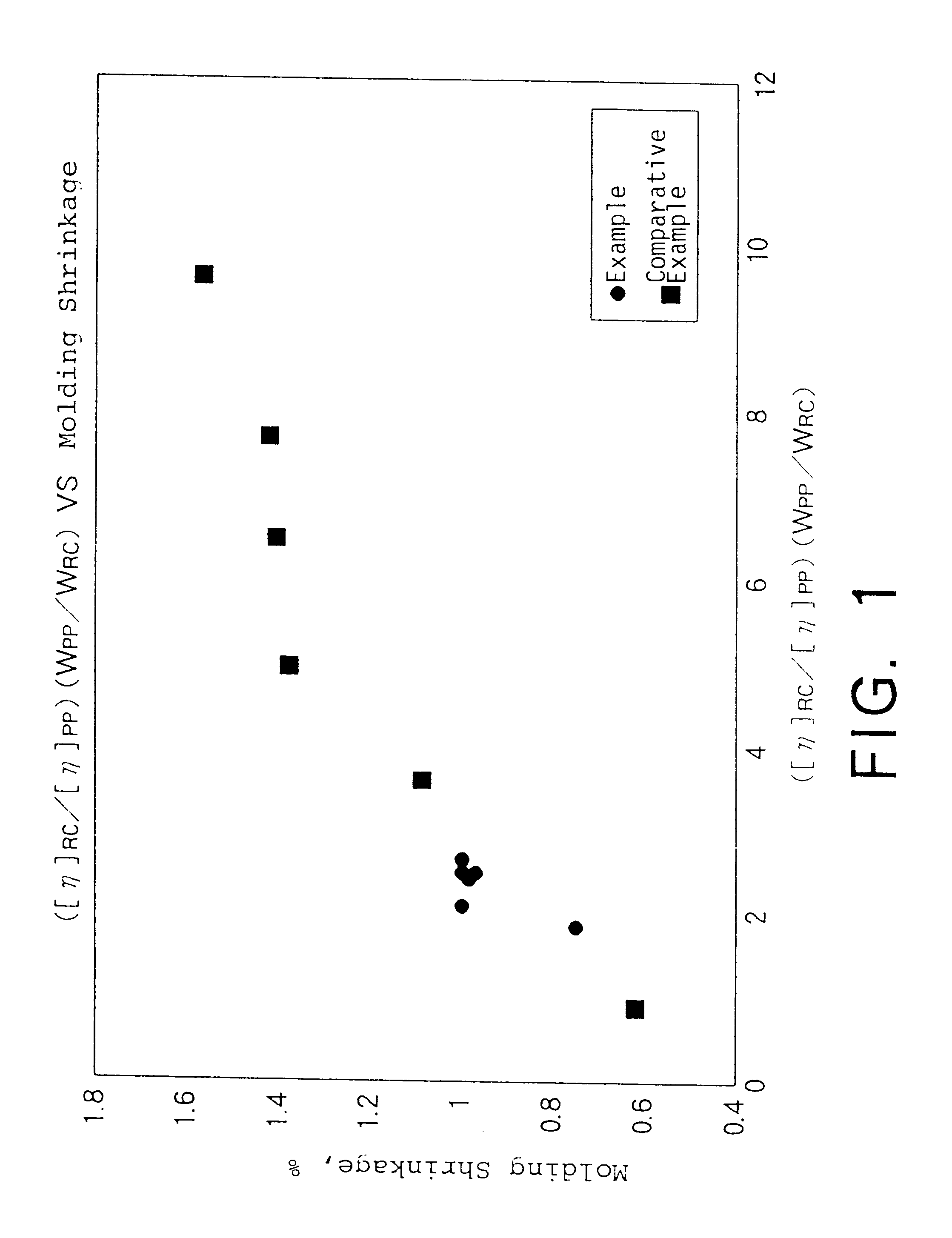
FIG. 1 shows a curve representing a molding shrinkage relative to the product ([.eta.].sub.RC / [.eta.].sub.PP).times.(W.sub.PP / W.sub.RC) of the intrinsic viscosity ratio and the weight ratio of the propylene homopolymers (PP) to the propylene-ethylene copolymers (RC).
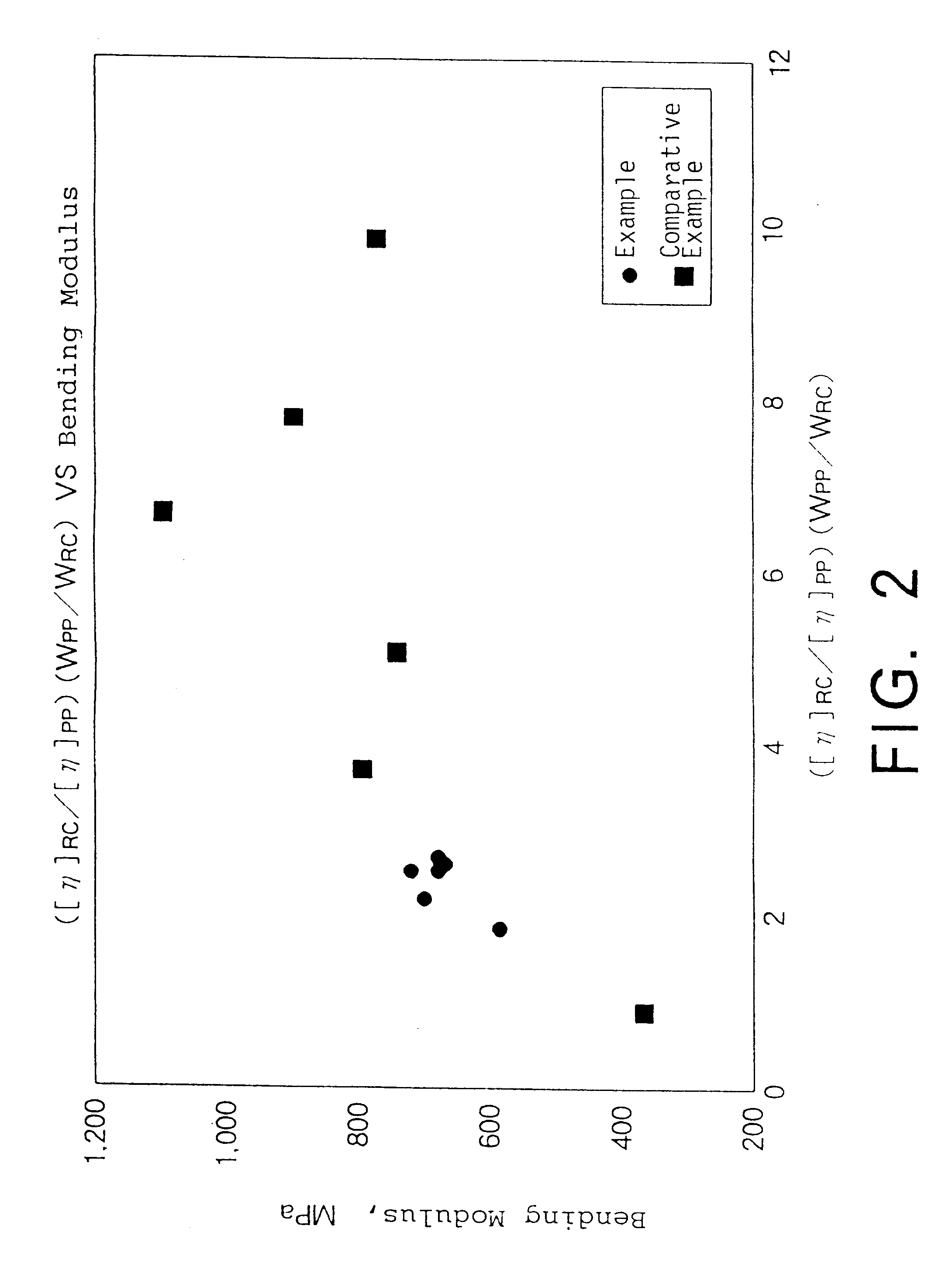
FIG. 2 shows a curve representing a bending modulus relative to the product ([.eta.].sub.RC / [.eta.].sub.PP).times.(W.sub.PP / W.sub.RC) of the intrinsic viscosity ratio and the weight ratio of the propylene homopolymers (PP) to the propylene-ethylene copolymers (RC).
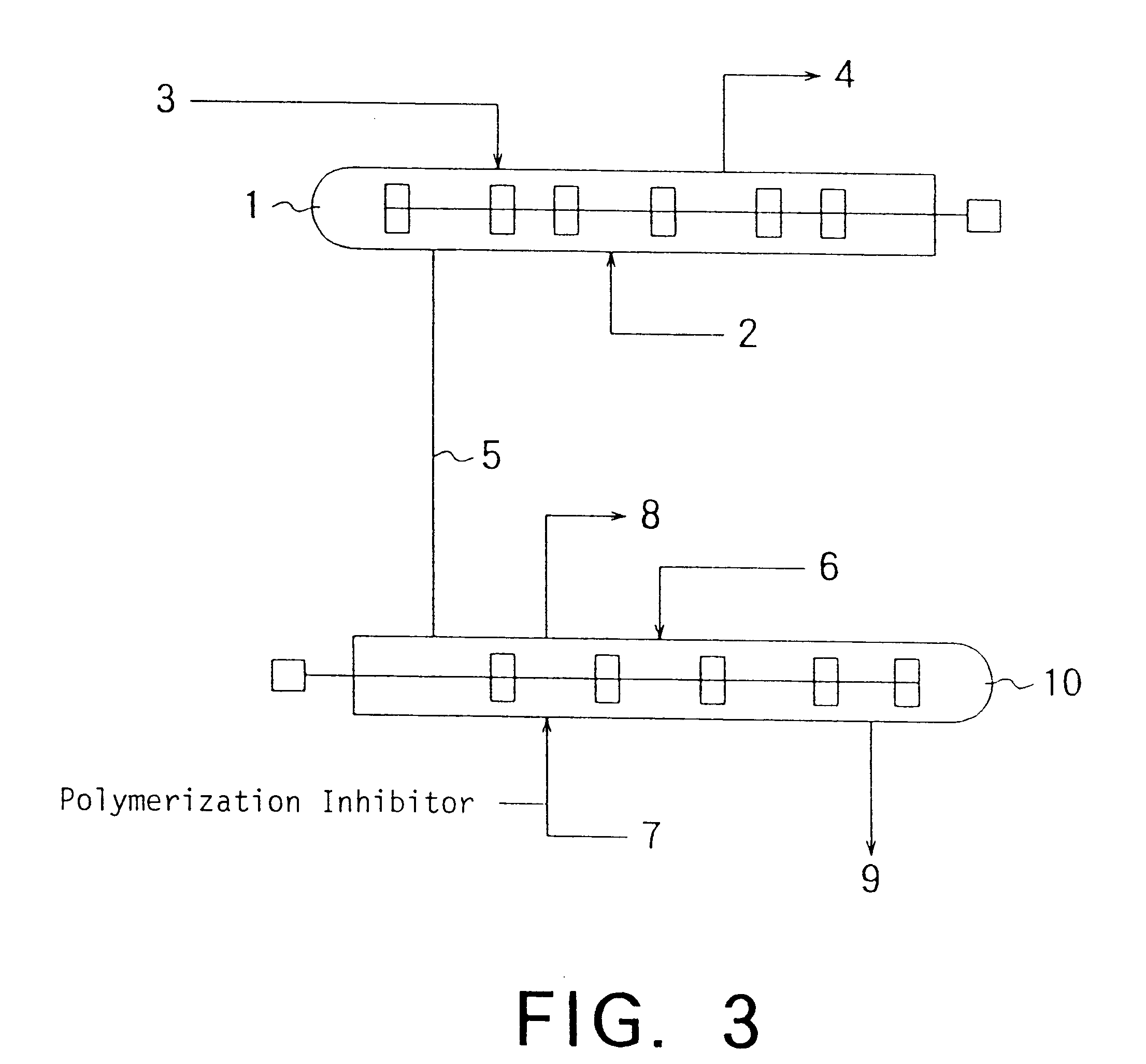
FIG. 3 is a flow sheet of the continuous polymerization apparatus for the propylene compositions used in the examples.
Problems solved by technology
In general, propylene homopolymer has high rigidity, good heat resistance, but insufficient flexibility, poor impact resistance, especially low-temperature impact resistance and poor tear strength when it is formed into films.
Random copolymers of propylene and .alpha.-olefins have good, transparency and good flexibility, but poor heat resistance and poor low-temperature impact resistance.
However, they are inferior in transparency and gloss to homopolymer, but have high mold shrinkage factor like homopolymer, and also they are inferior in tear strength and flexibility to copolymers.
In any case, a phenomenon of whitening is observed in said known compositions when impacting and bending, and their whitening resistance is insufficient.
However, the method requires a large quantity of inorganic materials such as talc to improve the mold shrinkage factor, which results in an increased weight of the molded article and a remarkably poor appearance.
In the multilayered film, a compatibility of,the laminating low-density polyethylene with polypropylene resin may be not substantially good, and so fish eye is easy to occur when the film is remelted and reused.
This tubular body may be insufficient in the bonding strength between the rigid portion and the flexible portion.
Method used
the structure of the environmentally friendly knitted fabric provided by the present invention; figure 2 Flow chart of the yarn wrapping machine for environmentally friendly knitted fabrics and storage devices; image 3 Is the parameter map of the yarn covering machine
View more
Image
Smart Image Click on the blue labels to locate them in the text.
Viewing Examples
Smart Image
Click on the blue label to locate the original text in one second.
Reading with bidirectional positioning of images and text.
Smart Image
Examples
Experimental program
Comparison scheme
Effect test
first embodiment
The molded articles of the first embodiment are injection molded articles. More specifically, these molded articles are those obtained by injection-molding method using pellets of each of the polypropylene compositions into those articles such as sheet-like articles, containers, caps for containers, molded articles with a hinge, and the like.
As the polypropylene compositions for injection molding can be used any of the above-mentioned compositions, but it is preferred to use polypropylene compositions (Ci) for injection molding.
Depending on the aimed molded articles and properties required therefor, the compositions incorporated with an .alpha.-crystal nucleating agent, a radical generator and / or a crystalline propylene homopolymer, etc. can be used.
By using these polypropylene compositions (Ci), it is possible to produce an injection molded article which has an excellent stress-whitening resistance at folded portions (such as in hinge constructions), transparency, gloss, regidity, ...
second embodiment
The molded articles according to the present invention are sheets. In view of printability and flexibility, the sheets have a Young's modulus in a longitudinal direction at 23.degree. C. of 200 to 450 MPa, preferably 300 to 400 MPa, and a tensile strength at yield in a longitudinal direction at 50.degree. C. of not less than 15 MPa, preferably not less than 17 MPa.
The sheets according to the present invention can be produced by any of the known sheet molding methods, but are preferably produced by extrusion molding or calendering because of their good productivity. Specifically, the sheets are molded by T-die extrusion method using an apparatus equipped with extruder, T-die, polishing roll (cooling roll), guide roll, take-off roll, trimming cutter, masking, cutter for cutting in desired lengths, stacker and the like (T-die sheet molding machine), or using an apparatus (calenderingmachine) equipped with Banburry mixer, mixing roll, warming roll, extruder, calender roll, trimming cut...
third embodiment
The molded products according to the present invention are films produced by molding the above-mentioned polypropylene composition (C), preferably polypropylene composition (Cf) in which conventional additives for polyolefins are added to the propylene compositions (A). The films include unstretched, uniaxially stretched and biaxially oriented films.
The unstretched films can be produced by the T-die method or inflation method which are usually used for production of polyolefin films, and the uniaxially stretched films or biaxially oriented films can be produced by stretching the thus obtained unstretched films by way of uniaxial stretching with a tentering method, or by succesive biaxial orienting or by simultaneous biaxial orienting with a tubular method, respectively.
These films are excellent in low-temperature impact resistance, thermal resistance and tear resistance due to the use of the polypropylene compositions (C) containing as a base resin the propylene compositions of the ...
the structure of the environmentally friendly knitted fabric provided by the present invention; figure 2 Flow chart of the yarn wrapping machine for environmentally friendly knitted fabrics and storage devices; image 3 Is the parameter map of the yarn covering machine
Login to View More
PUM
Property
Measurement
Unit
Linear density
aaaaa
aaaaa
Linear density
aaaaa
aaaaa
Percent by mass
aaaaa
aaaaa
Login to View More
Abstract
A polypropylene composition for the production of various molded articles which are excellent in moldability, mold shrinkage factor on molding, rigidity, flexibility, impact resistance, in particular low-temperature impact resistance, transparency, gloss, stress-whitening resistance, and the balance thereof; various molded articles having the above properties; a propylene composition which is suitable for a base resin for the polypropylene composition; and a process for the production thereof. The propylene composition comprises a propylene homopolymer and a propylene-ethylenecopolymer, the intrinsic viscosity of the copolymer ([eta]RC) is in the range of 1.7 to 2.8 dl / g, the intrinsic viscosity ratio of the homopolymer to the copolymer ([eta]RC / [eta]pp) is in the range of 0.7 to 1.2 and a product [(WPP / WRC)x([eta]RC / [eta]pp)] of the weight ratio (WPP / WRC) of the homopolymer to the copolymer and the intrinsic viscosity ratio thereof is in the range of 1.0 to 3.0.
Description
This invention relates to propylene compositions, more specifically propylene compositions comprising a propylene homopolymer and a propylene-ethylene copolymer, processes for the production thereof, polypropylene compositions based on said propylene composition and molded articles from those compositions, particularly injection molded articles, extruded sheets, films and blow molded articles.BACKGROUND OF THE ARTPolypropylene resins are relatively cheap and have good properties, and so have a widespread use such as various molded articles, e.g., injection molded articles such as sheets, containers, caps and those having a hinge structure; films; and blow molded articles such as air ducts. Films of polypropylene resins have been extensively employed as packaging materials for foods and fiber products, taking advantage of their mechanical, optical and thermal properties.In compliance with the properties required for the molding applications, there have been used polypropylene composi...
Claims
the structure of the environmentally friendly knitted fabric provided by the present invention; figure 2 Flow chart of the yarn wrapping machine for environmentally friendly knitted fabrics and storage devices; image 3 Is the parameter map of the yarn covering machine
Login to View More
Application Information
Patent Timeline
Application Date:The date an application was filed.
Publication Date:The date a patent or application was officially published.
First Publication Date:The earliest publication date of a patent with the same application number.
Issue Date:Publication date of the patent grant document.
PCT Entry Date:The Entry date of PCT National Phase.
Estimated Expiry Date:The statutory expiry date of a patent right according to the Patent Law, and it is the longest term of protection that the patent right can achieve without the termination of the patent right due to other reasons(Term extension factor has been taken into account ).
Invalid Date:Actual expiry date is based on effective date or publication date of legal transaction data of invalid patent.


 Login to View More