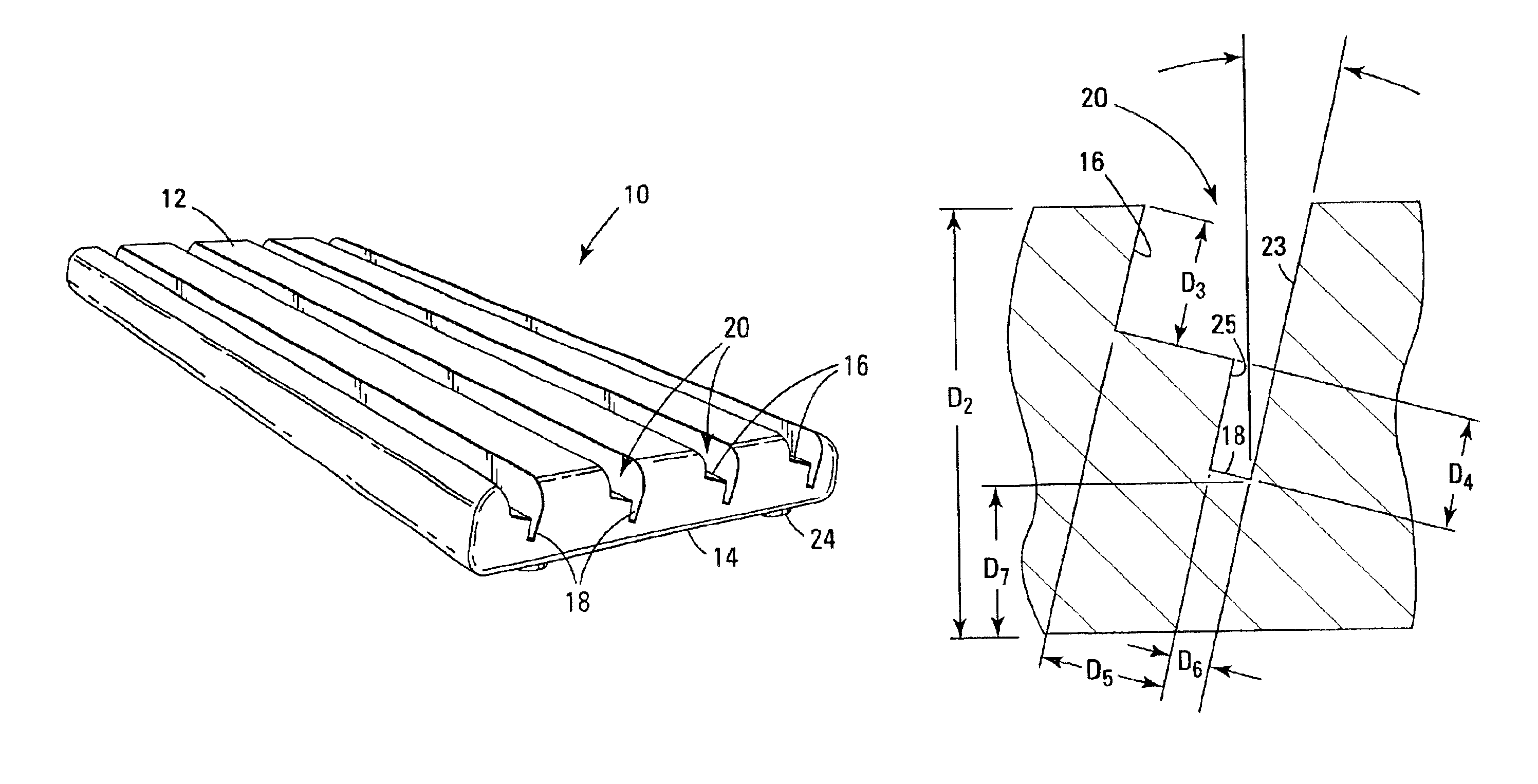
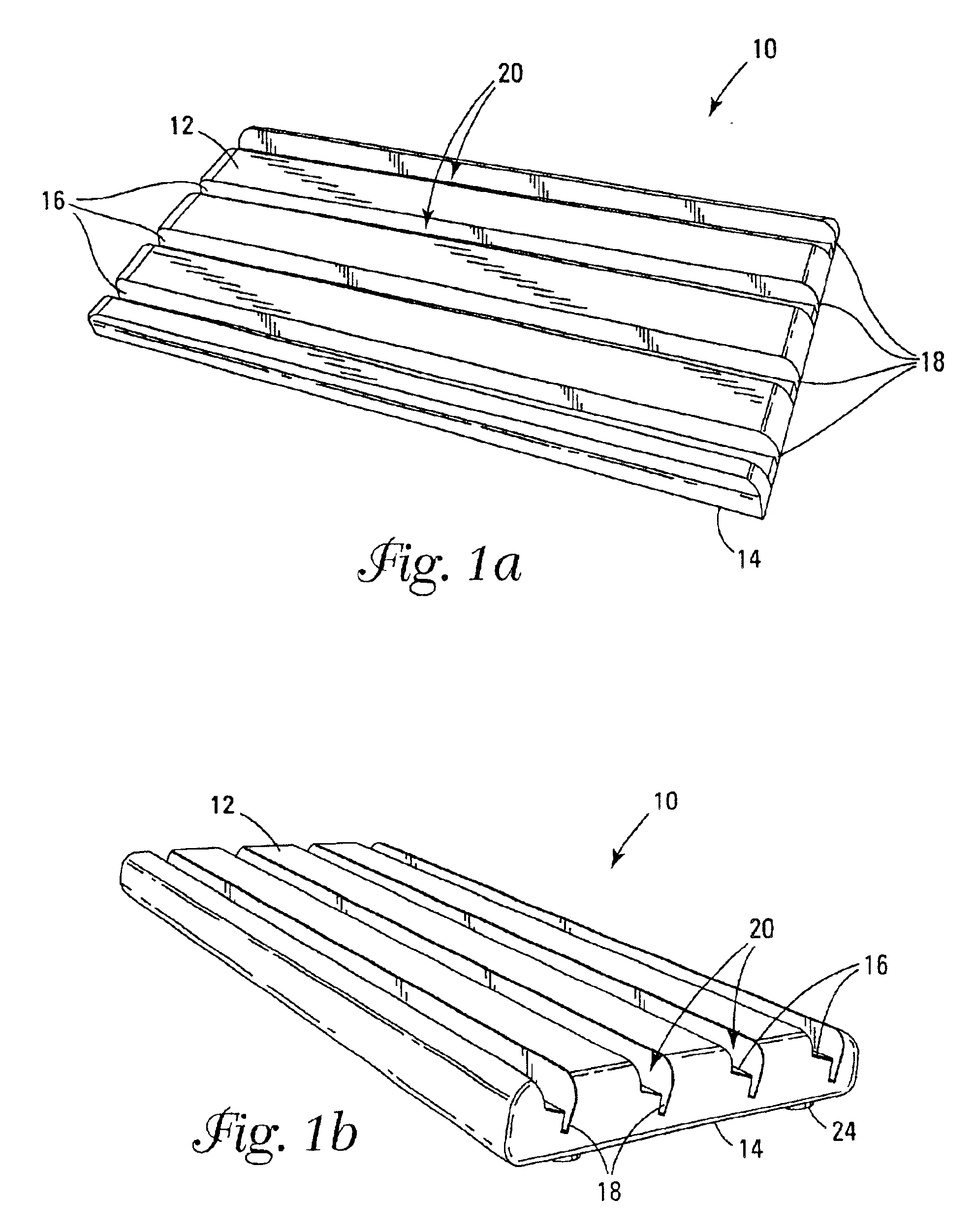
FIG. 7 shows the rear supporting surface of a game board 10. The second major surface 14 of the game board can have a plurality of feet 24 disposed towards the corners of the game board for supporting it on a flat surface. The feet 24 preferably are made from a resilient material that would provide a high-friction, non marring interface on flat surfaces such as wood tables. The feet thus would prevent the game board from sliding across the supporting surface or from vibrating on or
scratching the supporting surface during use. The feet 24 are preferably positioned on the surface of the game board towards the corners such that the feet do not fall within the compound slot of another game board when the boards are stacked. This allows the boards to be evenly stacked for storage. A particular
advantage of the present invention is that the use of the compound slots 20, 20′, 20″ on the first major surface 12 of the gaming board allows a second major surface 14 to have high friction vibrational dampening features so that it can be better supported on a surface such as a table. In lieu of feet 24, the game board could have an elastic or felt-type sheet disposed over the second major surface for anti-friction, anti-marring, or stabilization purposes.
is that the use of the compound slots 20, 20′, 20″ on the first major surface 12 of the gaming board allows a second major surface 14 to have high friction vibrational dampening features so that it can be better supported on a surface such as a table. In lieu of feet 24, the game board could have an elastic or felt-type sheet disposed over the second major surface for anti-friction, anti-marring, or stabilization purposes.
FIGS. 8 and 9 show how cards and dominos can be supported on the inventive gaming board. As shown, the cards can be arranged in a variety of orders, for example, according to suit or rank. For example, all “hearts” could be deployed in one slot, whereas all “clubs” could be deployed in another slot. Alternatively, face cards could be arranged in one or more slots, and number cards could be arranged in other slots.
In a game of dominos, the gaming pieces can be arranged such that ends that have a similar number of dots shown on them can be placed next to each other so that the user can strategically plan the deployment of each domino in successive order. To this end, the dominos could also be laid on edge rather than in the upright position shown in FIG. 9.
FIG. 10 shows a plurality of gaming boards disposed within a gaming table 30. The gaming table 30 includes a table top 31 that has a top surface and a bottom surface. A plurality of legs extend from the bottom surface of the table top to support it in spaced relation from a floor onto which the gaming table may reside. Gaming table 30 also contains a plurality of recessed regions 32, which have a depth that equals the thickness of the game board 10. The recessed regions 32 allow the game boards to reside flush with the tabletop surface. When using game boards that have the supporting slots disposed only on one surface, the gaming boards can be inverted when persons are not using the table for playing cards or dominos. Under these instances, the table may serve another function. Alternatively, the gaming board could be inverted if there is not a person sitting at that location on the table who is playing cards, dominos, Scrabble™, etc. In another situation, the gaming table of the present invention includes a plurality of gaming boards that have card or gaming piece slots disposed on one or both sides of each game board. When used in conjunction with the gaming table 30, the gaming boards would not need feet 24 (FIG. 7) or other frictional / dampening member on the bottom or second major surface of the gaming board. Because the table includes a plurality of recessed regions, each gaming board is disposed in the table without risk of
lateral movement. The side walls 34 of each recessed region prevent the game board from making lateral movements on the table. In another embodiment, the game boards may be “integral” with the table. That is, they may be formed as a continuous one-piece part of the table top or permanently secured to it, for example by gluing the bottom surface 14 (FIG. 7) to the opposing face in the recess.
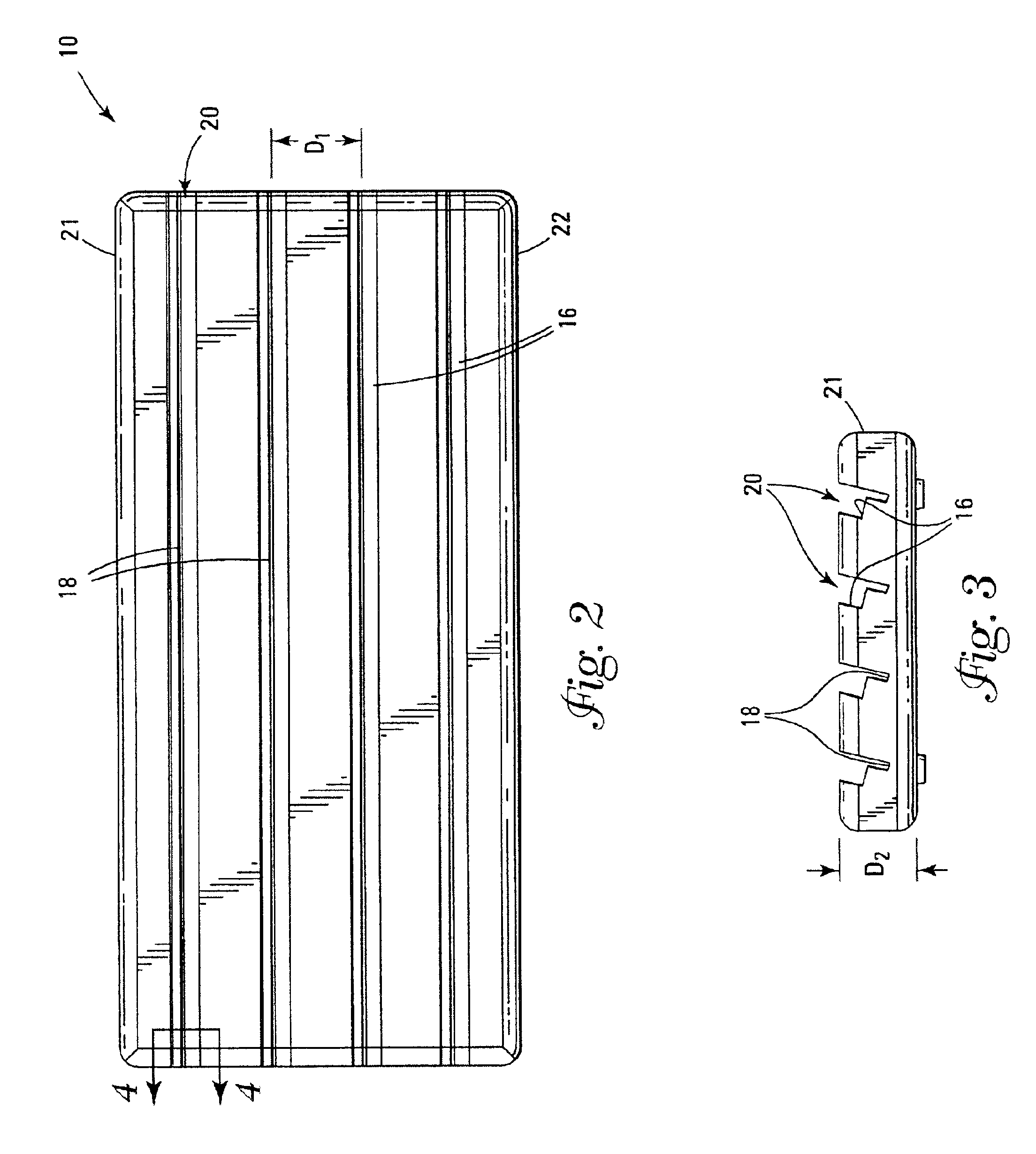
Below in Table 1 are dimensions in inches for the particular distances described in reference to FIGS. 2 and 4 for a game board that is adapted to accommodate playing cards and dominos:


 Login to View More
  Login to View More