
Apparatus for controlling the drying of previously baked goods
a technology for controlling the drying and baking of previously baked goods, which is applied in the direction of lighting and heating apparatus, ovens, furnaces, etc., can solve the problems of significant or even complete loss of moisture from previously baked products, the equilibration of moisture in baked products, and the product becomes hard, so as to prevent overheating
- Summary
- Abstract
- Description
- Claims
- Application Information
AI Technical Summary
Benefits of technology
Problems solved by technology
Method used
Image

Examples
example 1
A Prior Art Thaw and Serve Cookie
[0090]Cookies having a 4 inch diameter were previously baked and frozen. These cookies were thawed under ambient conditions and the moisture content measured over time at the outer zone, central zone, and an intermediate zone therebetween.
[0091]
Moisture Content (%)Edge ZoneIntermediate ZoneCentral ZoneAfter 1 hour5.8%6.9%8.5%After 3 hours5.8%8.1%8.4%After 6 hours5.4% 7%8.1%
As demonstrated, the cookies according to the prior art have an insufficient drying, or moisture loss, from the outer zone. Thus, cookies merely thawed and served after having equilibrated with ambient conditions do not have the most desired moisture profile.
example 2
A Prior Art Apparatus Using a Wire Rack
[0092]Cookies having a 4 inch diameter were previously baked and frozen. These cookies were placed on an open wire rack in a conventional apparatus used to warm and display cookies. The wire rack had approximately a 78 percent open area between wires. The moisture content of the cookies was measured over time at the outer zone, central zone, and an intermediate zone therebetween, using the same zones as for Example 1.
[0093]
Moisture Content (%)Edge ZoneIntermediate ZoneCentral ZoneAfter 1 hour4.2%6.7%8.6%After 3 hours4.2%5.7%7.6%After 6 hours 2%4.5% 7%
As demonstrated, frozen cookies warmed by a prior art apparatus have too much drying, or moisture loss, from the central zone. The outer zone has lost a significant, but acceptable, amount of moisture over 6 hours. Thus, cookies warmed in a device that does not sufficiently contact and protect the previously baked products being warmed did not have a desired moisture profile.
example 3
A Cookie Prepared According to a First Embodiment of the Invention
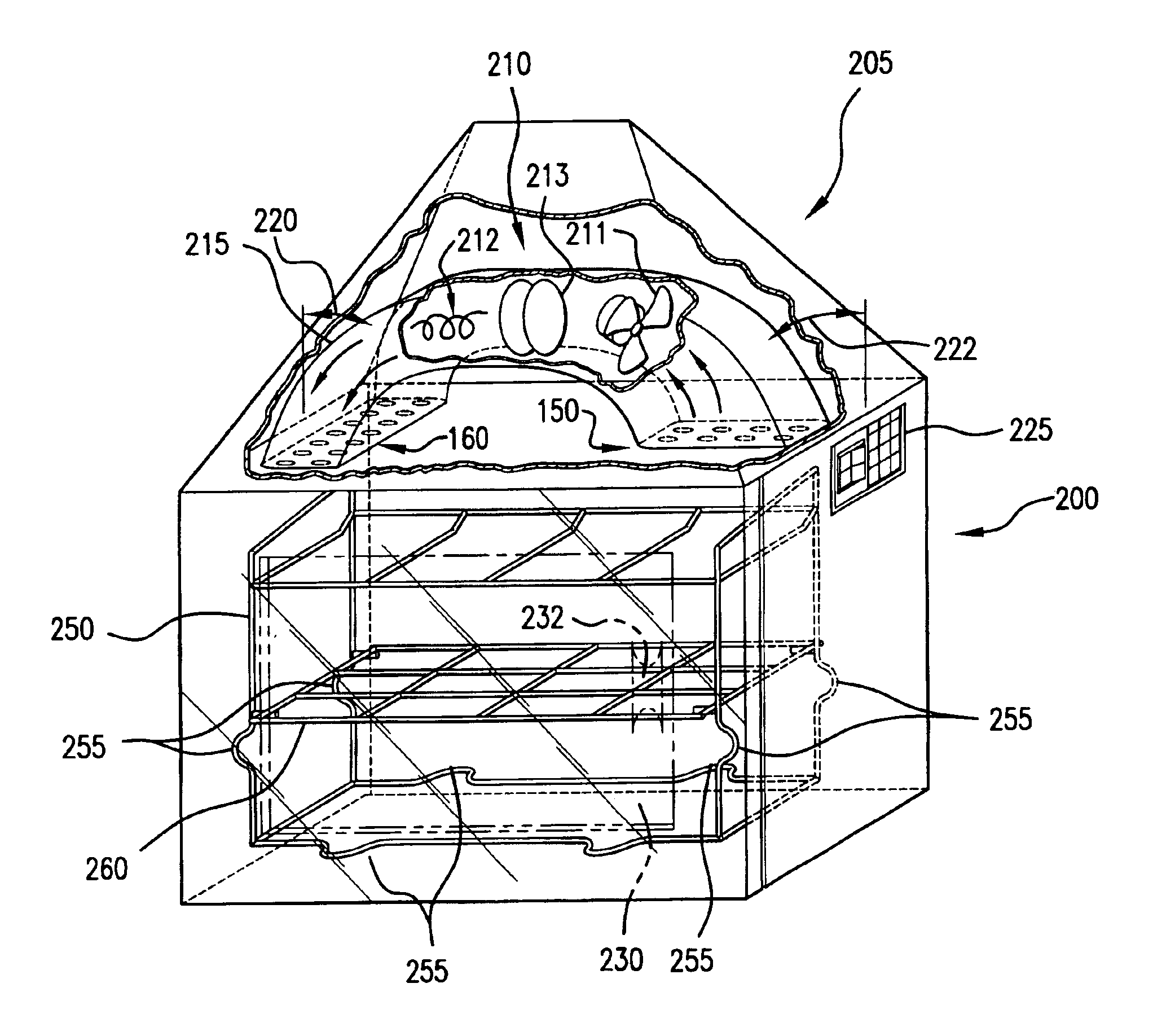
[0094]Cookies having a 4 inch diameter were previously baked and frozen. These cookies were placed on a solid tray in an apparatus according to the invention used to warm and display the cookies. The solid tray had 0 percent open area and the apparatus employed a resistance heating element (e.g., Calrod) for heating with no direct line of sight to the cookies. Thus, the apparatus employed a fan to provide indirect heating by blowing the air warmed by the lamps over and about the cookies. The moisture content of the cookies was measured over time at the outer zone, central zone, and an intermediate zone therebetween, using the same definitions of these zones as for Example 1.
[0095]
Moisture Content (%)Edge ZoneIntermediate ZoneCentral ZoneAfter 1 hour 5%6.8%8.5%After 3 hours3.5% 6%8.5%After 6 hours2.6% 5%8.3%
Using the inventive apparatus provided a desired moisture profile in the baked products even up to 6 hours. Th...
PUM
 Login to View More
 Abstract
Description
Claims
Application Information
 Login to View More