Method and apparatus for recovering load/unload zone real estate on data storage media in data storage devices to increase a data storage capacity thereof

a data storage device and load/unload zone technology, applied in the field of disk storage space improvement, can solve the problems of reducing the overall storage capacity of the drive by 5 to 15%, potentially risking media damage from slider-disk contact, etc., to increase the efficiency and storage capacity of the hard disk drive, reduce the problem of disk damage during l/ul, and reduce the effect of disk damage from l/ul

US6937419B2Inactive Publication Date: 2005-08-30WESTERN DIGITAL TECH INC
17 Cites 20 Cited by

Patent Information

Authority / Receiving Office
US · United States
Patent Type
Patents(United States)
Current Assignee / Owner
Publication Date
2005-08-30
Estimated Expiration
Not applicable · inactive patent

Smart Images

  • Figure 1
    Figure 1
  • Figure 2
    Figure 2
  • Figure 3
    Figure 3
Patent Text Reader

Abstract

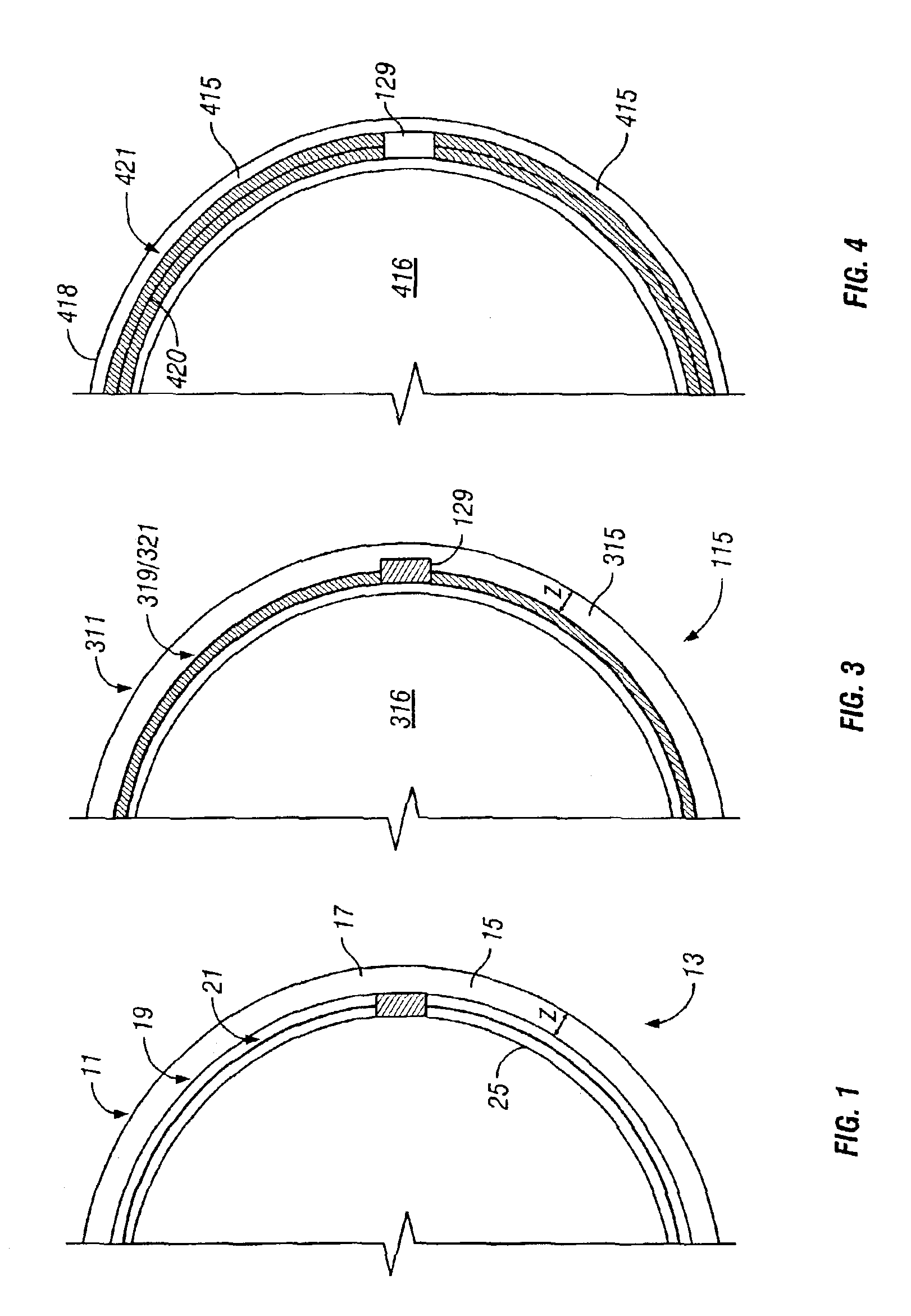
A hard disk drive utilizes hard disks that recover the historically unused read / write space or real estate located in the load / unload zone. Approximately one-half of the load / unload zone is recovered and available for reading and writing operations by forming a first or radially outermost read / write track beginning immediately adjacent to the inner radial edge of the load / unload zone and proceeding radially inward from there to the conventional location of first tracks in the prior art. In another version of the invention, almost the entire load / unload zone is recovered and available for reading and writing operations by aligning the first track with the center of the load / unload zone and proceeding radially inward from there as described above. Both of these versions make significant additional surface area on the disk available where, in the prior art, no data was stored, thereby increasing the efficiency and storage capacity of the hard disk drive.
Need to check novelty before this filing date? Find Prior Art

Description

BACKGROUND OF THE INVENTION

[0001] 1. Technical Field

[0002] The present invention relates in general to improved utilization of disk storage space in a hard disk drive and, in particular, to an improved method and apparatus for recovering previously unutilized load / unload zone real estate on the disks of hard disk drives.

[0003] 2. Description of the Related Art

[0004] Generally, a data access and storage system consists of one or more storage devices that store data on magnetic or optical storage media. For example, a magnetic storage device is known as a direct access storage device (DASD) or a hard disk drive (HDD) and includes one or more disks and a disk controller to manage local operations concerning the disks. The hard disks themselves are usually made of aluminum alloy or a mixture of glass and ceramic, and are covered with a magnetic coating. Typically, one to six disks are stacked vertically on a common spindle that is turned by a disk drive motor at several thousand revolutions...

Examples

Embodiment Construction

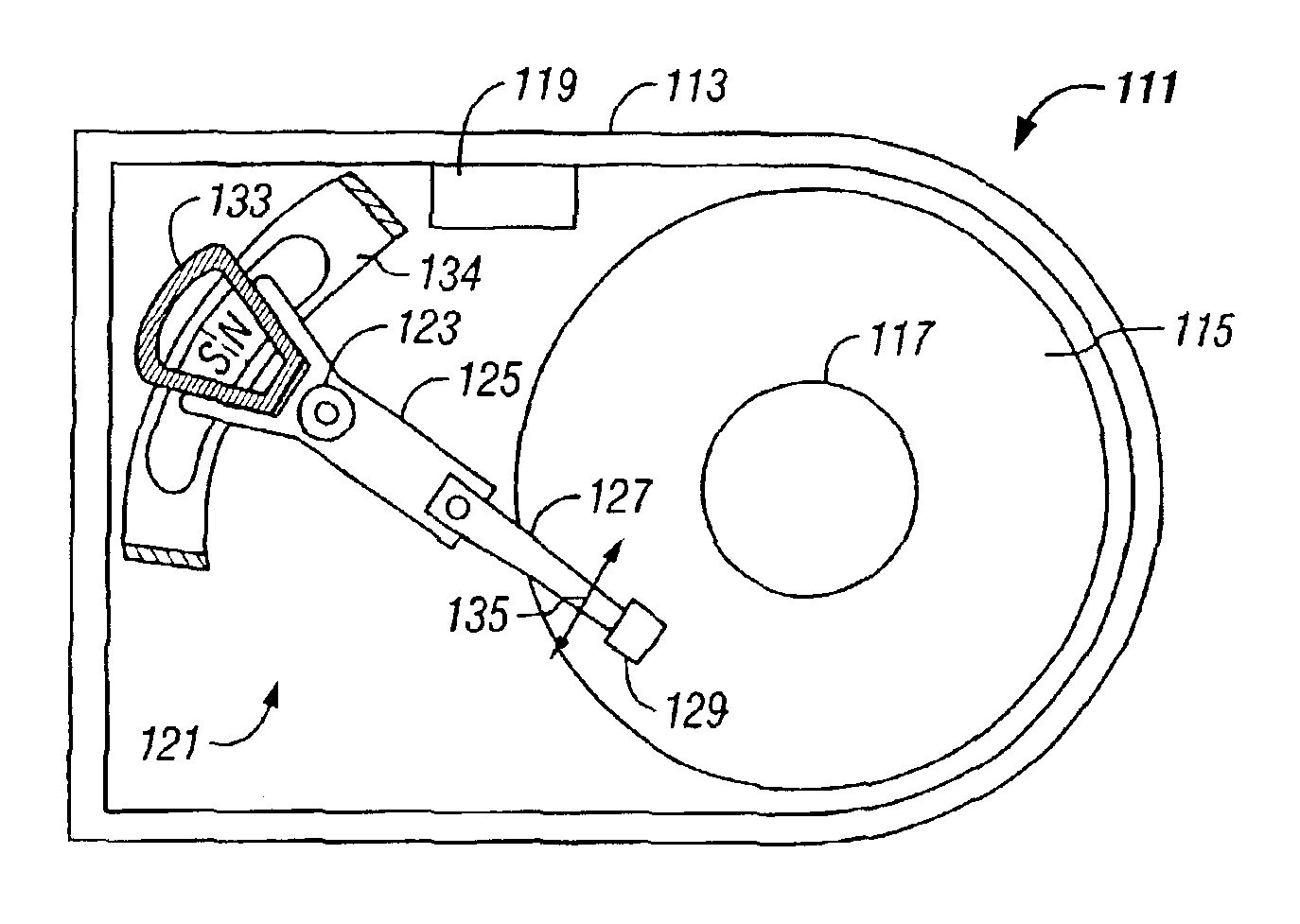
[0021]Referring to FIG. 2, a schematic drawing of one embodiment of an information storage system comprising a magnetic hard disk file or drive 111 for a computer system is shown. Drive 111 has an outer housing or base 113 containing a plurality of stacked, parallel magnetic disks 115 (one shown) which are closely spaced apart. Disks 115 are rotated by a spindle motor assembly having a central drive hub 117. An actuator 121 comprises a plurality of parallel actuator arms 125 (one shown) in the form of a comb that is pivotally mounted to base 113 about a pivot assembly 123. A controller 119 is also mounted to base 113 for selectively moving the comb of arms 125 relative to disks 115.

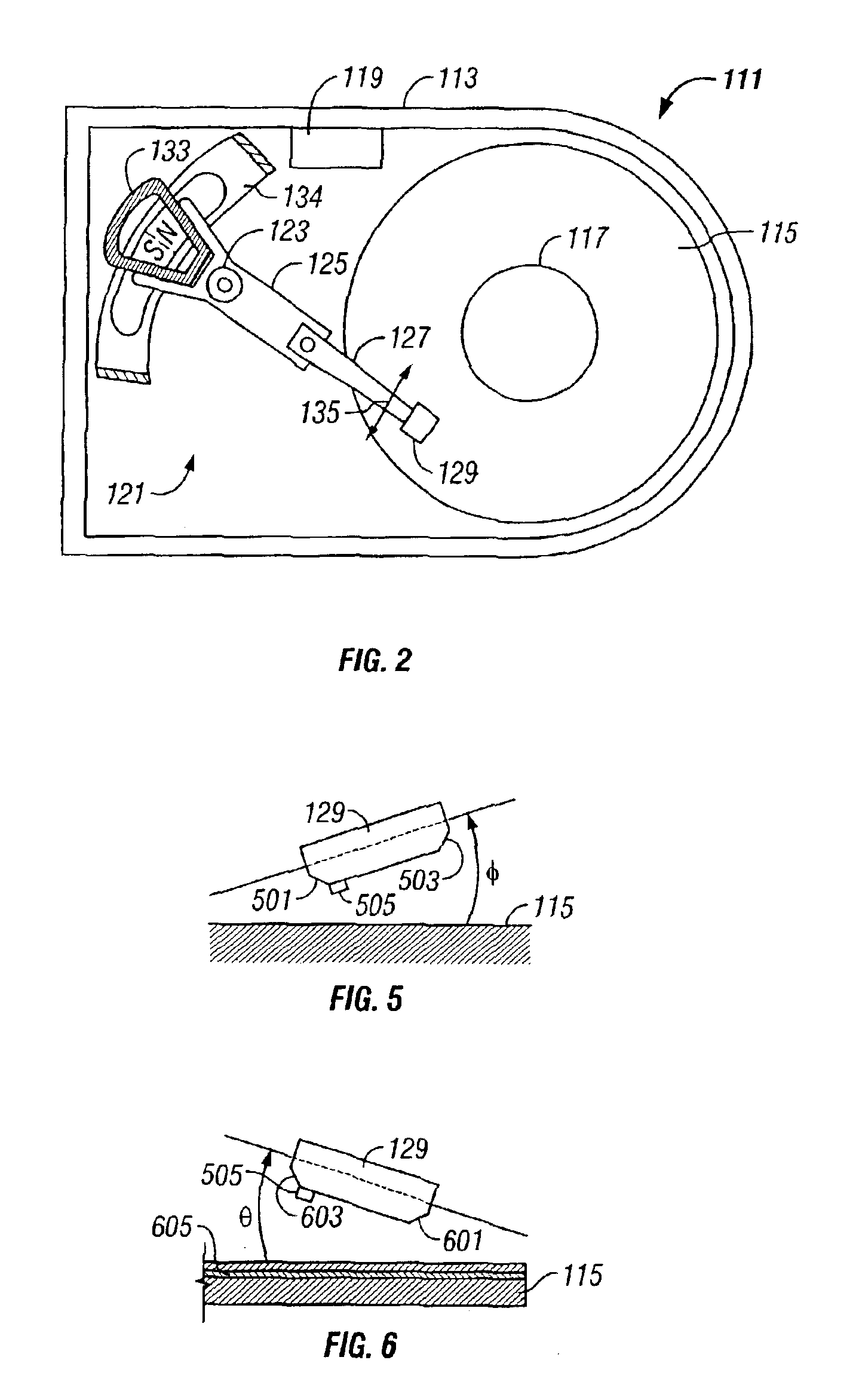
[0022]In the embodiment shown, each arm 125 has extending from it at least one cantilevered load beam or suspension 127. A magnetic read / write transducer or head is mounted on a slider 129 (shown schematically) and secured to a flexure that is flexibly mounted to each suspension 127. The read / write heads ...