Method and system for enhanced packet transmission in cellular networks

a packet transmission and cellular network technology, applied in the field of communication, can solve problems such as further optimization of usable radio resources

a packet transmission and cellular network technology, applied in the field of communication, can solve problems such as further optimization of usable radio resources

US7075911B2Inactive Publication Date: 2006-07-11LUCENT TECH INC

Image

Smart Image Click on the blue labels to locate them in the text.
Viewing Examples
Smart Image
  • Method and system for enhanced packet transmission in cellular networks
  • Method and system for enhanced packet transmission in cellular networks
  • Method and system for enhanced packet transmission in cellular networks

Examples

Experimental program
Comparison scheme
Effect test

Embodiment Construction

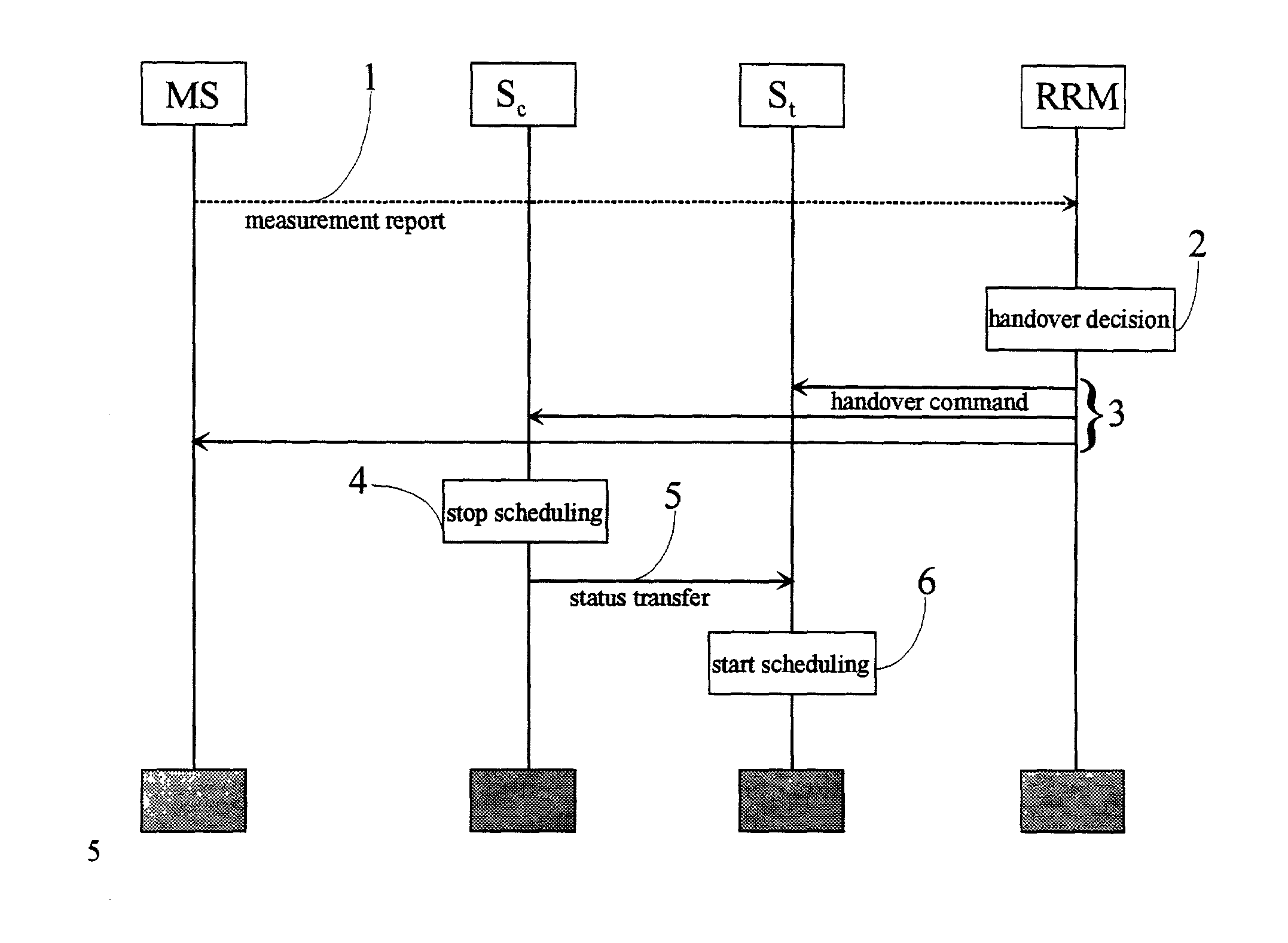
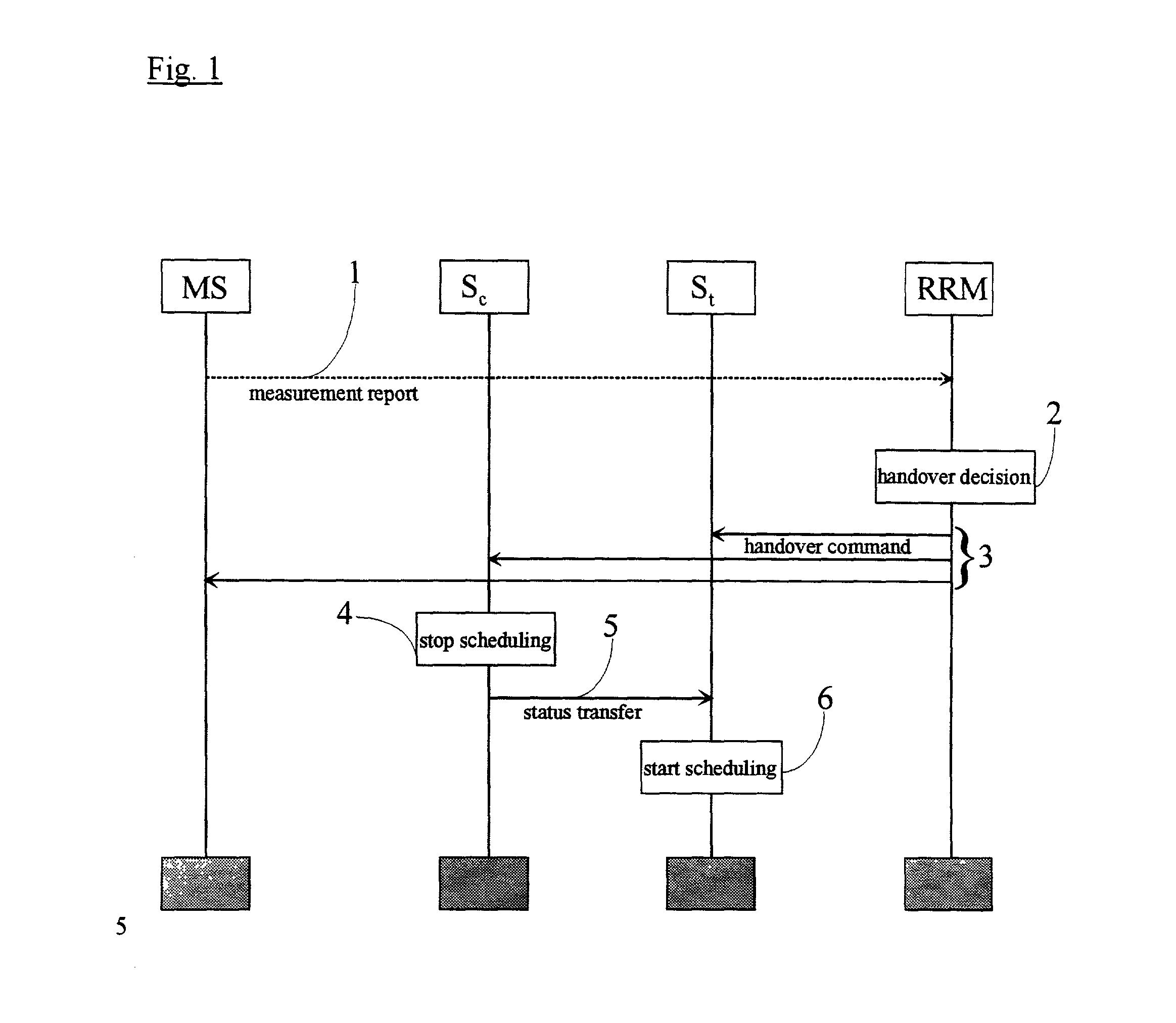
[0031]Referring next to FIG. 1 a main idea of coupling schedulers over cell boundaries for improving the mobility handling is shown. According to the example of FIG. 1, the coupling is achieved by an explicit transfer of status information about the data flow to be handed over from a current scheduler Sc towards the scheduler St of a new or target cell.

[0032]It has to be noted, that only the control signaling message data flows are depicted. For simplicity reasons, any eventually necessary acknowledgement (ACK) and / or negative acknowledgement (NACK) forming an important part of a signaling message transfer are neglected, since they are generally known by a person skilled in the art. In the following exemplar description, however, it is always assumed that acknowledgements (ACKs) and / or negative acknowledgements (NACKs) are properly handled by the system.

[0033]The example of an information update during a handover procedure, as shown in FIG. 1, incorporates one mobile station MS and ...

the structure of the environmentally friendly knitted fabric provided by the present invention; figure 2 Flow chart of the yarn wrapping machine for environmentally friendly knitted fabrics and storage devices; image 3 Is the parameter map of the yarn covering machine
Login to View More

PUM

No PUM Login to View More

Abstract

QoS scheduling is used for handling multiple data flows in packet switched cellular systems, especially in a packet switched mobile telecommunication system, wherein the scheduling mechanism of a specific cell is coupled with the scheduling mechanism of at least one second cell, in particular by transferring data between the specific cell and at least one second cell comprising a status information concerning data flow within the specific cell.

Description

CROSS-REFERENCE TO RELATED APPLICATIONS[0001]This application is related to copending commonly assigned U.S. patent application Ser. No. 10 / 002,570, which was filed on Nov. 1, 2001, and entitled “Method And System For UMTS Packet Transmission Scheduling On Shared Downlink Channels”.BACKGROUND OF THE INVENTION[0002]1. Field of the Invention[0003]The invention relates to communications; in particularly, packet transmission scheduling for cellular networks and to a packet transmission scheduling system having such efficient packet transmission scheduling functionality.[0004]2. Description of the Prior Art[0005]There are problems associated with mobility handling in packet switched networks having scheduling systems, especially in packet switched cellular mobile communication systems, and particularly Code Division Multiple Access systems (CDMA) like Universal Mobile Telecommunication Systems (UMTS) or Time Division Multiple Access systems (TDMA) like General Packet Radio Systems (GPRS)...

Claims

the structure of the environmentally friendly knitted fabric provided by the present invention; figure 2 Flow chart of the yarn wrapping machine for environmentally friendly knitted fabrics and storage devices; image 3 Is the parameter map of the yarn covering machine
Login to View More

Application Information

Patent Timeline
11 Jul 2006
Publication
US7075911B2
IPC
H04Q7/00; H04L12/28; H04L12/56; H04W28/14; H04W36/26; H04W72/12
CPC
H04W36/0055; H04W28/14; H04W92/20; H04W72/1278; H04W36/26; H04W72/20
Inventors
BERNHARD, URS PETER; GRUHL, STEFAN