[0022]The non-condensing gas discharge device of the present invention separates the non-condensing gas (such as air), remaining within the condenser, from the gaseous-phase working medium (such as vapor) and thus selectively discharges only the separated non-condensing gas from the condenser. Thus, the non-condensing gas discharge device allows the gaseous-phase portion to be filled with the vapor and thereby allows a high condensing efficiency of the condenser to be maintained and even enhanced effectively utilizing the heat transmission area of the heat transmission portion. Namely, by means of the valve device, the non-condensing gas discharge device of the present invention can selectively discharge, on a timely basis, only the non-condensing gas (such as air) in separated relation from the gaseous-phase working medium (such as vapor), thereby allowing the high condensing efficiency to be maintained with good response.
[0023]Preferably, the valve device in the present invention is shifted to its opened position (i.e., valve-opening position) at a temperature lower than the boiling temperature of the liquid-phase working medium (such as water), so as to discharge the non-condensing gas of a temperature lower than the boiling temperature. Thus, only the non-condensing gas can be discharged via the valve device, without the gaseous-phase working medium (vapor), higher in temperature than the boiling temperature of the liquid-phase working medium (water), being discharged via the valve device. Further, if, for example, the valve device is set at a low valve-opening temperature with a predetermined difference from a saturated vapor temperature, the present invention can selectively discharge only the non-condensing gas from the condenser, without discharging the vapor, while effectively preventing the non-condensing gas from accumulating within the condenser.
[0024]Further, preferably, the condenser includes a plurality of condensing pipes and an intermediate chamber communicating with the plurality of condensing pipes, and the valve device is operatively connected with (or provided in correspondence with) the intermediate chamber. This inventive arrangement can minimize the number of the valve device to be used and permits shared use of the valve device among the plurality of condensing pipes, with the result that the present invention can effectively prevent the non-condensing gas from staying and accumulating non-uniformly across the condenser and can thereby discharge the non-condensing gas in a stabilized manner.
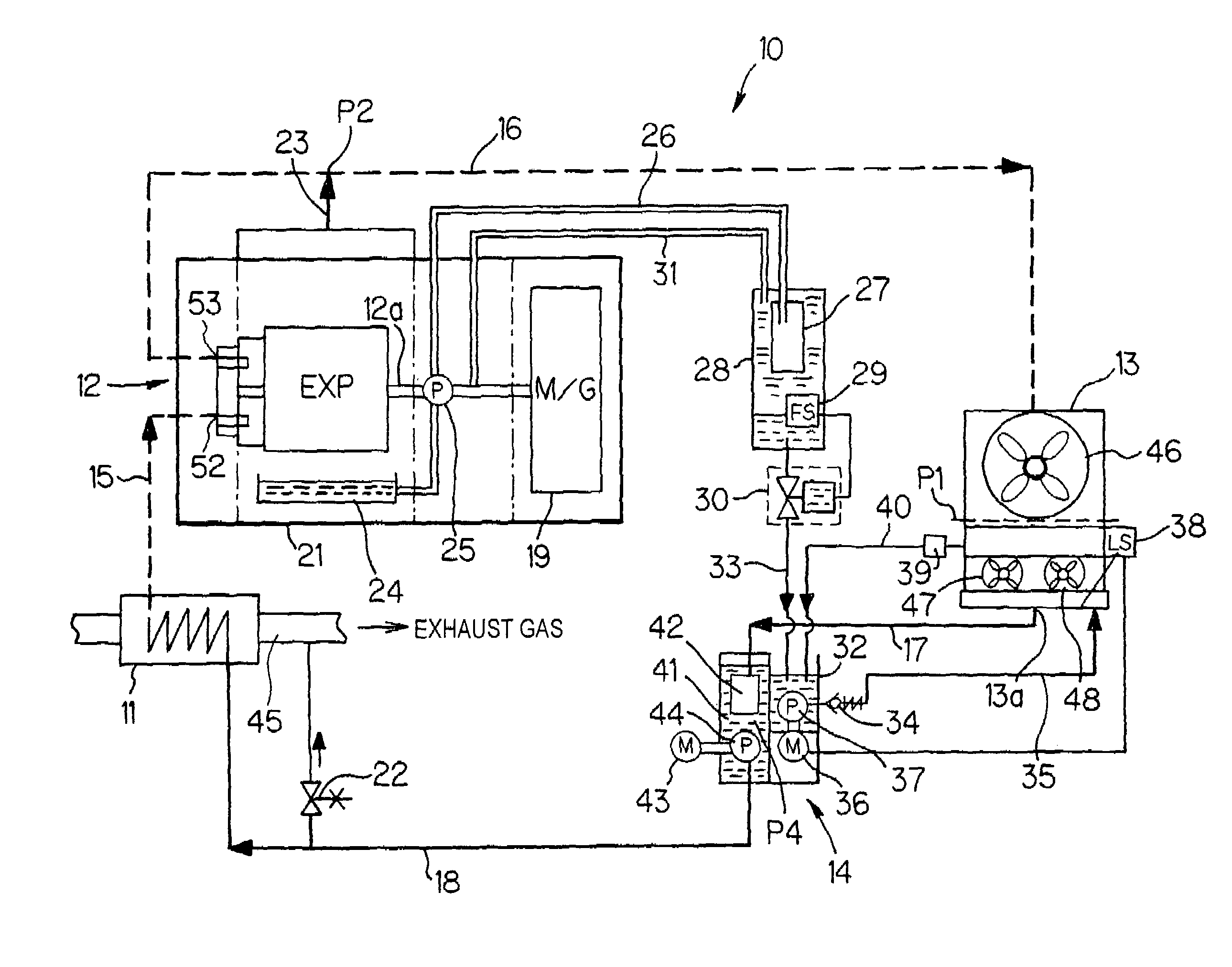
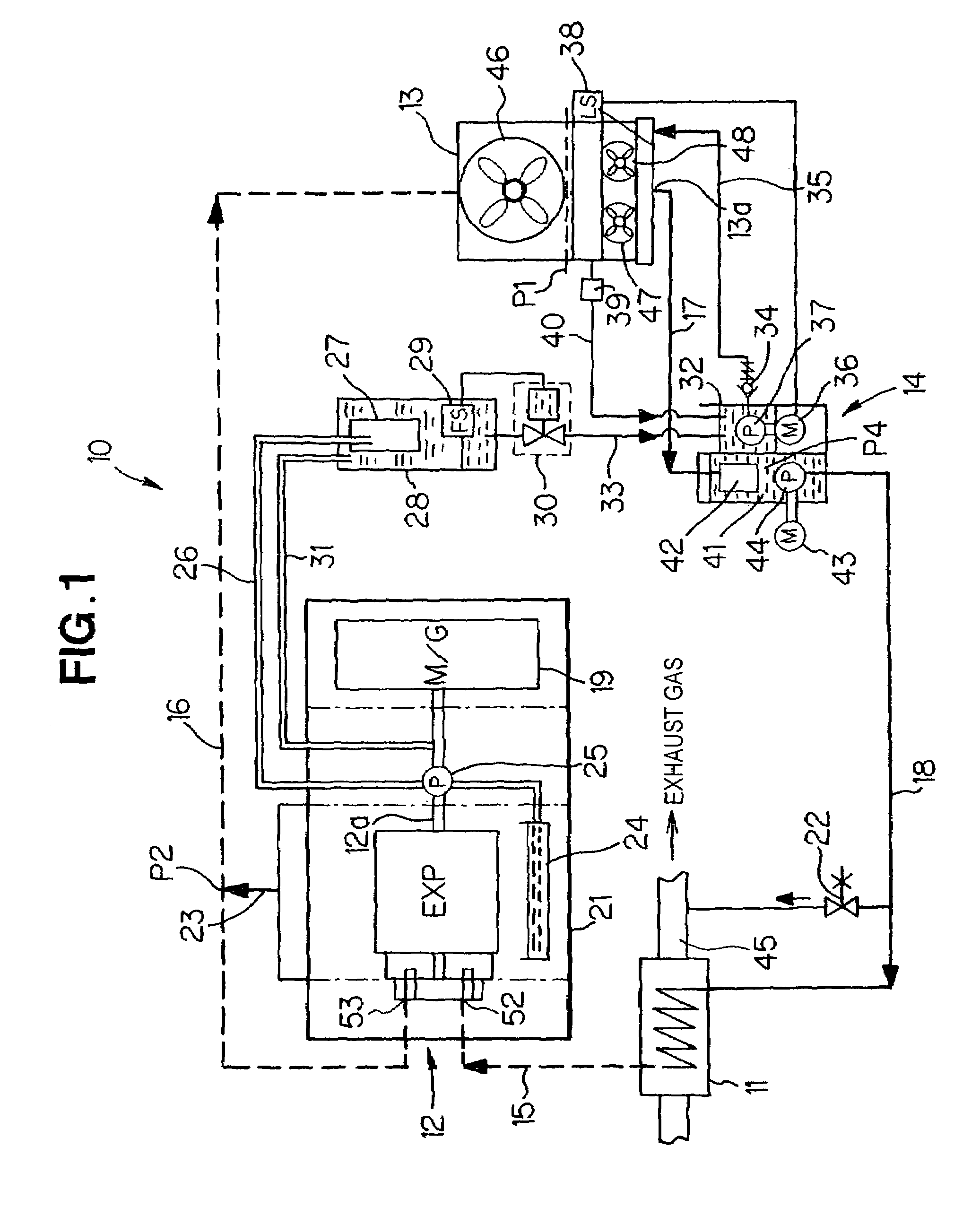
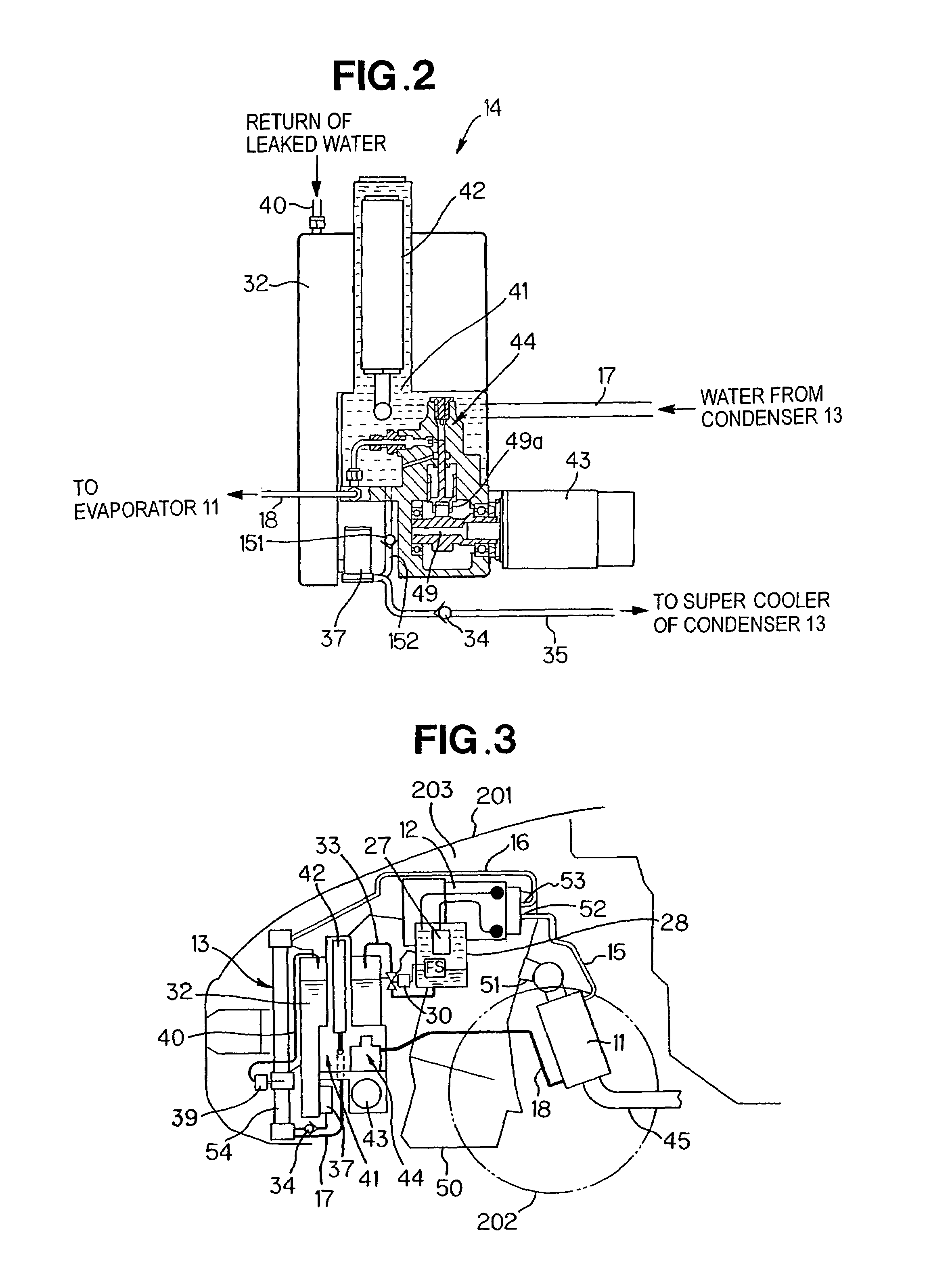
[0027]Further, preferably, the valve device in the present invention has an outlet for discharging the water, and the liquid level of the water lies below the outlet. The valve device is constantly operatively connected with the gaseous-phase portion lying immediately above and close to the liquid level and set to operate at any time, so that it can be brought to its opened position on a timely basis and thereby allows the condenser to keep up its high condensing efficiency.
[0029]As set forth above, the present invention is characterized by separating, from the vapor, the non-condensing gas that impedes condensation of the vapor and discharging only the thus-separated non-condensing gas from the condenser, to thereby allow the gaseous-phase portion of the condenser to be filled with the vapor; thus, the condenser can maintain its high condensing efficiency and even enhance the condensing efficiency. The non-condensing gas having a higher density than the gaseous-phase working medium (vapor) would stay and accumulate in the lower area of the gaseous-phase portion of the condenser near the liquid level due to the flow of the gaseous-phase working medium (vapor) and action of gravity. However, in the present invention, the valve device, which is brought to its opened position to selectively discharge only the non-condensing gas at a temperature lower than the boiling temperature of the liquid-phase working medium (e.g., temperature lower than the temperature of saturated vapor), is operatively connected with the lower area of the gaseous-phase portion. In this way, the present invention allows the condenser to maintain its high condensing efficiency with good response while effectively preventing undesired discharge of the gaseous-phase working medium (vapor) from the condenser.


 Login to View More