

Transparent and high-heat polycarbonate-polysiloxane copolymers and transparent blends with polycarbonate and a process for preparing same
Image

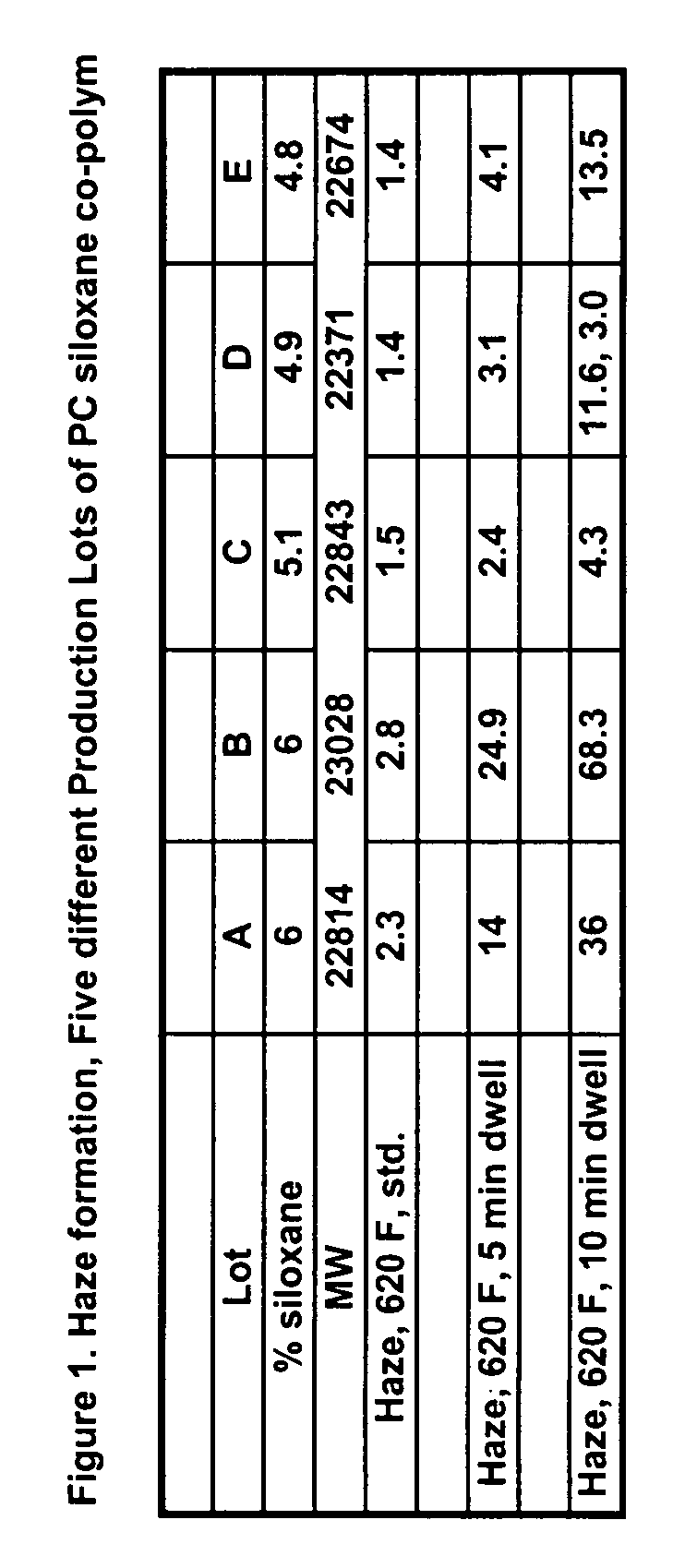
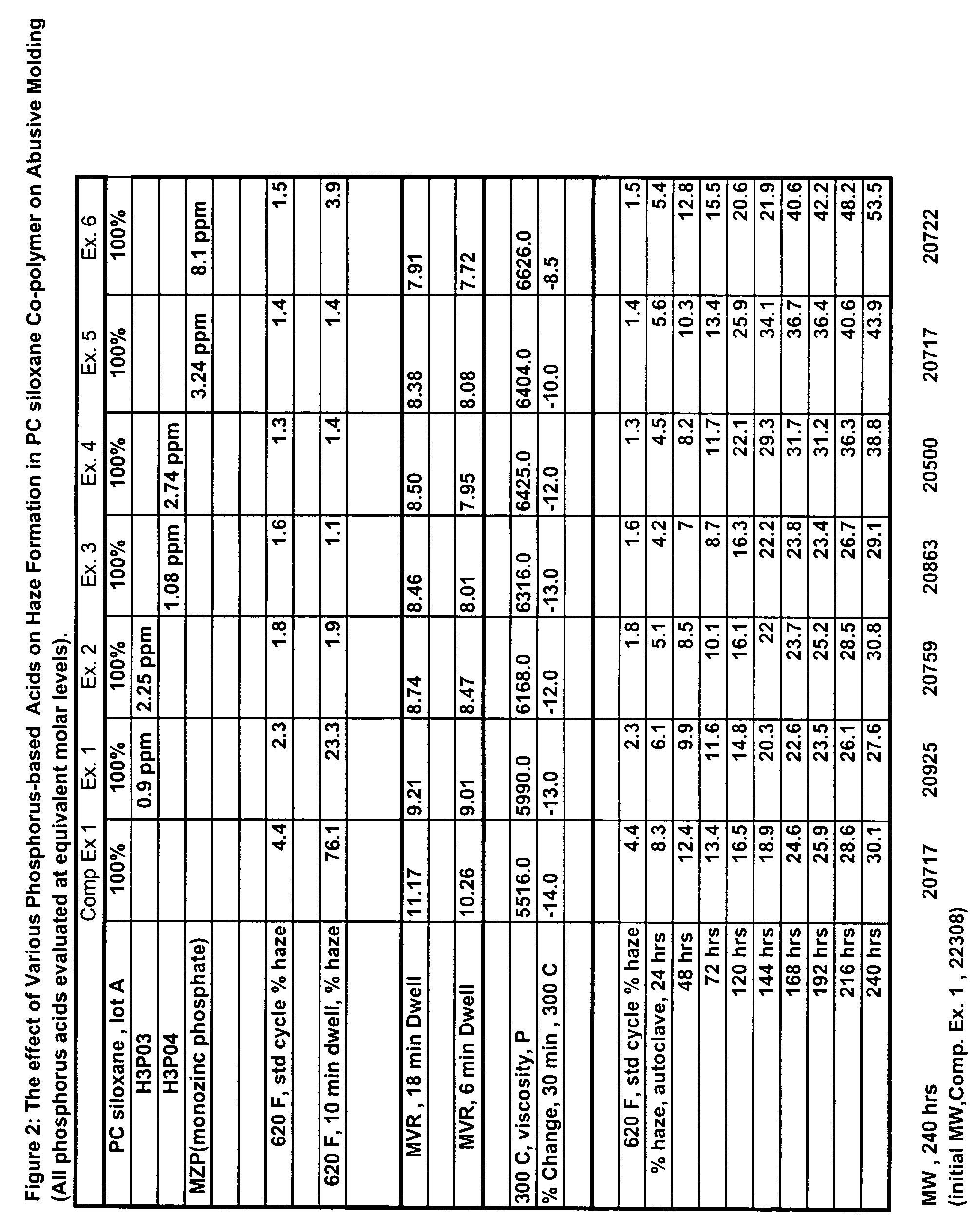
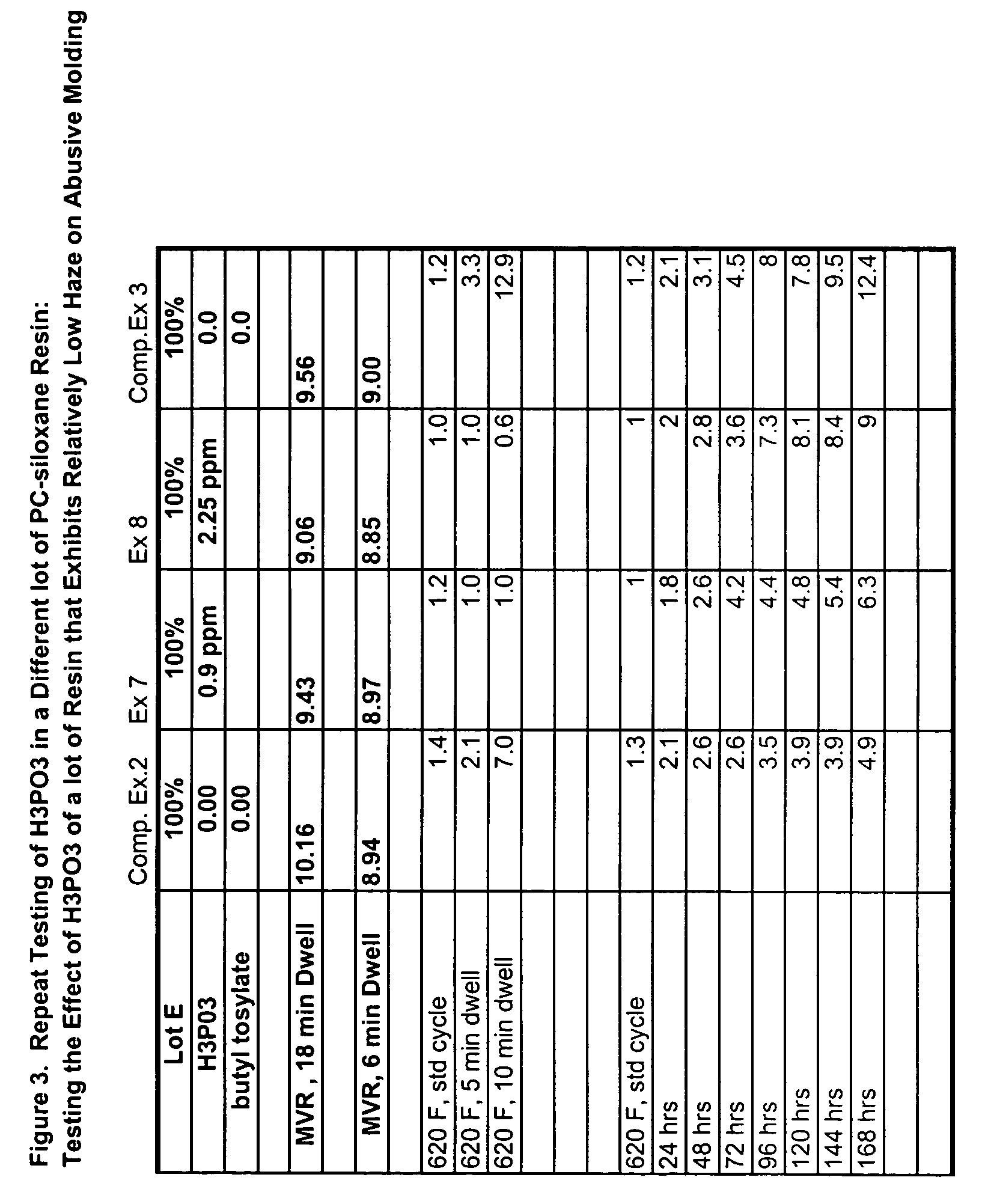
Examples
example 1
BPA / D-50 Eugenolsiloxane Copolycarbonate (BCF-PTC Method—Using Pre-formed BCF)
[0088]A 30 L phosgenator was charged with 0.33 M BPA-bischlorformate (about n=6) solution (2 L, 660 mmol), methylene chloride (5 L), distilled water (7 L) and MTBA (20 g of a 75 wt % solution in water) and D-50 eugenolsiloxane (90 g, 22 mmol). The pH was adjusted to 10.5 with 50 wt % NaOH, and the reaction mixture was stirred for 10 minutes. BPA (1254 g, 5500 mmol) was added, and the reaction mixture was stirred until the chloroformates were gone. Then p-cumylphenol (85 g, 401 mmol, 5.5 mol %) and triethylamine (15 mL, 1.5 mol %)) were added. Phosgene (681 g, 6879 mmol) was added at pH 10.5. Methylene chloride (4 L) was added. The polymer solution was separated from the brine and washed two times with 1N HCl and three times with distilled water. The polymer solution was anti-solvent (methanol) precipitated in a Henchel blender, and dried overnight at 110° C. under vacuum. The polymer, analyzed by 1H NMR, s...
example 2
BPA / D-50 Eugenolsiloxane Copolycarbonate (5% D-50 Copolymer)
[0089]A 150 L stirred-reactor was charged with 15 L of methylene chloride, 15 L of de-ionized (DI) water, 1585 g (6.94 mol) of BPA, and 100 ml of MTBA. The mixture was phosgenated at a rate of between 40 and 140 g / min until 1050 g of phosgene was delivered. (The delivered amount was determined by a totalizer connected to a mass flowmeter). The phosgenation target rate was 140 g / min; however, it was necessary to deviate from this rate due to heavy foaming in the reactor. The pH was held between 6 and 7 by the continuous addition of sodium hydroxide (50 wt % ). Once the addition of phosgene was complete, the reactor was sparged with nitrogen to remove excess phosgene. A reactor sample was then taken, tested for phosgene using phosgene paper, and analyzed for chloroformate. The chloroformate concentration was found to be 0.24 moles / liter. A charge of eugenol capped siloxane 450 g (0.11 mol) dissolved in 1 liter of methylene ch...
example 3
BPA / D-50 Eugenolsiloxane Copolycarbonate (7% D-50 Copolymer)
[0090]A 150 L stirred-reactor was charged with 15 L of methylene chloride, 15 L of DI water, 5000 g (21.9 mol) of BPA, and 100 ml of MTBA. The mixture was phosgenated at a rate between 40 and 140 g / min until 3360 g of phosgene was delivered. (The delivered amount was determined by a totalizer connected to a mass flowmeter). The phosgenation target rate was 140 g / min; however, it was necessary to deviate from this rate due to heavy foaming in the reactor. The pH was held between 6 and 7 by the continuous addition of sodium hydroxide (50 wt % ). Once the addition of phosgene was complete the reactor was sparged with nitrogen to remove excess phosgene. A reactor sample was then taken, tested for phosgene using phosgene paper, and analyzed for chloroformate. The chloroformate concentration was found to be 0.39 moles / liter. A charge of eugenol capped siloxane 906 g (0.23 mol) dissolved in 1 liter of methylene chloride was then a...
PUM
| Property | Measurement | Unit |
|---|---|---|
| haze | aaaaa | aaaaa |
| Tg | aaaaa | aaaaa |
| mol % | aaaaa | aaaaa |
Abstract
Description
Claims
Application Information
- IPC
- C08F20/00; C08G; C08G64/16; C08G64/18; C08G64/20; C08G64/24; C08G77/04; C08G77/448; C08L69/00; C08L83/00; C08L83/10
- CPC
- C08G64/186; C08G64/24; C08G77/448; C08L69/00; C08L83/10; C08L2666/02; C08L2666/18; C08G64/20
- Inventors
- DERUDDER, JAMES LOUIS; ROSENQUIST, NILES RICHARD