
Binary decoders in electronic integrated circuits
- Summary
- Abstract
- Description
- Claims
- Application Information
AI Technical Summary
Benefits of technology
Problems solved by technology
Method used
Image

Examples
Embodiment Construction
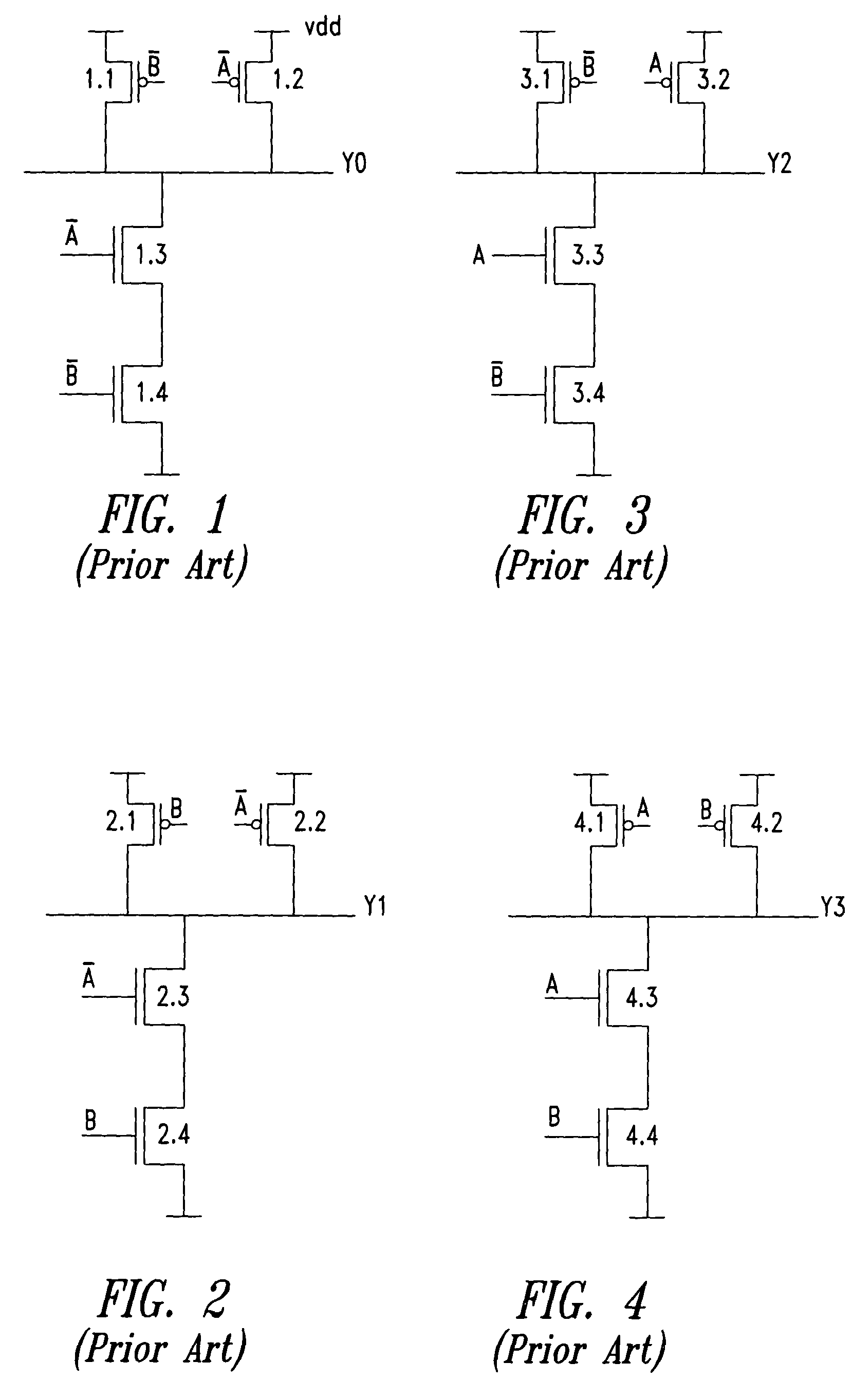
[0021]FIG. 1 shows one circuit of a conventional 2-to-4 decoder, corresponding to a single combination of the inputs= AB or AB. The output Y0 is set to active low whenever this combination is true, i.e., when A=0 and B=0, transistors 1.3 and 1.4 conduct and pull output Y0 to 0. For any other condition Y0 is set to HIGH.
[0022]FIG. 2 shows another circuit of a conventional 2-to-4 decoder, corresponding to another single combination of the inputs=ĀB. The output Y1 is set to active low whenever this combination is true, i.e., when A=0 and B=1, transistors 2.3 and 2.4 conduct and pull Y1 to 0. In any other condition Y1 is set to HIGH.
[0023]FIG. 3 shows another circuit of a conventional 2-to-4 decoder, corresponding to the combination of the inputs=A B, The output Y2 is set to active low whenever this combination is true, i.e., when inputs A=1 and B=0, transistors 3.3 and 3.4 conduct and pull Y2 to 0. In any other condition Y2 is set to HIGH.
[0024]FIG. 4 shows another circuit of a convent...
PUM
 Login to View More
 Abstract
Description
Claims
Application Information
 Login to View More