
Polymeric alkylpolyglycoside carboxylates
a polyglycoside and polymer technology, applied in the field of polymer carboxylated alkyl polyglycosides, can solve the problem of monomerization of molecules
- Summary
- Abstract
- Description
- Claims
- Application Information
AI Technical Summary
Problems solved by technology
Method used
Image

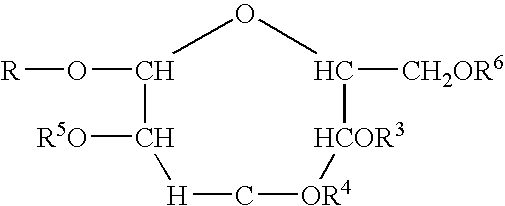
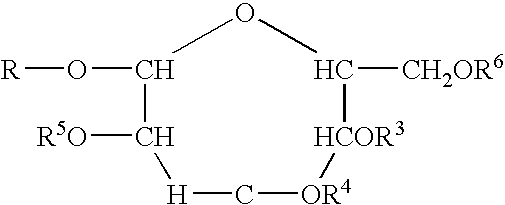
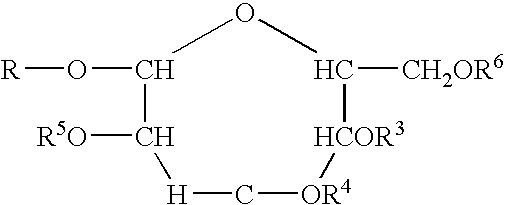
Examples
example 11 1 , 3
Example 11 1,3 dichloro2-propanol
[0057]This material is an item of commerce and conforms to the following structure:
Cl—CH2—CH(OH)CH2—Cl
example 2-9
[0058]The raw material compounds used in the present invention are described U.S. Pat. No. 5,908,928. The raw material for the preparation of the carboxylates which is in turn a raw material for the polymeric compounds of the present invention are commercially available from Cognis. The commercial names are given merely for reference. The compositions were verified by analytical technology including wet methods (hydroxyl value, and C-13 nmr).
example 2 preparation
of the APG Carboxylate
[0059]A mixture of 650 grams (one mole) of a C 12-16 alkyl polyglycoside (commercially available from Cognis as GLUCOPON. 625) having an average degree of polymerization of 1.4 and 700 ml of toluene were heated in order to azeotropically distill any water present in the alkyl polyglycoside, using a Dean Stark trap. The temperature of the mixture rose from 85° C. to 110° C. The distillation required about 4 hours. The dry alkyl polyglycoside was clearly soluble in the toluene at room temperature. To this mixture, 485 grams (one mole) of ethanolic sodium hydroxide was added, with agitation. When the addition was complete, the reaction mixture was heated to about 60° C. for about 1 hour, at which time 116.5 grams (one mole) of sodium monochloroacetate was added, with stirring, and was refluxed for about 5 hours. Water was then added in 200 ml increments while distilling, in 200 ml increments, the ternary azeotrope (toluene / ethanol / water) until the pot temperature ...
PUM
| Property | Measurement | Unit |
|---|---|---|
| Percent by mass | aaaaa | aaaaa |
| Fraction | aaaaa | aaaaa |
| Concentration | aaaaa | aaaaa |
Abstract
Description
Claims
Application Information
 Login to View More