
Simplified night sky display system
a night sky display and simplified technology, applied in the field of planes, can solve the problems of unmatched detail in the night sky display, increasing and increasing the complexity of assembling and operating planes
- Summary
- Abstract
- Description
- Claims
- Application Information
AI Technical Summary
Benefits of technology
Problems solved by technology
Method used
Image

Examples
Embodiment Construction
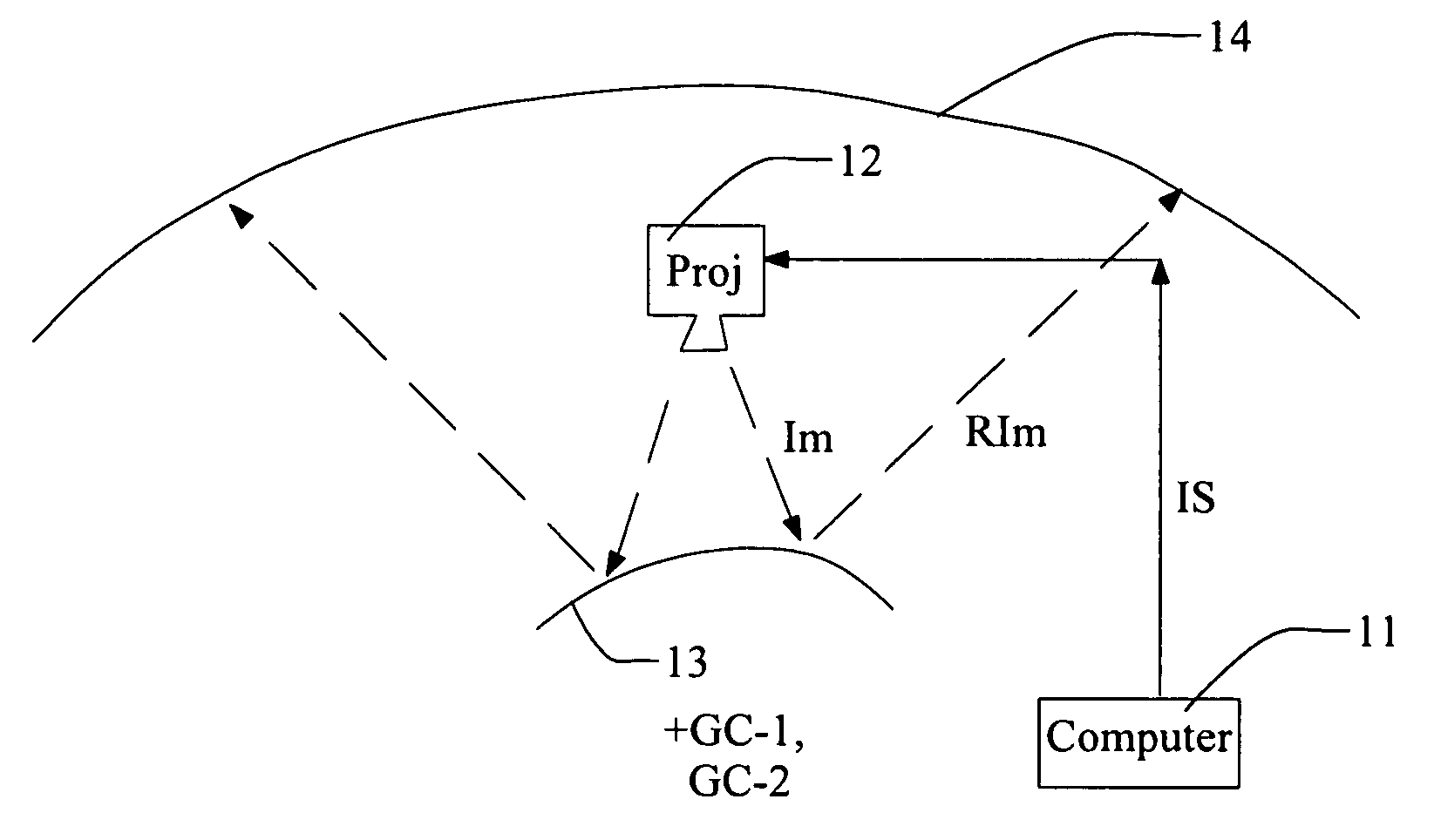
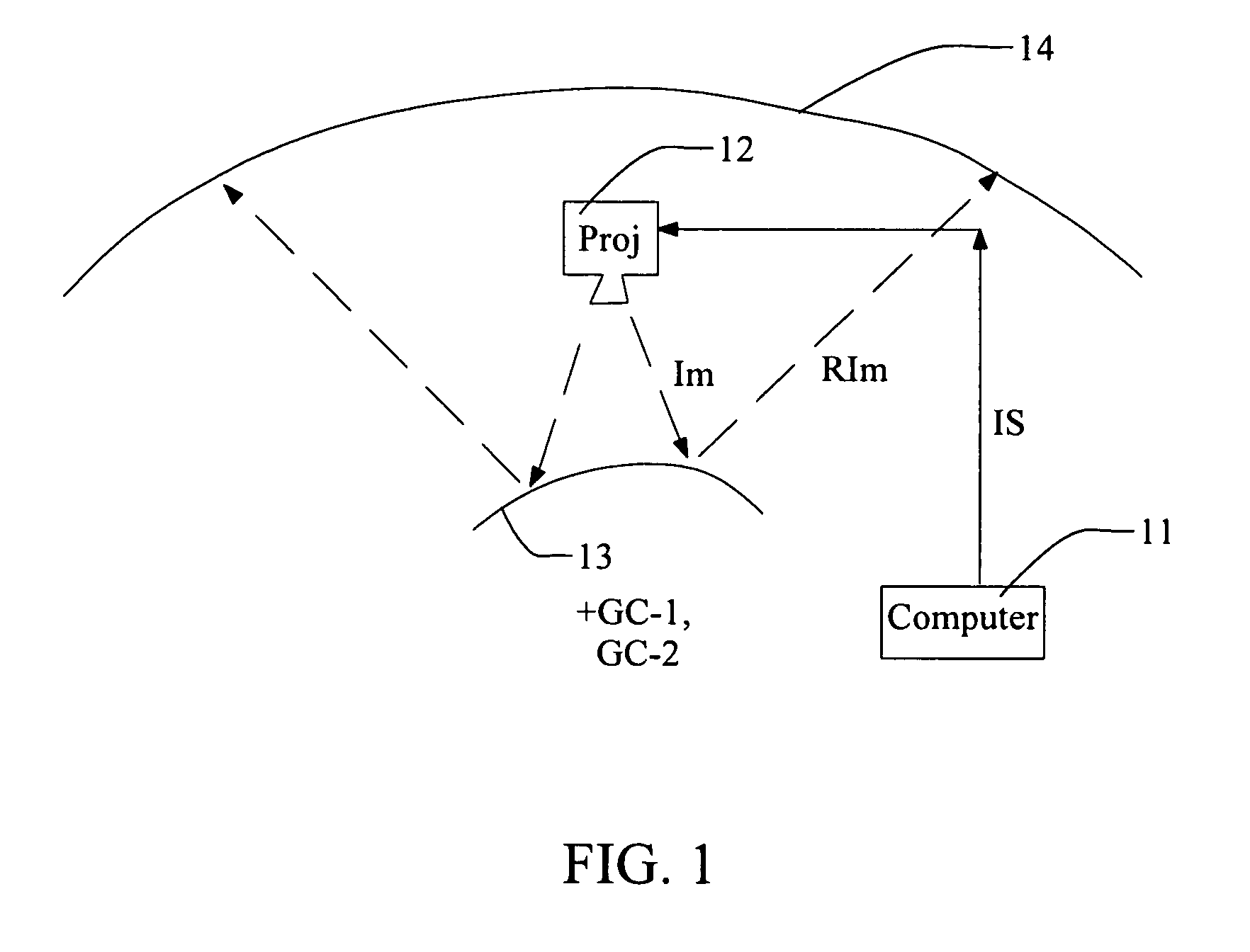
[0012]FIG. 1 schematically illustrates an embodiment of the inventive display structure 10, which includes: (i) a computer II having a permanent or temporary memory containing at least one image signal IS representing one or more images of a portion of a “night sky” (defined to be a contiguous portion of a celestial sphere that is viewable from a selected position in space, including but not limited to a position on the Earth, at a selected time that may but need not correspond to “nighttime” at that selected position); (ii) a projector 12 that receives the at least one signal IS from the computer 11 and forms and projects a visually perceptible image Im of the portion of the night sky; (iii) a substantially spherical light reflecting first surface 13, having a first surface geometric center GC-1 at a selected location, for receiving and reflecting at least a portion of the visually perceptible image Im from the projector 12 as a reflected image RIm; (iv) a substantially spherical l...
PUM
 Login to View More
 Abstract
Description
Claims
Application Information
 Login to View More