

Use of an organic matrix material for producing an organic semiconductor material, organic semiconductor material and electronic component
a technology of organic matrix material and organic semiconductor material, which is applied in the direction of discharge tube luminescnet screen, non-metal conductor, other chemical processes, etc., can solve problems such as inability to produce electronic components, and achieve the effect of high hole conductivity
- Summary
- Abstract
- Description
- Claims
- Application Information
AI Technical Summary
Benefits of technology
Problems solved by technology
Method used
Image

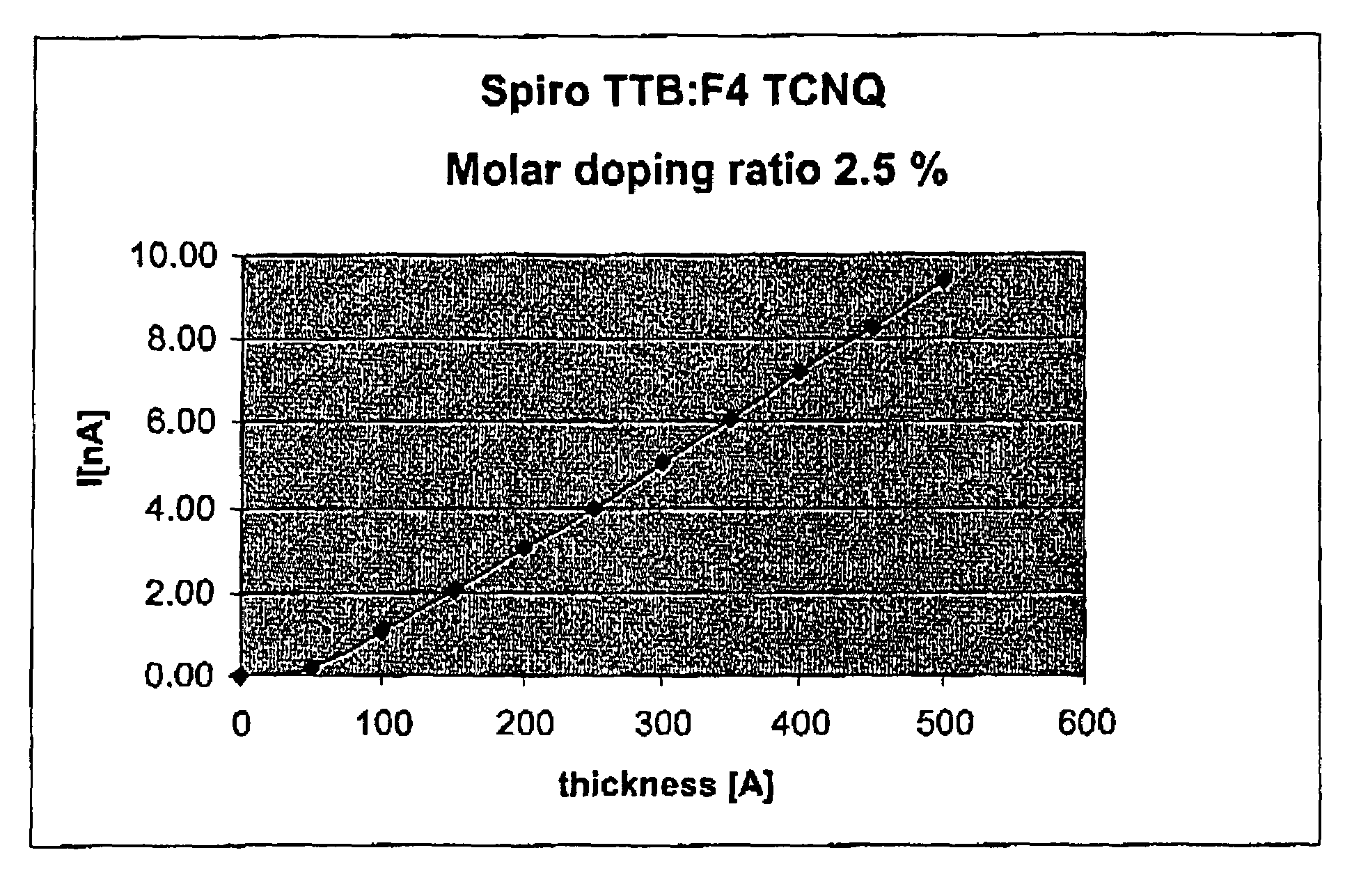
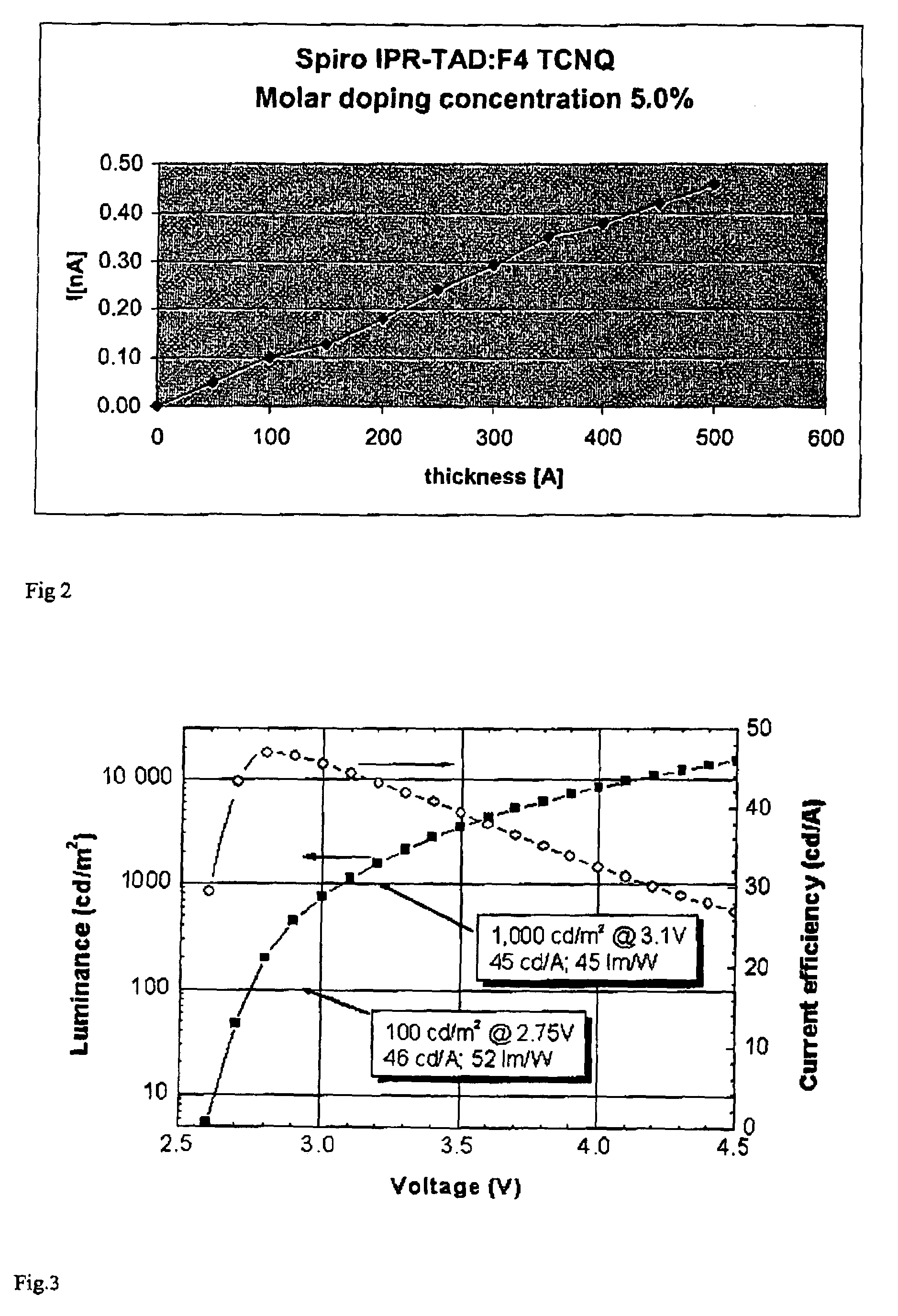
Examples
examples
A. Preparation of 2,2′,7,7′-tetrakis(N,N-di-p-methylphenylamino)-9,9′-spirobifluorene (spiro-TTB)
[0032]
[0033]2,2′,7,7′-Tetrabromo-9,9′-spirobifluorene (10 g, 15.8 mmol), di-p-tolylamine (14.2 g, 72.1 mmol) and sodium tert-butoxide (9.6 g, 100 mmol) are stirred in 100 ml of anhydrous toluene under nitrogen at 60° C. for 1 h. Subsequently, tri-tert-butylphosphine. (200 mg, 1.0 mmol, 6.3% based on tetrabromospirobifluorene) and palladium(II) acetate (92 mg, 0.4 mmol, 2.6% based on tetrabromospirobifluorene) are added and the reaction mixture is heated to reflux under nitrogen. The progress of the reaction is monitored by thin-layer chromatography (eluent: 50% hexane in dichloromethane). After 2.5 h, no reactant can any longer be detected in the TLC. The reaction mixture is cooled, admixed with a solution of 100 mg of KCN in 20 ml of water and stirred at 60° C. for another 1 h. After cooling to room temperature, the phases are separated, and the organic phase is dried over sodium sulpha...
PUM
| Property | Measurement | Unit |
|---|---|---|
| glass transition temperature | aaaaa | aaaaa |
| glass transition temperature | aaaaa | aaaaa |
| temperature | aaaaa | aaaaa |
Abstract
Description
Claims
Application Information
 Login to View More