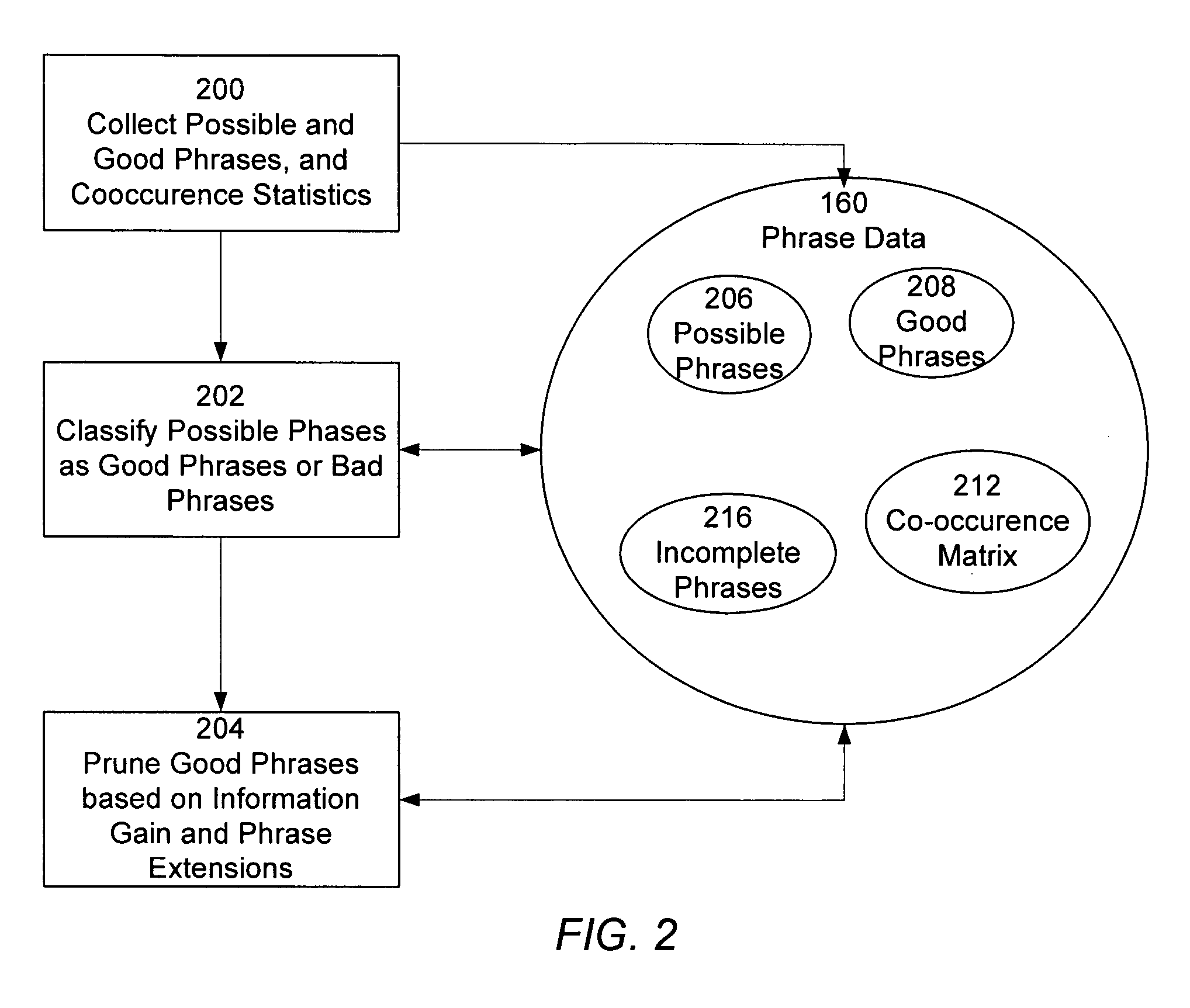
[0011]An information retrieval system and methodology uses phrases to index, search, rank, and describe documents in the document collection. The system is adapted to identify phrases that have sufficiently frequent and / or distinguished usage in the document collection to indicate that they are “valid” or “good” phrases. In this manner multiple word phrases, for example phrases of four, five, or more terms, can be identified. This avoids the problem of having to identify and index every possible phrases resulting from the all of the possible sequences of a given number of words.
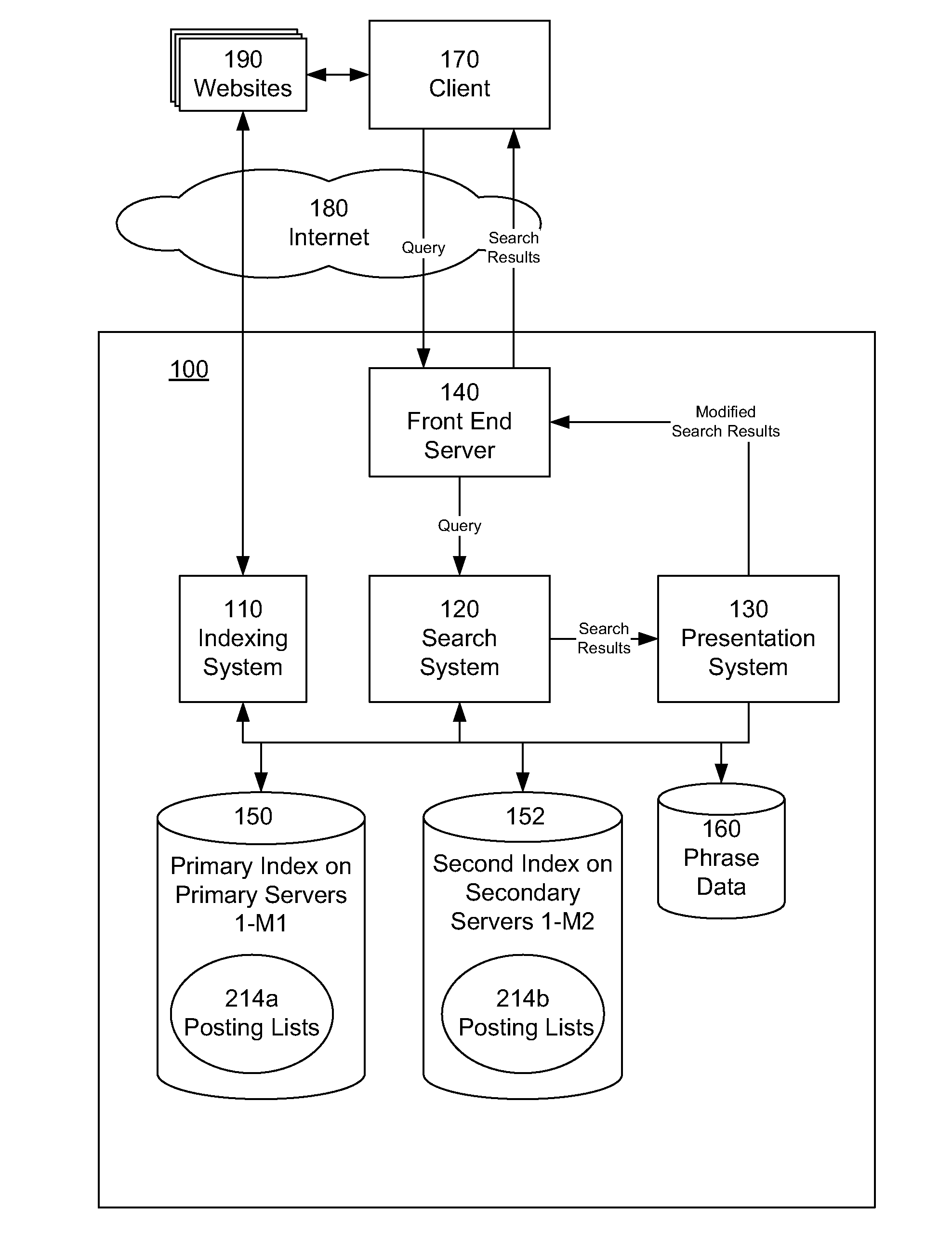
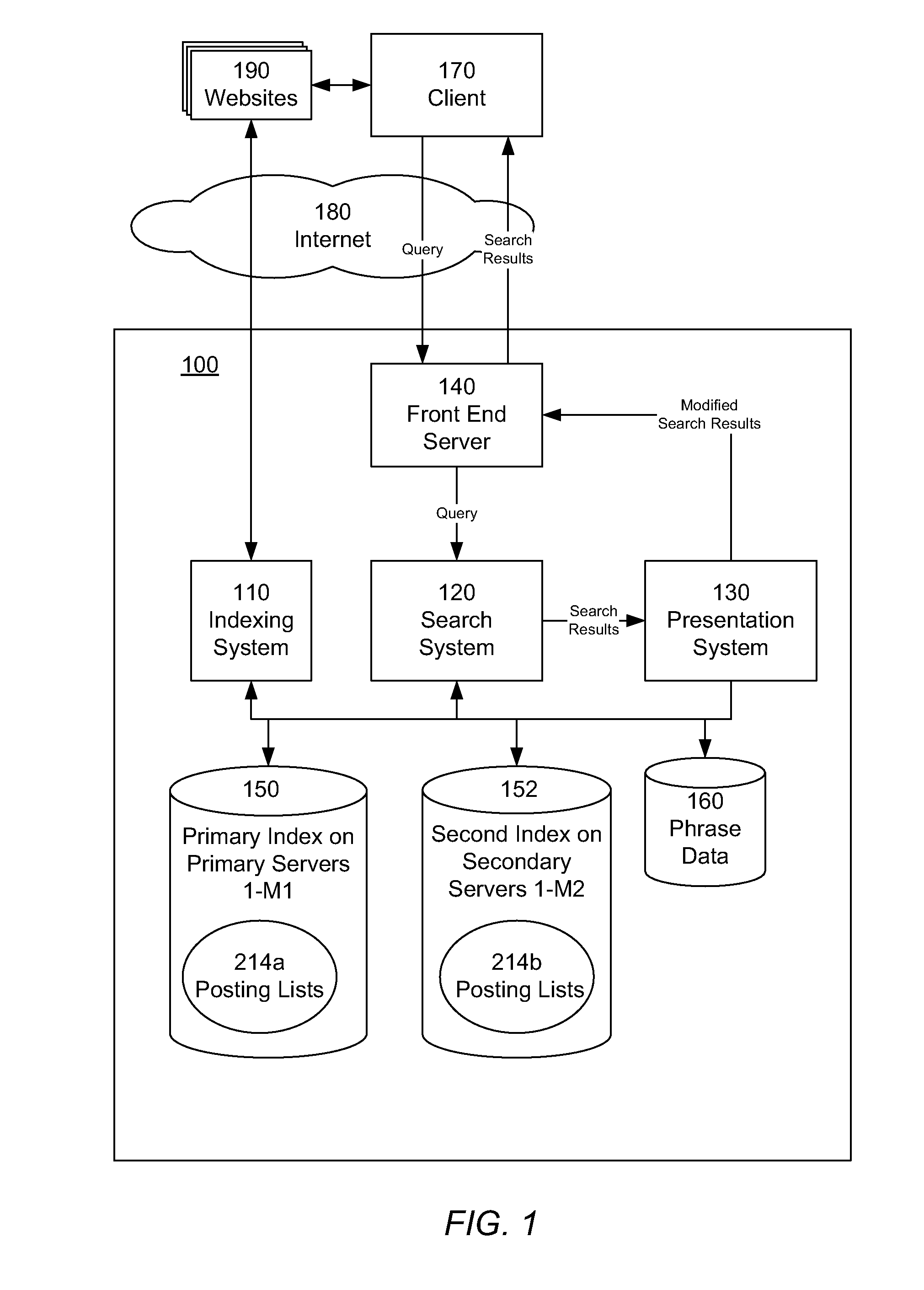
[0013]An information retrieval system indexes documents in the document collection by the valid or good phrases. For each phrase, a posting list identifies the documents that contain the phrase. In addition, for a given phrase, a second list, vector, or other structure is used to store data indicating which of the related phrases of the given phrase are also present in each document containing the given phrase. In this manner, the system can readily identify not only which documents contain which phrases in response to a search query, but which documents also contain phrases that are related to query phrases, and thus more likely to be specifically about the topics or concepts expressed in the query phrases.
[0014]The information retrieval system is also adapted to use the phrases when searching for documents in response to a query. The query is processed to identify any phrases that are present in the query, so as to retrieve the associated posting lists for the query phrases, and the related phrase information. In addition, in some instances a user may enter an incomplete phrase in a search query, such as “President of the”. Incomplete phrases such as these may be identified and replaced by a phrase extension, such as “President of the United States.” This helps ensure that the user's most likely search is in fact executed.
[0016]For example, the primary index may be structured to store 32 k document entries for each phrase, and the secondary index structured to store any further documents entries for further documents beyond the 32 k that contain the phrase. To obtain the document entries for the primary index, the documents are scored for relevance with respect to the phrase, and rank ordered by their relevance score. Alternatively, the documents may be rank ordered by various document features useful for relevance analysis. The rank ordering for the document entries is used partition the entries between the primary index and the secondary index. Where there are less than the limited number of documents that contain the phrase, then all of the entries are stored in the primary index, again in relevance rank order. The indexing arrangement enables a ten to fifteen-fold increase in storage capacity for the index, and because of the optimized index information, and a ten-fold increase in server performance.
[0017]Another aspect of the present invention is the capability to index multiple versions or instances of documents for archiving. This capability enables a user to search for documents within a specific range of dates, and enables date or version related relevance information to be used in evaluating documents in response to a search query and in organizing search results. In one embodiment, a document is associated with one or more date ranges. Each date range is associated with relevance data derived from the document and deemed valid for the document during the date range. A current date range is associated with a current instance of the document, from the date that the document was most recently indexed. When a document is encountered during an indexing pass, it is compared with a previous version to determine if the document has changed. If the document has not changed, then indexed relevance data is maintained. If the document has changed, then the current date range for the document is closed, and the document is re-indexed, and a new current date range is established, and associated with the current relevance data.



 Login to View More
  Login to View More