
Issuing global shared memory operations via direct cache injection to a host fabric interface
a shared memory and host fabric technology, applied in the field of distributed data processing systems, can solve the problems of smp computer systems with limited scalability, many smp architectures suffer to a certain extent from bandwidth limitations, and suffer significantly higher access latencies for data contained in system memories
- Summary
- Abstract
- Description
- Claims
- Application Information
AI Technical Summary
Benefits of technology
Problems solved by technology
Method used
Image

Examples
Embodiment Construction
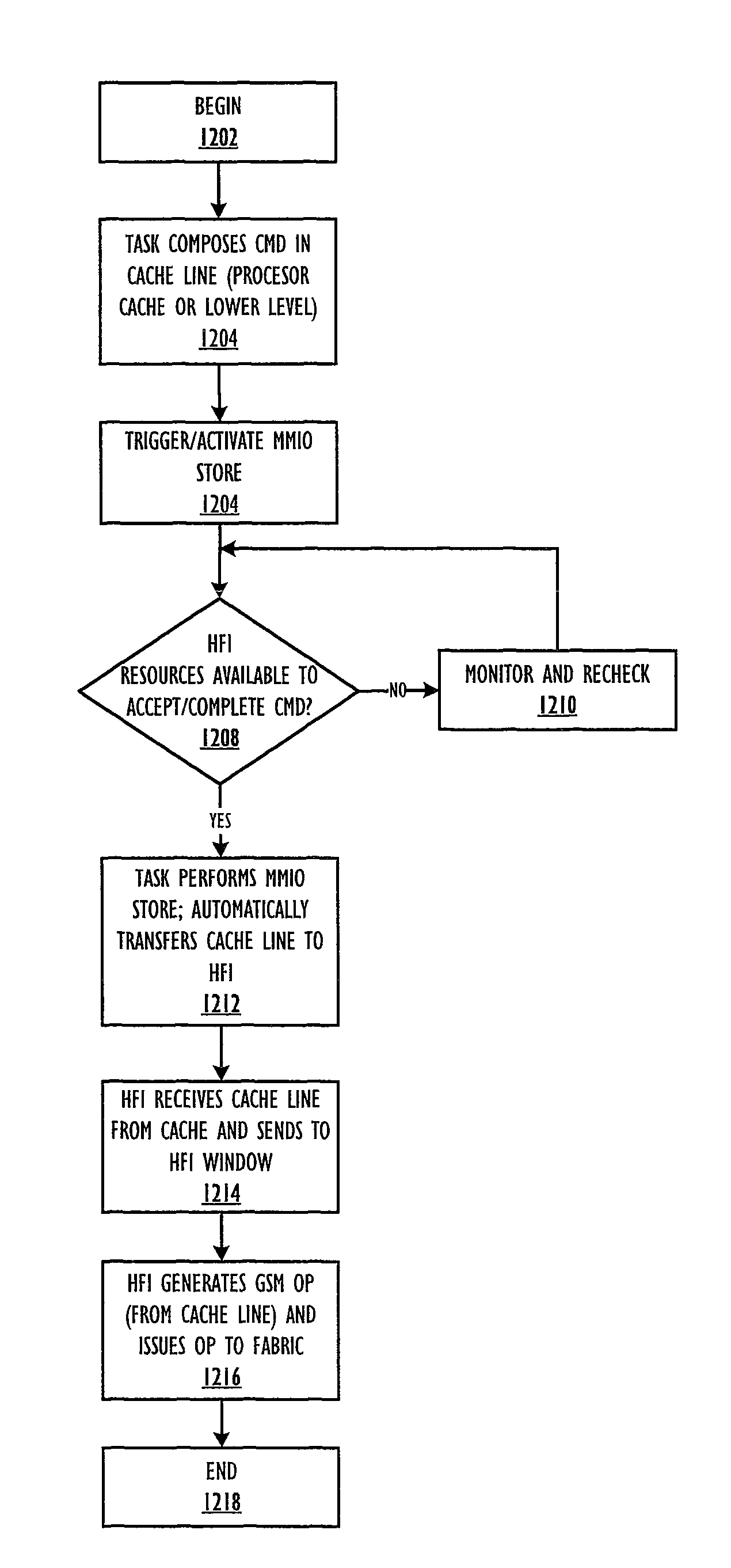
[0025]Disclosed are a method, computer program product, and data processing system for issuing global shared memory (GSM) operations from an originating task on a first node coupled to a network fabric of a distributed network via a host fabric interface (HFI). The originating task composes a GSM command within a cache line. The task then forwards the entire cache line directly to the HFI. The HFI responds to receipt of a forwarded cache line by generating a GSM packet containing GSM operations and data corresponding to the GSM command. The HFI then issues the generated GSM packet to the network fabric via a HFI window allocated to the originating task. According to one embodiment, forwarding the cache line entails assigning the HFI as a target device for an MMIO store, and performing the MMIO store of the cache line to the HFI.
[0026]In one embodiment, an operation detecting function of the task detects a type of operation scheduled to be performed by the task. When the operation is...
PUM
 Login to View More
 Abstract
Description
Claims
Application Information
 Login to View More