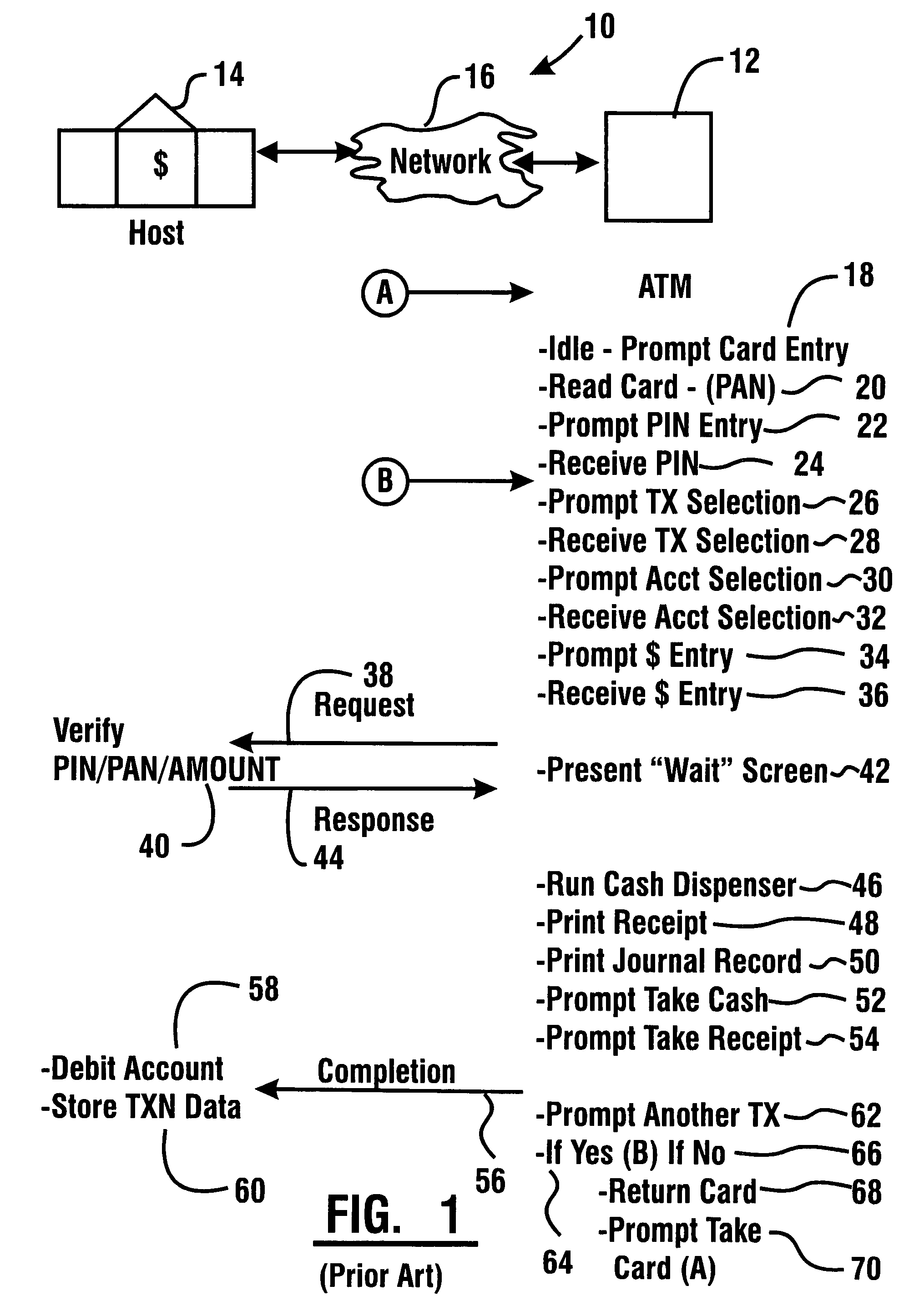
While conventional ATM
programming is highly efficient for conducting transactions, it provides only a limited range of marketing capabilities to the ATM operator.
While the operator may present some customized material in their screens promoting services provided by the institution, such information will not be of interest to many users.
In addition, when institutions provide promotional messages, they often provide information that is only of value to customers of the particular institution.
While this approach provides more marketing options for operators of ATMs, such systems have drawbacks.
One of these drawbacks is that it can slow transaction times for ATM operators by requiring the host to not only do the necessary
financial transaction processing, but also the necessary
processing to determine the appropriate marketing message.
This additional
processing time combined with the promotional message presentation time can slow down a user's operation of an ATM and annoy both the user and others who are waiting to use the machine.
A further drawback associated with such prior marketing systems is that the ATM
programming and financial transaction flow must be significantly modified to accommodate the display of marketing presentations.
A further drawback is that such systems do not have the capability of receiving responsive inputs from the customer concerning the presentation.
This inability to obtain immediate feedback through the ATM terminal as well as the inability for a user to immediately accept a marketing offer, usually results in the user not following up on the offer even if there is some interest.
A further drawback associated with existing ATM marketing systems is that users will generally receive the same promotion every time they use the ATM.
As a result, after the first presentation the user will generally ignore further follow-up presentations and will consider their presentation an inconvenience.
A further drawback of existing systems is that the data which specifies the marketing information must come from the host computer that can authorize the transaction.
A further complication would be if the ATM has the capability but the presentation files stored do not correspond with those that the host expects.
This could result in a presentation of a totally inappropriate message to the user.
A further drawback of such existing approaches is that the owner of the ATM cannot specifically address messages to those users who are not currently customers of the owning institution.
This is because the entity owning the ATM cannot authorize the transaction unless the customer is one who already has their account with the institution owning the ATM.
Conventional systems do not enable the ATM owning entity to selectively provide presentations to users who are not its customers for other purposes.
However, they would not want their competitor's products promoted on their ATM.
At present there is no effective way to provide such marketing messages on a selective wide scale basis.


 Login to View More
  Login to View More