Method to improve plant resistance to infections
a technology for plants and bacteria, applied in the field of proteins, can solve the problems of limited activity spectrum of resistance proteins, negative side effects, and programmed cell death, and achieve the effect of improving the resistance of plants to infections and enhancing the ability to resist infections
- Summary
- Abstract
- Description
- Claims
- Application Information
AI Technical Summary
Benefits of technology
Problems solved by technology
Method used
Image

Examples
example 1
Identification and Cloning of OsRHC1-Encoding cDNA
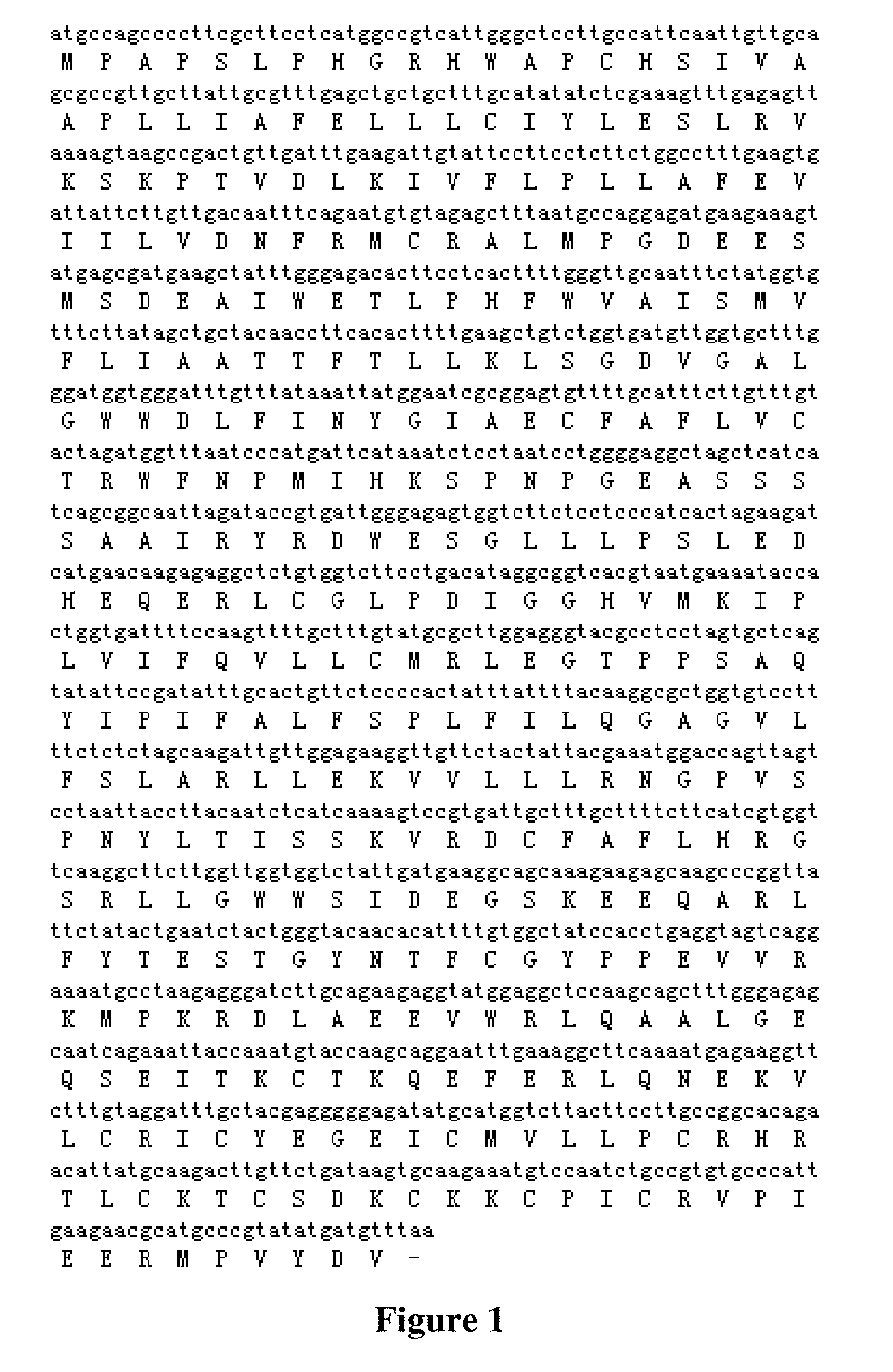
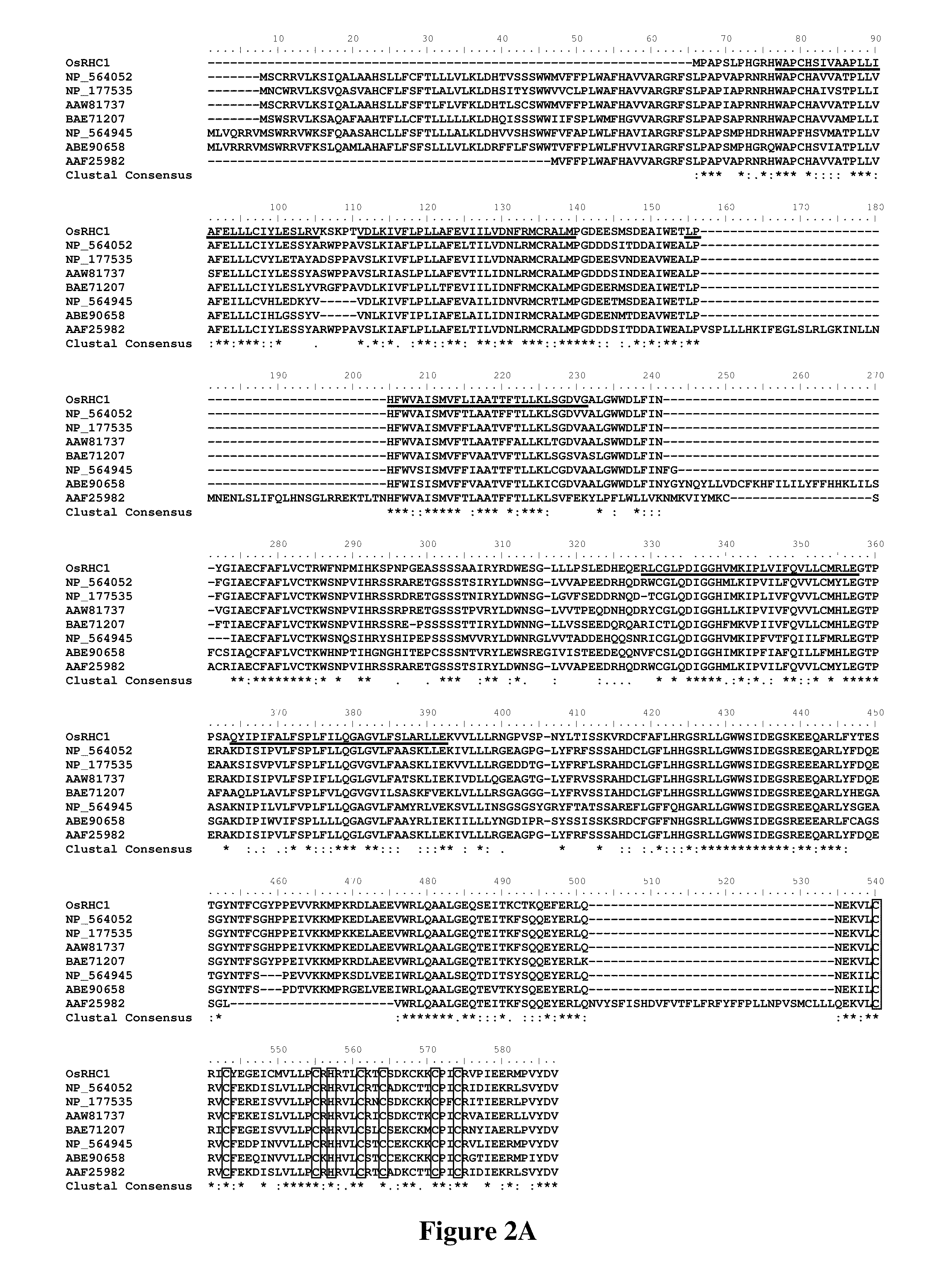
[0042]One partial cDNA clone was obtained via suppression subtractive hybridization techniques with the PCR-select cDNA subtraction kit (Clontech 637401), using total RNA extracted from six to eight-week-old CBB14 which is bacterial blight resistant (tester) and SN1033 the susceptible parent of CBB14 (driver) rice lines collected four days after pathogen (Xoo race LN44) inoculation. Inoculation was performed by clipping method described in Zhang, Q., et al., Acta Agr. Sin. (1996) 22:135-141. Using the DNA sequence information of this partial clone, 5′-Rapid-Amplification of cDNA Ends (5′-RACE) experiment and subsequent PCR amplifications using specific primers were performed. Gene specific primers 5′-TTCTCC ATGTTCGGTAAACCTTTC-3′ (SEQ ID NO:3), 5′-TAAAGTTGTGATTGAGACTACA TGG-3′ (SEQ ID NO:4) and 5′-ACATTGCACAACCAACATGTAC-3′ (SEQ ID NO:5) were employed in the 5′RACE reactions. To amplify the full length coding region, PCR using the prim...
example 2
Demonstration that OsRHC1 is Membrane Bound
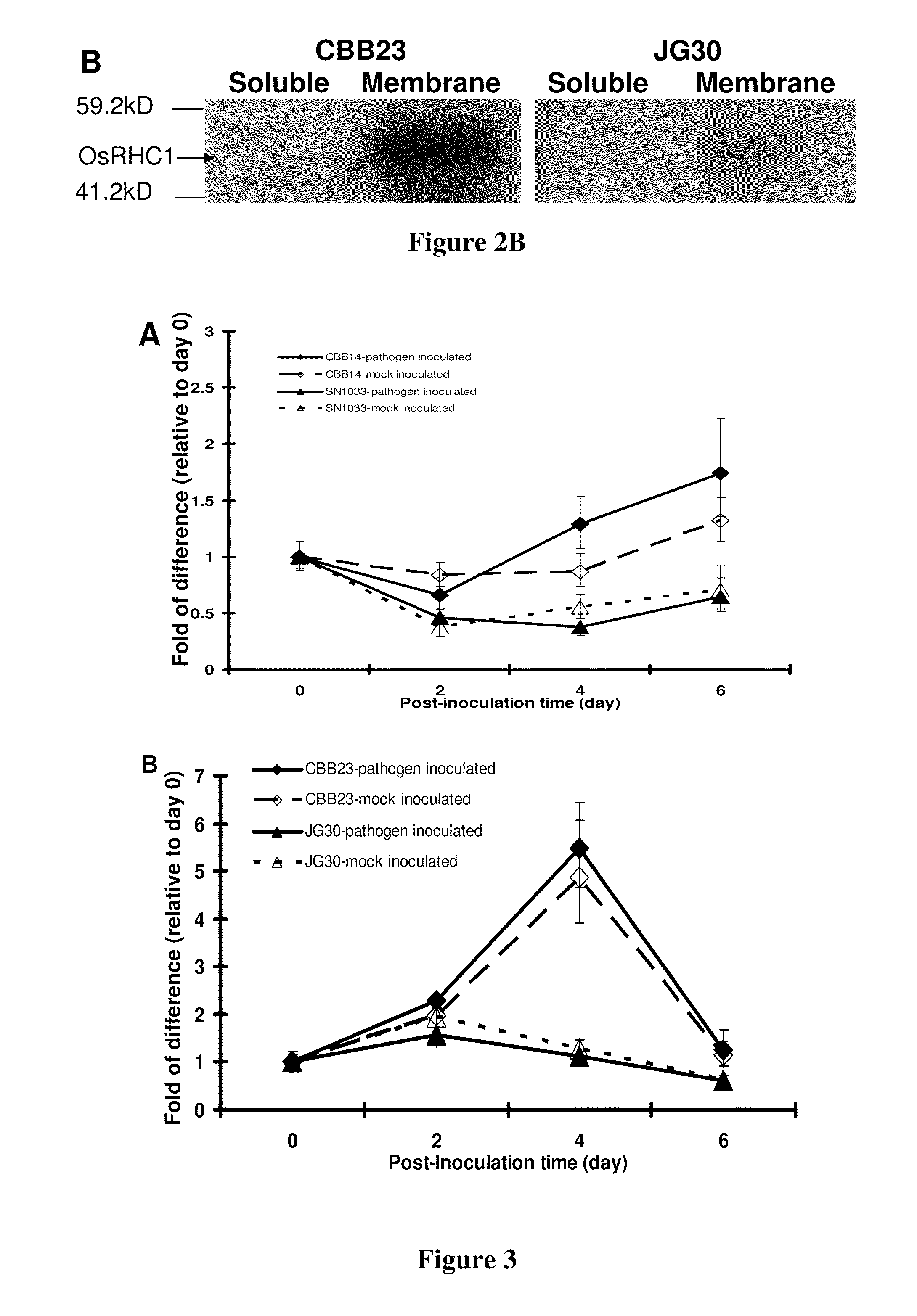
[0046]To verify that the OsRHC1 is membrane bound as depicted by bioinformatics tools, membrane-bound and soluble proteins were separated using a fractionation protocol (modified from Jiang and Rogers, J. Cell Biol. (1998) 143:1183-1199). For Western blot analysis, the proteins were electrophoretically separated on a polyacrylamide gel (4% stacking; 10% resolving) before transferred to an activated PVDF membrane (pre-treated in absolute methanol for 20 minutes followed by protein transfer buffer for 15 minutes) using the Trans-Blot® SD Semi-Dry Electrophoretic Transfer Cell (Bio-Rad 170-3949). The blocking and detection steps were performed according to the manufacturer's manual (Western Breeze™ Immunodetection Kit, InvitroGen WB7106). Primary antibodies (polyclonal) targeting the OsRHC1 protein was raised by a commercial service (InvitroGen, Custom antibody) via injecting a synthetic peptide (‘N’-CGYPPEVVRKMPKRD-‘C’) (SEQ ID NO:9) into rab...
example 3
OsRHC1 is Wound-Inducible in the Rice Lines CBB14 and CBB23
[0047]To study the expression pattern of OsRHC1, real-time PCR analyses was performed using reverse-transcribed RNA samples from two near isogenic pairs (CBB14 containing Xa14 and its susceptible recurrent parent SN1033; CBB23 a resistant line containing Xa23 and its susceptible recurrent parent JG30). Rice lines were grown on regular field soil in a green house (temperature 24-28° C.; RH 70-80%; under natural light). Inoculation of the Xoo races LN44 and P6 was performed by clipping method described in Zhang, Q., et al., supra (1996). Mock inoculation and wounding treatment followed the same procedure except that the pathogen was replaced by water. For the time-course experiments, samples were collected at 0, 2, 4, 6 days at around the same time of the day (between 8-10 am). Day 0 sample was collected before treatment.
[0048]For evaluating expression of OsRHC1 via real-time PCR, total RNA was extracted by the phenol extracti...
PUM
| Property | Measurement | Unit |
|---|---|---|
| temperature | aaaaa | aaaaa |
| time | aaaaa | aaaaa |
| time | aaaaa | aaaaa |
Abstract
Description
Claims
Application Information
 Login to View More
 - R&D
- Intellectual Property
- Life Sciences
- Materials
- Tech Scout
- Unparalleled Data Quality
- Higher Quality Content
- 60% Fewer Hallucinations
Browse by: Latest US Patents, China's latest patents, Technical Efficacy Thesaurus, Application Domain, Technology Topic, Popular Technical Reports.
© 2025 PatSnap. All rights reserved.Legal|Privacy policy|Modern Slavery Act Transparency Statement|Sitemap|About US| Contact US: help@patsnap.com