Supercharge Your Innovation With Domain-Expert AI Agents!

Method for producing internal and external toothings on thin-walled, cylindrical hollow parts

a thin-walled, cylindrical technology, applied in the direction of forging hammers, domestic applications, applications, etc., can solve the problems of inability to tightly press against the annular shoulder of the toothing on the workpiece, curvature with radii which are larger, and the curvature of the longitudinal toothing profile produced

Active Publication Date: 2012-02-21
ERNST GROB
View PDF6 Cites 6 Cited by
  • Summary
  • Abstract
  • Description
  • Claims
  • Application Information

AI Technical Summary

Benefits of technology

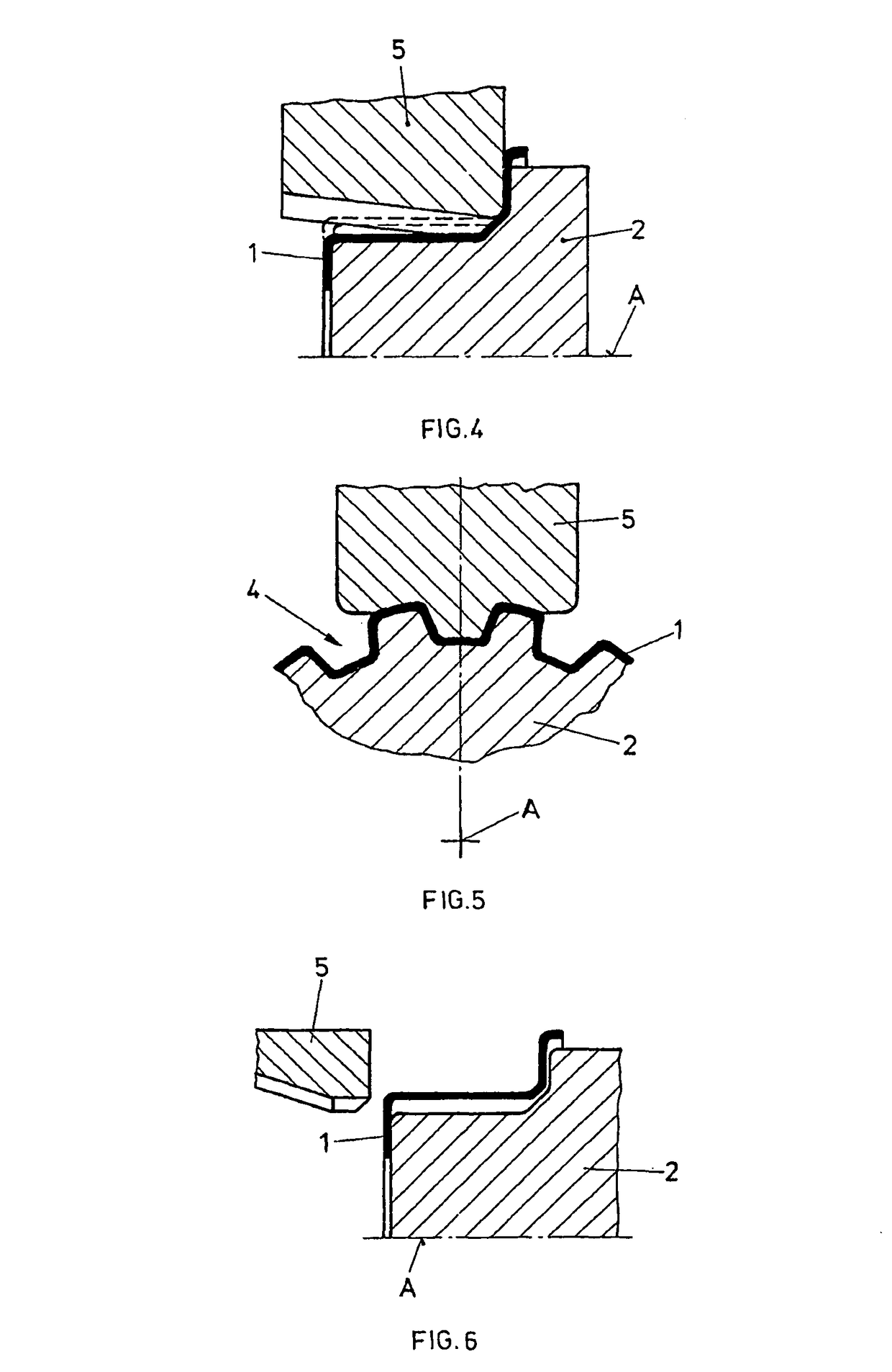
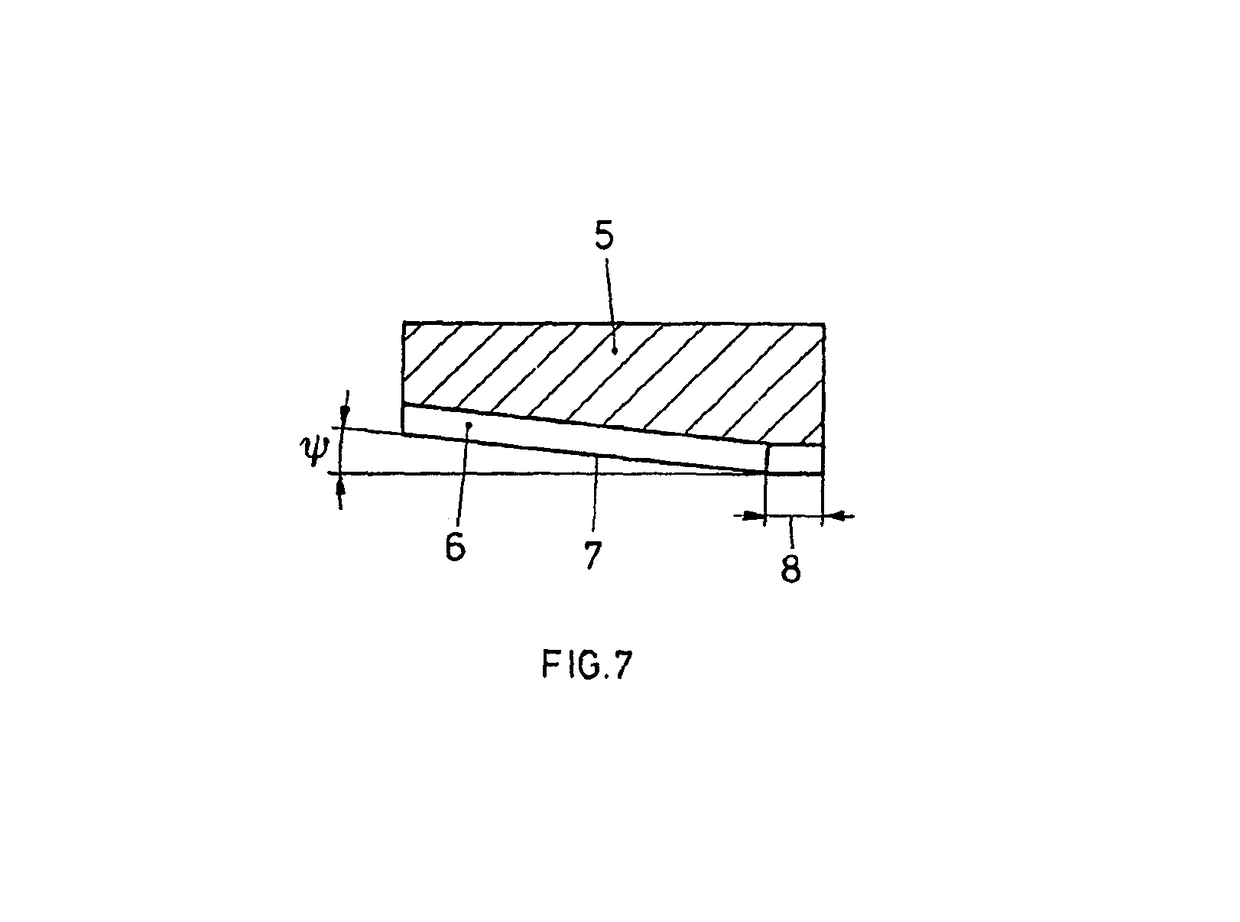
[0011]In an exemplary manner, preliminary to its axial movement, the profiling tool can be adjusted to a predetermined profile depth, measured radially to the longitudinal axis of the workpiece. Because of the fact, that the profiling tool, preliminarily to the actual metal working process, has been radially placed in a position external to the workpiece, sufficient free installation space in the workpiece exists so that the said profiling tool can be easily connected to a holding mechanism.
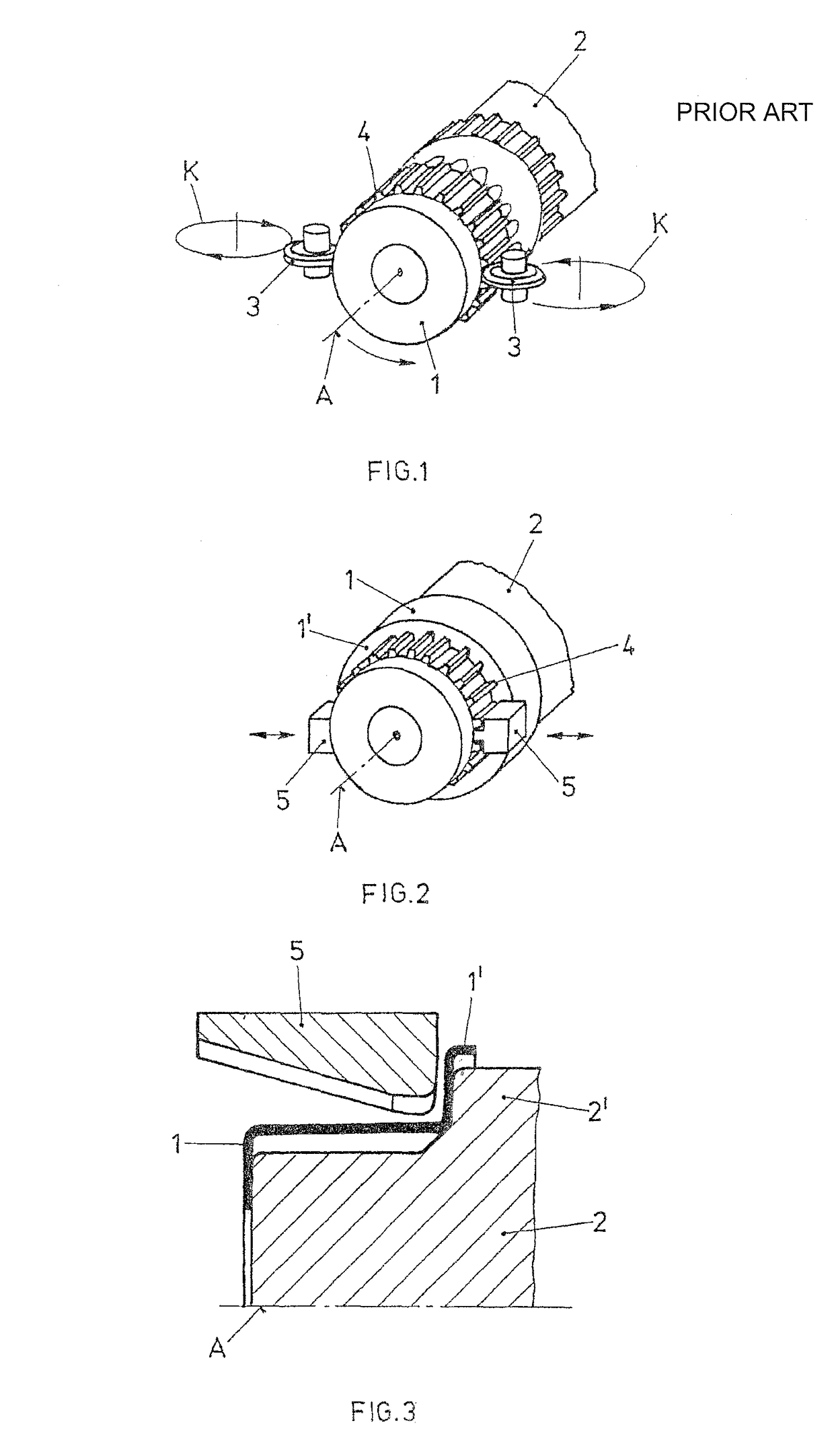
[0018]For example, the profiled zone of the mandrel can extend from its free end to a radially, projecting annular shoulder and the open end of a workpiece is set thereupon, wherein the said workpiece also exhibits a surrounding shoulder, i.e. in other words, possesses a limiting obstruction to further profiling tool advance. Such workpieces find application in automotive motor construction, for instance serving for the transfer of rotary motion and torque in automatic transmissions. In this application, the extent of the profile must extend itself in design and manufacture as an exact inner and outer toothing, closely approaching in an axial direction the outward projecting collar of the workpiece.

Problems solved by technology

However, a continual disadvantage of this conventional method, attributable to varying diameters of the profiling tool orbits, is that the produced longitudinal toothing profiles possess curvatures with radii which are larger or smaller than desired.
Another disadvantage of the above described method of cold forming by means of profiling rollers, lies in the fact that toothing on a workpiece which possesses an annular shoulder, cannot be brought up tightly against the said shoulder.

Method used

the structure of the environmentally friendly knitted fabric provided by the present invention; figure 2 Flow chart of the yarn wrapping machine for environmentally friendly knitted fabrics and storage devices; image 3 Is the parameter map of the yarn covering machine
View more

Image

Smart Image Click on the blue labels to locate them in the text.
Viewing Examples
Smart Image
  • Method for producing internal and external toothings on thin-walled, cylindrical hollow parts
  • Method for producing internal and external toothings on thin-walled, cylindrical hollow parts
  • Method for producing internal and external toothings on thin-walled, cylindrical hollow parts

Examples

Experimental program
Comparison scheme
Effect test

Embodiment Construction

[0037]FIG. 1 shows, in a schematic manner, the assembly of the principal parts of a conventional profiling tool, operating with a rolling impact head for the production of inner and outer teething on a thin walled, cylindrical, hollow object 1 (as stated above, here designated as “workpiece”). The said workpiece 1 is caused to encase an already profiled mandrel 2. The outer circumferential surface of the said workpiece 1 is subjected to impact metal working by means of profiling rollers 3, which themselves rotate in respective orbits K, which orbits K are in a plane transverse to the longitudinal axis A of the said workpiece 1. Accordingly, the profiling rollers 3 themselves are likewise positioned radially transverse to the said longitudinal axis A. These rollers remain actively in place until the desired depth of the profiling on the workpiece 1 has been reached. FIG. 1 makes plain, that the profile 4 on the workpiece 1, at its exposed end, terminates with a straight radial face t...

the structure of the environmentally friendly knitted fabric provided by the present invention; figure 2 Flow chart of the yarn wrapping machine for environmentally friendly knitted fabrics and storage devices; image 3 Is the parameter map of the yarn covering machine
Login to View More

PUM

PropertyMeasurementUnit
depthaaaaaaaaaa
angleaaaaaaaaaa
angleaaaaaaaaaa
Login to View More

Abstract

A method is disclosed for cold-form profiling cylindrical, thin-walled hollow parts (1), comprising profiles (4) which extend in an essentially parallel manner in relation to the longitudinal axis (A) of the hollow part (1). At least one profiling tool (5) engages in a strike-like hammering manner with the outside of the hollow part (1) in a radial manner in relation to the longitudinal axis (A) o the hollow part (1). The profiling tool (5) engages, respectively, in an essentially vertical and oscillating manner on the surface of the hollow part (1). Then, the profiling tool (5) is displaced in an axial manner in relation to the hollow part (1) at a constant radial adjusting depth until the desired profile length is obtained.

Description

RELATED APPLICATION[0001]This is a U.S. national phase application under 35 U.S.C. §371 of International Application No. PCT / CH2005 / 000406 filed Jul. 15, 2005.TECHNICAL FIELD[0002]The present invention concerns a method for cold rolled profiling of a cylindrical thin-walled, hollow workpiece as well as an apparatus for execution of the method.BACKGROUND AND SUMMARY[0003]The manufacture of axial profiling of a thin-walled, cylindrical hollow part (hereinafter, “workpiece”) can, for example, be carried out by means of a cold rolling process. Accordingly, methods are known, wherein rotational tools, designated as profiling rollers, which are confined in circular orbits, are caused to repeatedly impact against the circumferential surface of a workpiece. By means of an axial progression of the workpiece relative to the profiling tool and with the aid of axially toothed mandrels, the desired toothing can be realized. Profiling in this manner is effective in producing internal and external...

Claims

the structure of the environmentally friendly knitted fabric provided by the present invention; figure 2 Flow chart of the yarn wrapping machine for environmentally friendly knitted fabrics and storage devices; image 3 Is the parameter map of the yarn covering machine
Login to View More

Application Information

Patent Timeline
no application Login to View More
Patent Type & Authority Patents(United States)
IPC IPC(8): B21C37/20B21J7/16B23P15/10
CPCB21D53/28B21J5/12B21K1/30B21J7/14Y10T29/49474B21D15/02
Inventor DERIAZ, DANIEL
Owner ERNST GROB
Features
  • R&D
  • Intellectual Property
  • Life Sciences
  • Materials
  • Tech Scout
Why Patsnap Eureka
  • Unparalleled Data Quality
  • Higher Quality Content
  • 60% Fewer Hallucinations
Social media
Patsnap Eureka Blog
Learn More