Unlock instant, AI-driven research and patent intelligence for your innovation.

Handover method and apparatus in a wireless telecommunications network

a wireless telecommunications network and wireless technology, applied in the field of wireless telecommunications network handover method and apparatus, can solve the problems of increasing the interruption time, affecting the decision whether to forward data, so as to avoid potential interruption and increase the interruption time

Active Publication Date: 2013-03-05
ALCATEL LUCENT SAS
View PDF11 Cites 9 Cited by
  • Summary
  • Abstract
  • Description
  • Claims
  • Application Information

AI Technical Summary

Benefits of technology

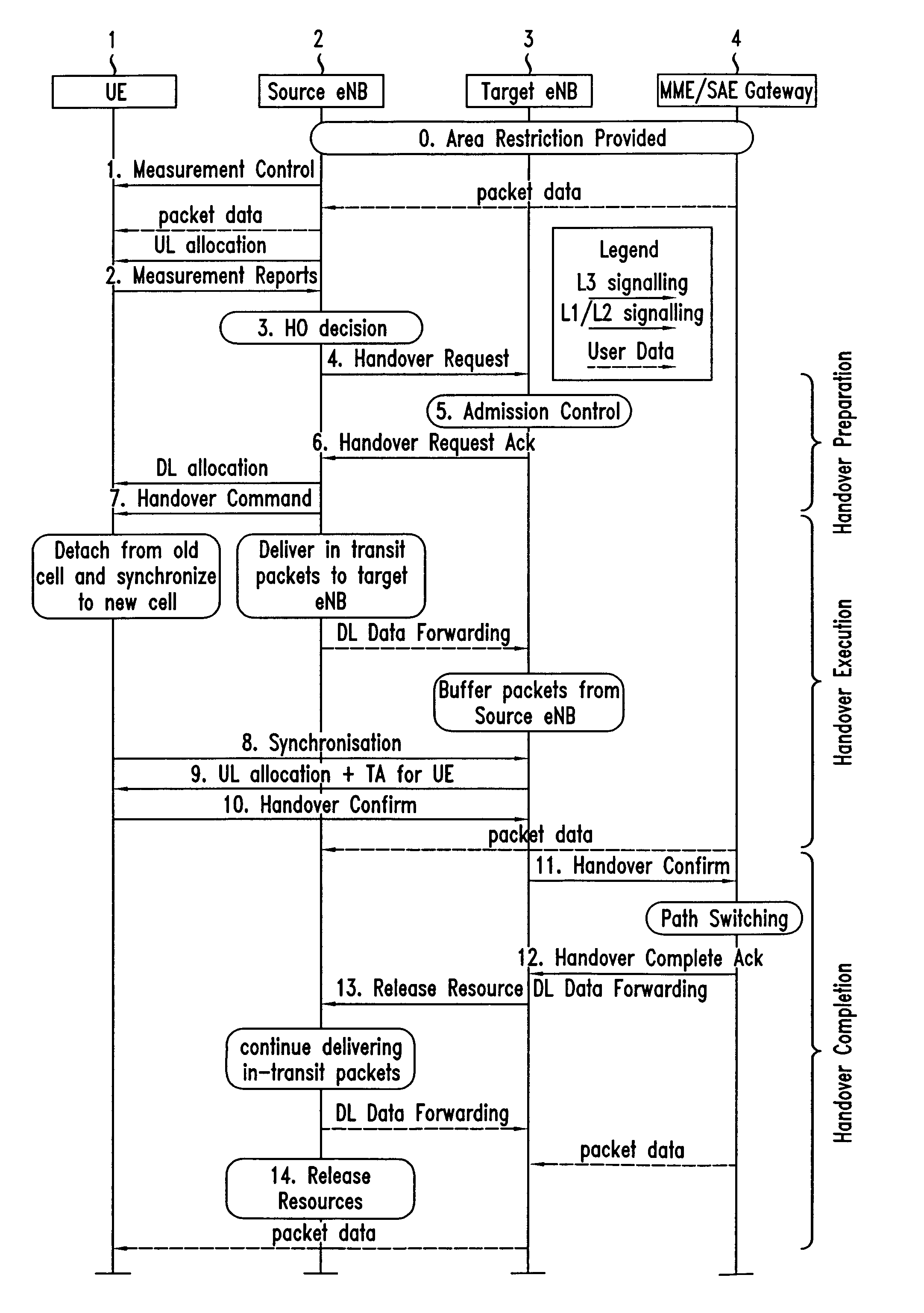
[0012]According to a first aspect of the invention, a method for handover of a mobile terminal from a source node to a target node in a wireless telecommunications network includes the step of: making a determination as to whether or not to forward data from the source node to the target node, and the determination for each radio bearer being made independently of which radio link control, RLC, mode it supports. Thus, in a method in accordance with the invention, data forwarding may be selected irrespective of whether RLC-UM or RLC-AM bearers are involved and may be chosen per radio bearer. This provides flexibility independent of RLC mode. The method is applicable to networks implemented in accordance with Long Term Evolution, LTE, standards, but may also be used in other types of network.
[0017]Previously, for RLC-AM, the PDCP sequence number was continued in the target node after the HO. This was considered essential for re-sequencing and identifying packet duplicates over the radio. For this reason, the last used PDCP SN of the buffered packets and the last used PDCP SN were transferred to the target node by the source node. In a method in accordance with the invention, in contrast, when it is determined not to forward data to the target node, the PDCP sequence number is re-started with a known value and the last used PDCP SN is not transferred to the target node. Where the X2 interface between the source and target nodes is slow compared to the S1 interface, transferring the PDCP SN information to the target node could increase the interruption time, since the target node must wait for this SN before sending any fresh data received directly by it over S1. By re-starting the PDCP SN, this potential interruption can be avoided.
[0019]According to a method in accordance with the invention, since the mobile terminal must know if the PDCP should be reset or continued, a mechanism for signalling this to the mobile terminal is included. Where the PDCP SN is arranged to restart when data forwarding is not implemented, the mobile terminal may be signalled that data forwarding is not being used, so as to alert it that PDCP should be reset, whatever RLC mode is being used. Also, indicating to a mobile terminal that a bearer is not subject to data forwarding allows the mobile terminal to deliver any buffered packets immediately to the upper layers. The mobile terminal can also re-initialise the PDCP SN to a known value.

Problems solved by technology

For example, if the last mile topology for X2 is up to the S1 anchoring point, forwarding data will be costly for the operator and slow.
Further, the mobility rate of the UE may also impact the decision about whether to forward data or not.
It may not be worthwhile to implement data forwarding for a slow moving UE.

Method used

the structure of the environmentally friendly knitted fabric provided by the present invention; figure 2 Flow chart of the yarn wrapping machine for environmentally friendly knitted fabrics and storage devices; image 3 Is the parameter map of the yarn covering machine
View more

Image

Smart Image Click on the blue labels to locate them in the text.
Viewing Examples
Smart Image
  • Handover method and apparatus in a wireless telecommunications network
  • Handover method and apparatus in a wireless telecommunications network
  • Handover method and apparatus in a wireless telecommunications network

Examples

Experimental program
Comparison scheme
Effect test

Embodiment Construction

[0029]With reference to FIG. 2, a decision making device 5 includes an information store 6 containing data about various network parameters and about a mobile terminal 1 which is currently in an established connection with a source eNB 2, shown in FIG. 3. A processor 7 accesses the information held in the store 6, which may include QoS data 6a, UE speed data at 6b, and interface data relating to S1 and X2 at 6c, and uses it to make a determination as to whether or not data forwarding should be implemented when the mobile terminal 1 is handed over from the source eNB 2 to a target eNB 3. The processor 7 does not take into account the RLC mode of a radio bearer when making its determination. Suitable choice of the type of data held in the store 6 and how it is applied to the determination permits an operator to selectively choose data forwarding per bearer depending on deployment scenario and costs. For example, the operator can choose not to forward data over a costly last mile savin...

the structure of the environmentally friendly knitted fabric provided by the present invention; figure 2 Flow chart of the yarn wrapping machine for environmentally friendly knitted fabrics and storage devices; image 3 Is the parameter map of the yarn covering machine
Login to View More

PUM

No PUM Login to View More

Abstract

According to an aspect of the invention, a method for handover of a mobile terminal from a source node to a target node in a wireless telecommunications network includes the steps of making data forwarding of fresh data optional irrespective of the RLC mode, which may involve RLC-UM or RLC-AM bearers.The method may include providing an explicit instruction to the mobile terminal for each bearer on whether a bearer is subject to data forwarding or not. This may then be used by the mobile terminal to handle the buffered packets and PDCP SNs.

Description

FIELD OF THE INVENTION[0001]The present invention relates to a method and apparatus for handover in a wireless telecommunications network, and more particularly, but not exclusively, to a method and apparatus implemented in accordance with the 3rd Generation Partnership Project (3GPP) evolved Universal Terrestrial Radio Access Network (E-UTRAN) and evolved Universal Terrestrial Radio Access (E-UTRA) specifications.BACKGROUND OF THE INVENTION[0002]Currently, 3GPP is considering development of E-UTRA and E-UTRAN as set out in the technical specification 3GPP TS 36.300 v 8.1.0 (2007-06), incorporated herein by way of reference, and related documents. 3GPP Long Term Evolution (LTE) aims to enhance the Universal Mobile Telecommunications System (UMTS) standard, for example, by improving efficiency and services.[0003]In E-UTRAN, user equipment (UE) communicates with a network node, NodeB (eNB), with data being sent on radio bearers (RBs) over a radio link between them. The eNB interfaces ...

Claims

the structure of the environmentally friendly knitted fabric provided by the present invention; figure 2 Flow chart of the yarn wrapping machine for environmentally friendly knitted fabrics and storage devices; image 3 Is the parameter map of the yarn covering machine
Login to View More

Application Information

Patent Timeline
no application Login to View More
Patent Type & Authority Patents(United States)
IPC IPC(8): H04L12/26
CPCH04W36/02H04W92/20
Inventor CASATI, ALESSIOGODIN, PHILIPPEPALAT, SUDEEP KUMAR
Owner ALCATEL LUCENT SAS