Hearing aid system comprising a matched filter and a measurement method

a filter and hearing aid technology, applied in the field of hearing aid systems, can solve problems such as inability to implement, and achieve the effect of improving the signal-to-noise ratio of hearing aids

a filter and hearing aid technology, applied in the field of hearing aid systems, can solve problems such as inability to implement, and achieve the effect of improving the signal-to-noise ratio of hearing aids

US8442247B2Active Publication Date: 2013-05-14OTICON

Image

Smart Image Click on the blue labels to locate them in the text.
Viewing Examples
Smart Image
  • Hearing aid system comprising a matched filter and a measurement method
  • Hearing aid system comprising a matched filter and a measurement method
  • Hearing aid system comprising a matched filter and a measurement method

Examples

Experimental program
Comparison scheme
Effect test

example

“Critical Gain Measurement”

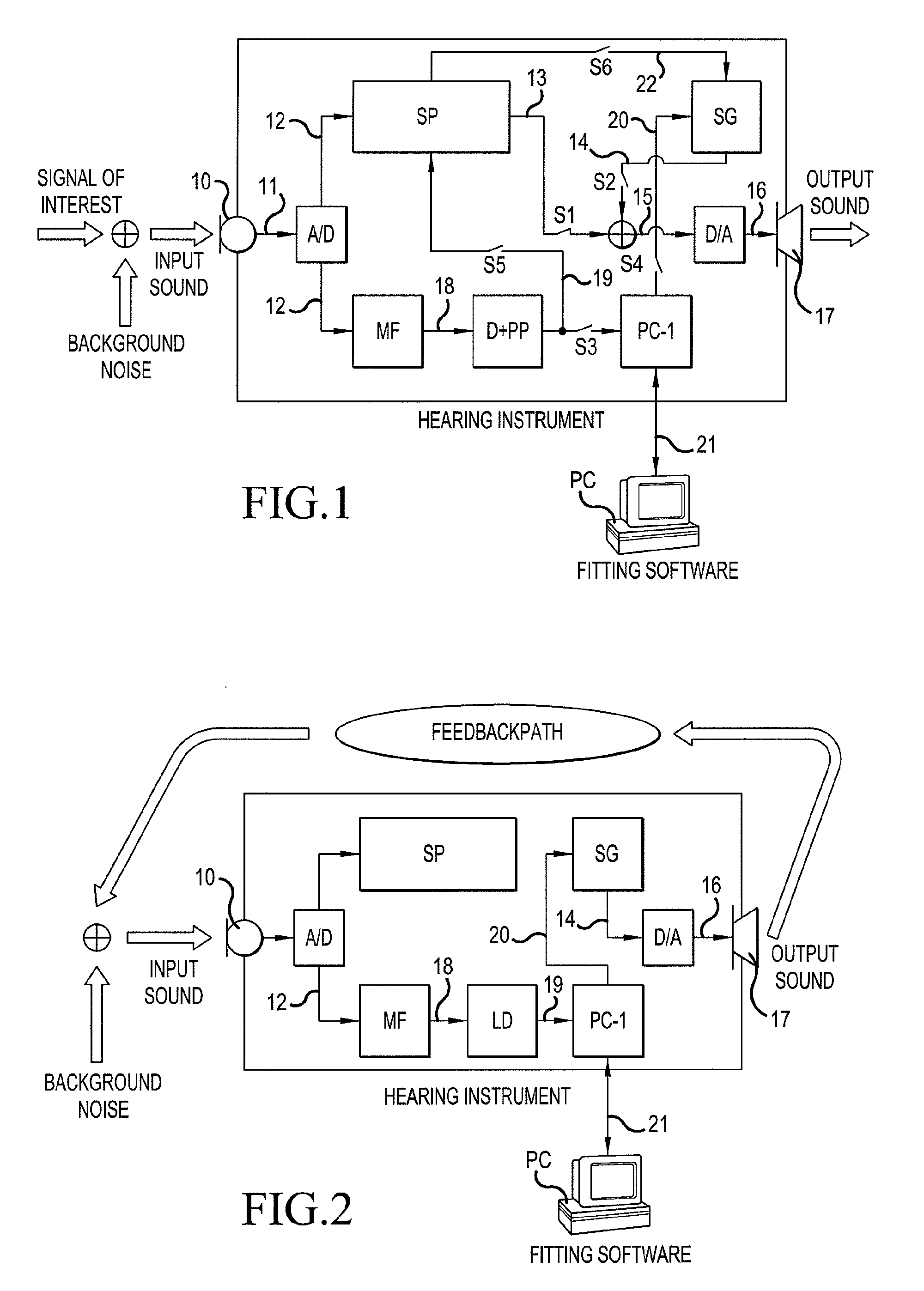
[0081]FIG. 2 is an illustration of a critical gain measurement using a hearing aid system according to an embodiment of the invention. The components of the hearing instruments shown in FIG. 2 are identical to those shown in FIG. 1, but their interconnection is different. The Detector+Post-processing unit of FIG. 1 is substituted by a Level detector (LD) in FIG. 2. The purpose of the Level detector is to measure level of signal produced by the signal generator that is picked up by the Hearing Instrument's input transducer. Subtracting the level of the signal that was produced by the signal generator from the measurement result on the dB scale yields an estimate of the transfer function between signal generator and Level detector at the frequency or frequency range of the signal emitted by the signal generator. The Level detector can be implemented as follows: its input signal is rectified or squared and then passed to a short-time integrator that applies o...

examples

“Automatic / Normal Mode”

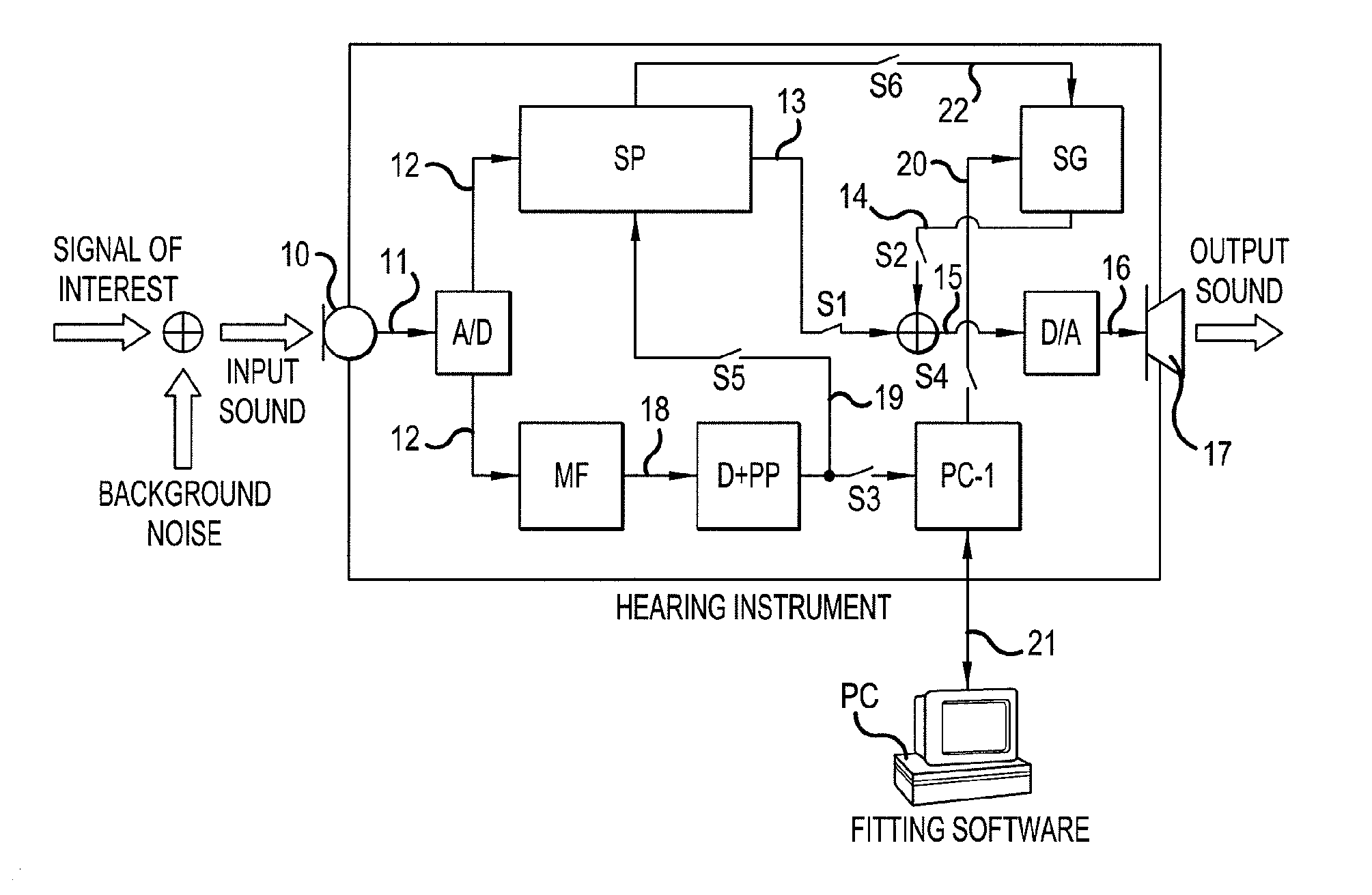
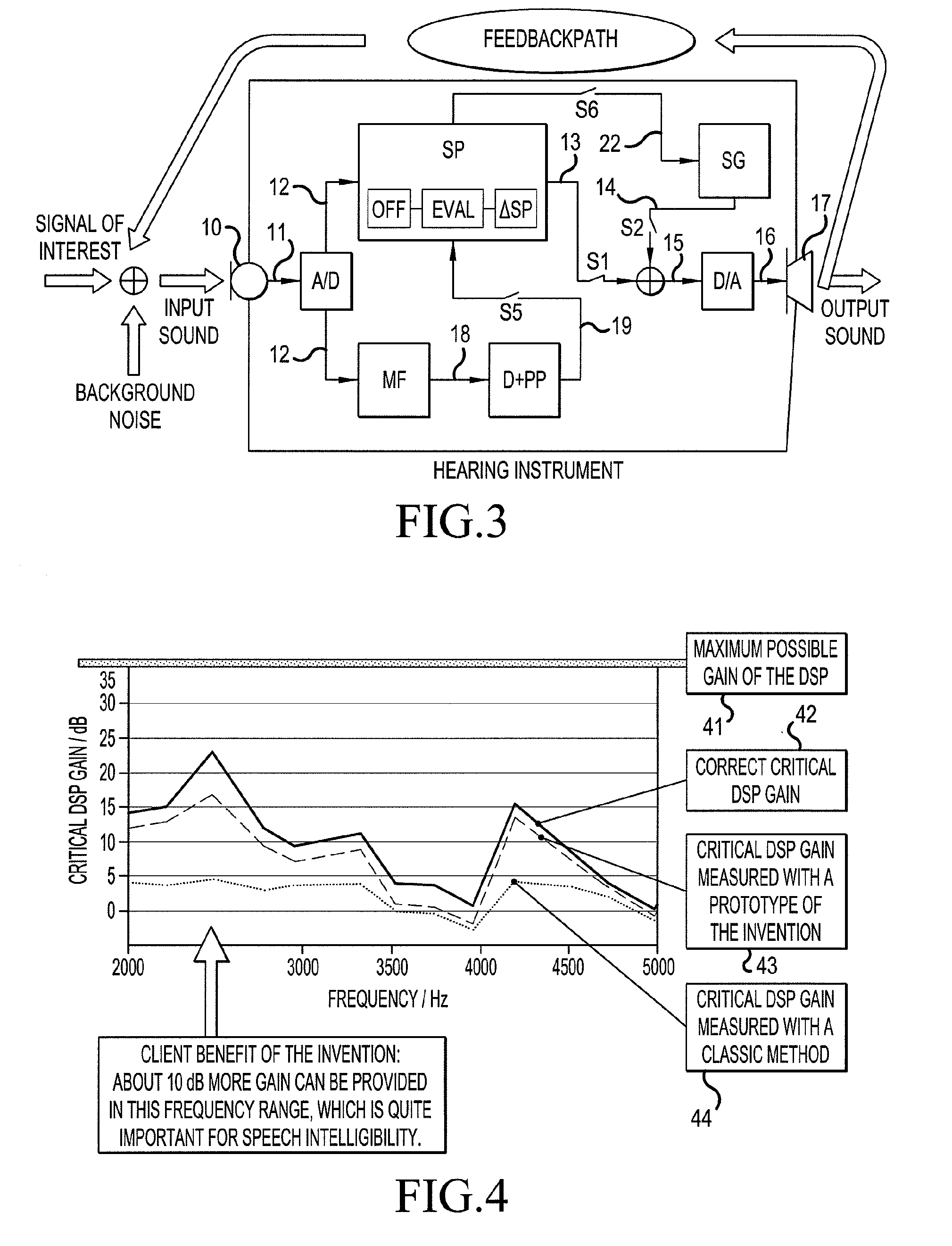
[0104]FIG. 3 shows an illustration of a configuration of a hearing aid system according to an embodiment of the invention in a normal operating mode. As illustrated in FIG. 3, a signal generator (SG) in the Hearing Instrument generates a predefined source signal 14, which is transformed to an output sound by the Hearing Instrument's output transducer 17. By measuring the level of that signal at the input transducer 10 of the Hearing Instrument, certain properties of the acoustic path (Feedbackpath) can be determined (e.g. transfer function and average gain). The measurement accuracy can be improved if the input signal is passed through a matched filter (MF) before the level measurement (in the detector unit D+PP), as is the case in the embodiment of FIG. 3. The measured properties of the acoustic path can be used to analyze the Hearing Instrument wearers current acoustic environment and to react to it appropriately. This is illustrated in FIG. 3 in that the ou...

the structure of the environmentally friendly knitted fabric provided by the present invention; figure 2 Flow chart of the yarn wrapping machine for environmentally friendly knitted fabrics and storage devices; image 3 Is the parameter map of the yarn covering machine
Login to View More

PUM

No PUM Login to View More

Abstract

The invention relates to a hearing aid system comprising an input transducer for converting an input sound signal comprising an information signal part of a known waveform and a background noise part to an electrical analogue input signal, optionally an A / D converter for converting the electrical input signal to a digital input signal. The invention further relates to a method of making a critical gain measurement. The object of the present invention is to improve the signal-to-noise ratio of a signal to be measured or detected in a hearing instrument compared to prior art solutions. The problem is solved in that a matched filter receiving said analogue or digital input signal and optimized to improve the identification of the information signal part from the noisy input signal. An advantage of the invention is that it provides an alternative scheme for improving signal to noise ratio of a hearing aid. The invention may e.g. be used for the customization of hearing aid parameters in cooperation with fitting software and / or for improving signal to noise ratio of a detected or measured signal.

Description

TECHNICAL FIELD[0001]The invention relates to a scheme for improving signal to noise ratio in a hearing aid (HA, also interchangeably termed ‘Hearing Instrument’ (HI) in the following). The invention further relates to a method of making a critical gain measurement. The invention relates specifically to a hearing aid system, to a method and use.[0002]The invention may e.g. be useful for the customization of hearing aid parameters in cooperation with fitting software and / or for improving signal to noise ratio of a detected or measured signal.BACKGROUND ART[0003]Signal detection and measurements play an important role in the application of Hearing Instruments. Among other things, they allow us to collect information about the different acoustic environments in which a Hearing Instrument is worn, to assess Hearing Instrument performance, to collect the data needed for user-specific Hearing Instrument adjustments and to verify that the Hearing Instrument operates properly after a repair...

Claims

the structure of the environmentally friendly knitted fabric provided by the present invention; figure 2 Flow chart of the yarn wrapping machine for environmentally friendly knitted fabrics and storage devices; image 3 Is the parameter map of the yarn covering machine
Login to View More

Application Information

Patent Timeline
14 May 2013
Publication
US8442247B2
IPC
H04R25/00
CPC
H04R25/558; H04R25/70; H04R25/453; H04R25/505; H04R2225/41
Inventors
LAMM, JESKO; MAURER, LUKAS