

Method and apparatus for generating lattice vector quantizer codebook
a lattice vector and codebook technology, applied in the field of communication technologies, can solve the problems of waste of storage space, heavy storage overhead of amplitude vectors and length vectors, etc., and achieve the effect of reducing the storage overhead of multi-rate coding lattice vector quantizers
- Summary
- Abstract
- Description
- Claims
- Application Information
AI Technical Summary
Benefits of technology
Problems solved by technology
Method used
Image



Examples
first embodiment
[0028]As shown in FIG. 1, the method provided in the present invention may include the following steps:
[0029]In this embodiment, the lattice vector quantizer may be a multi-rate lattice vector quantizer or a single-rate lattice vector quantizer. For example, an N-dimensional (N≧2) multi-rate Gosset lattice vector quantizer includes M lattice vector quantizers (M≧2), each of which has a different NCB; if the codebook corresponding to the lattice vector quantizer of NCBi is expressed as QRiN, where iε[0,M−1], the codebook of the whole N-dimensional multi-rate lattice vector quantizer is Q{QR0N, QR1N, . . . , QRM-1N}. It should be noted that the codebook of the Gosset lattice vector quantizer is generated out of some basic root leader vectors through transformation of the signs and positions of elements. The detailed process is: The signs of the elements in each root leader vector are transformed to form a series of leader vectors, and then the positions of the elements in each leader ...
second embodiment
[0059]As shown in FIG. 2, the method provided in the present invention may include the following steps:
[0060]In this embodiment, the 16-dimensional multi-rate Gosset lattice vector quantizer is taken as an example. The quantizer includes eight different NCBs: 9 bits, 16 bits, 21 bits, 23 bits, 26 bits, 28 bits, 30 bits, and 32 bits. The codebook of the lattice vector quantizer of each NCB can be generated out of the corresponding root leader vector through transformation of positions and signs of elements. The root leader vector can be expressed by amplitude vectors and length vectors.
[0061]In the Gosset lattice vector quantizer, there is 1 root leader vector whose NCB is 9: the amplitude vector corresponding to this root leader vector is μ(0,0)={2}, and the length vector corresponding to this root leader vector is W(0,0)={2}.
[0062]In the Gosset lattice vector quantizer, there are 3 root leader vectors whose NCB is 16: The amplitude vector corresponding to the root leader vector num...
third embodiment
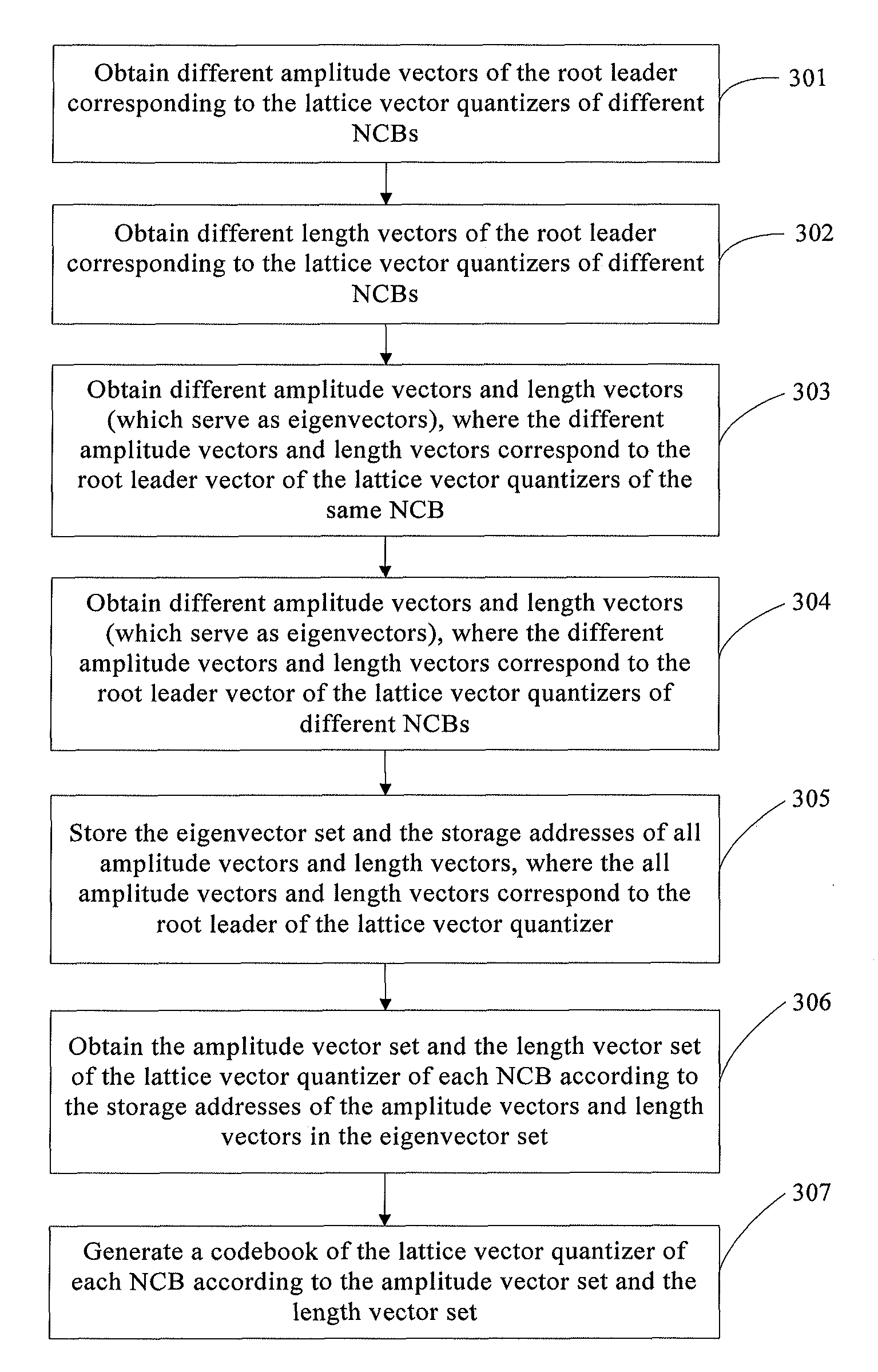
[0086]As shown in FIG. 3, the method provided in the present invention may include the following steps:
[0087]Step 301: Obtain different amplitude vectors corresponding to the root leader vector of the lattice vector quantizers of different NCBs.
[0088]In this embodiment, the 16-dimensional multi-rate Gosset lattice vector quantizer is still taken as an example. This quantizer is detailed in the second embodiment above.
[0089]For example, in this embodiment, in the amplitude vectors of the root leader vector corresponding to the lattice vector quantizers of different NCBs, μ(0,0), μ(1,1), μ(2,1), μ(3,2), μ(4,4), and μ(5,5) are the same. Therefore, only μ(0,0) is obtained as an eigenvector. In this step, 14 amplitude vectors independent of each other are obtained: {μ(0,0), μ(1,0), μ(1,2), μ(2,0), μ(2,2), μ(4,0), μ(4,3), μ(5,4), μ(6,0), μ(6,1), μ(6,3), μ(7,0), μ(7,1), μ(7,5)}.
[0090]Step 302: Obtain different length vectors corresponding to the root leader vector of the lattice vector qua...
PUM
 Login to View More
 Abstract
Description
Claims
Application Information
 Login to View More