
Resist composition and method for producing resist pattern
a composition and resist technology, applied in the direction of photosensitive materials, instruments, photomechanical equipment, etc., can solve the problems of increasing the number of resist pattern defects to be produced from resist compositions, and achieve excellent resist composition, good resist composition quality, and good resist composition quality.
- Summary
- Abstract
- Description
- Claims
- Application Information
AI Technical Summary
Benefits of technology
Problems solved by technology
Method used
Image

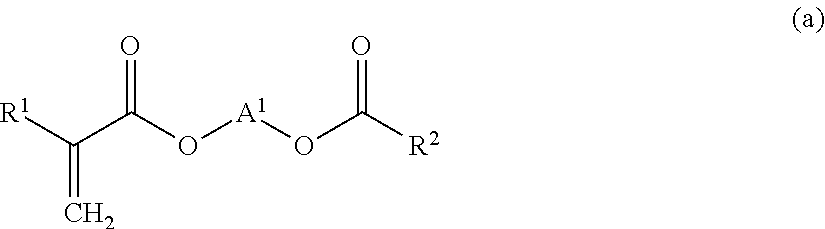

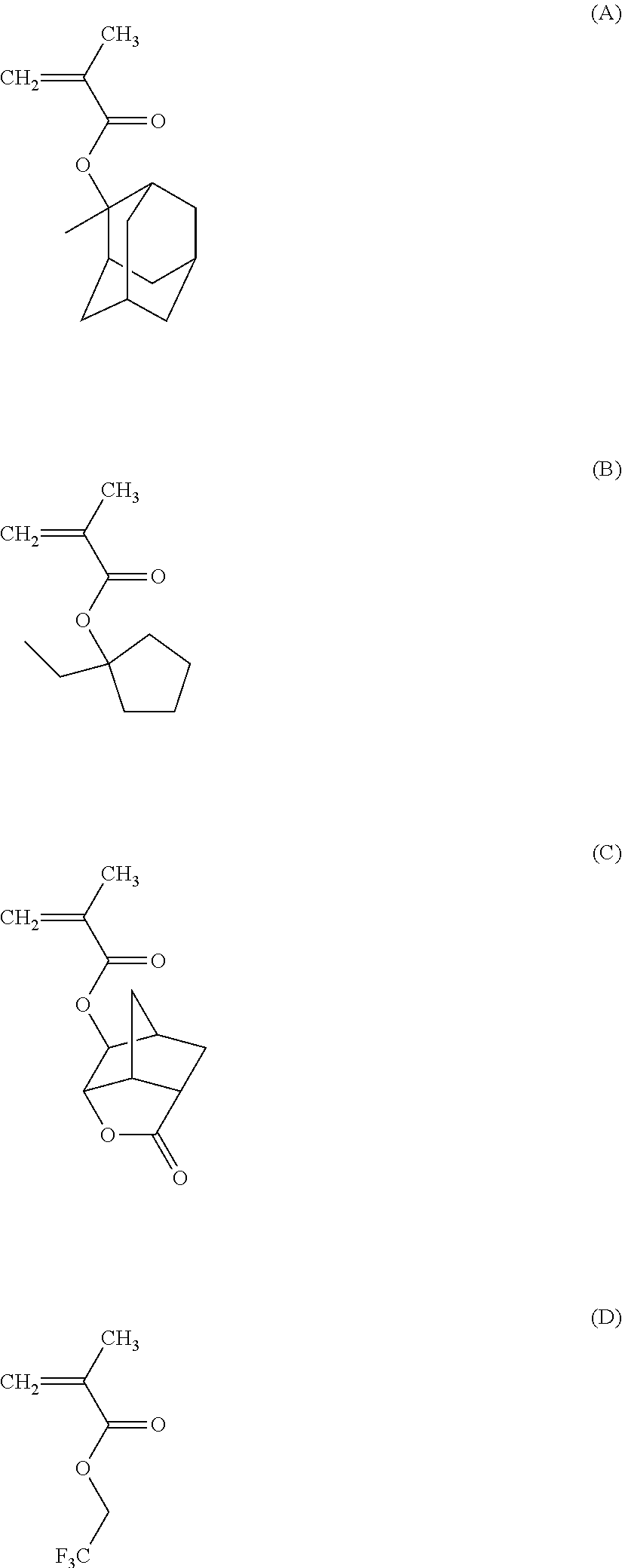
Examples
synthesis example 1
Synthesis of Compound (I)
[0741]
[0742]10.00 parts of a compound (I-2), 40.00 parts of tetrahydrofuran and 7.29 parts of pyridine were introduced into a reactor, and stirred for 30 minutes at 23° C. The obtained mixture was cooled to 0° C. To this mixture, 33.08 parts of a compound (I-1) was added over 1 hour while maintaining at the same temperature. The temperature of the mixture was then elevated to about 23° C., and the mixture was stirred for 3 hours at the same temperature. 361.51 parts of ethyl acetate and 20.19 parts of 5% hydrochloric acid solution were added to the obtained reactant, and stirred for 30 minutes at 23° C. Then, after allowed to stand, the obtained solution was separated to recover an organic layer. To the organic layer, 81.42 parts of a saturated sodium hydrogen carbonate was added, and the obtained solution was stirred for 30 minutes at 23° C., allowed to stand, and then separated to recover the organic layer. To the recovered organic layer, 90.38 parts of io...
synthesis example 2
Synthesis of Compound (J)
[0744]
[0745]8.50 parts of a compound (J-2), 34.00 parts of tetrahydrofuran and 6.20 parts of pyridine were introduced into a reactor, and stirred for 30 minutes at 23° C. The obtained mixture was cooled to 0° C. To this mixture, 13.78 parts of a compound (J-1) was added over 1 hour while maintaining at the same temperature. The temperature of the mixture was then elevated to about 23° C., and the mixture was stirred for 3 hours at the same temperature. 249.91 parts of ethyl acetate and 17.16 parts of 5% hydrochloric acid were added to the obtained reactant, and stirred for 30 minutes at 23° C. Then, after allowed to stand, the obtained solution was separated to recover an organic layer. To the recovered organic layer, 62.62 parts of a saturated sodium hydrogen carbonate was added, and the obtained solution was stirred for 30 minutes at 23° C., allowed to stand, and then separated to recover the organic layer. To the recovered organic layer, 62.62 parts of io...
synthesis example 3
Synthesis of Compound (O)
[0749]
[0750]88.00 parts of a compound (O-2), 616.00 parts of methyl isobutyl ketone and 60.98 parts of pyridine were mixed while stirring for 30 minutes at 23° C. The obtained mixture cooled to 0° C. To this mixture, 199.17 parts of a compound (O-1) was added over 1 hour while maintaining at the same temperature. The temperature of the mixture was then elevated to about 10° C., and the mixture was stirred for 1 hour at the same temperature. Thus obtained reactant was added to 1446.22 parts of n-heptane and 703.41 parts of 2% of hydrochloric acid solution to obtain a mixture, the mixture was stirred for 30 minutes at 23° C. The obtained solution was allowed to stand, and then separated to recover an organic layer. To the organic layer 337.64 parts of 2% of hydrochloric acid solution was added, and the obtained solution was stirred for 30 minutes at 23° C., allowed to stand, and then separated to recover the organic layer. To the recovered organic layer, 361.5...
PUM
| Property | Measurement | Unit |
|---|---|---|
| wavelength | aaaaa | aaaaa |
| temperature | aaaaa | aaaaa |
| pore diameter | aaaaa | aaaaa |
Abstract
Description
Claims
Application Information
 Login to View More