
All-optical regenerator and optical network incorporating same
a regeneration device and optical network technology, applied in multiplex communication, electrical equipment, wavelength-division multiplex systems, etc., can solve the problems of aor no longer being functional, aor increasing in sophistication and complexity, and aor reducing the functionality of aor, so as to reduce size, cost, power consumption, and complexity. , to achieve the effect of reducing noise and distortion, reducing complexity and complexity
- Summary
- Abstract
- Description
- Claims
- Application Information
AI Technical Summary
Benefits of technology
Problems solved by technology
Method used
Image

Examples
Embodiment Construction
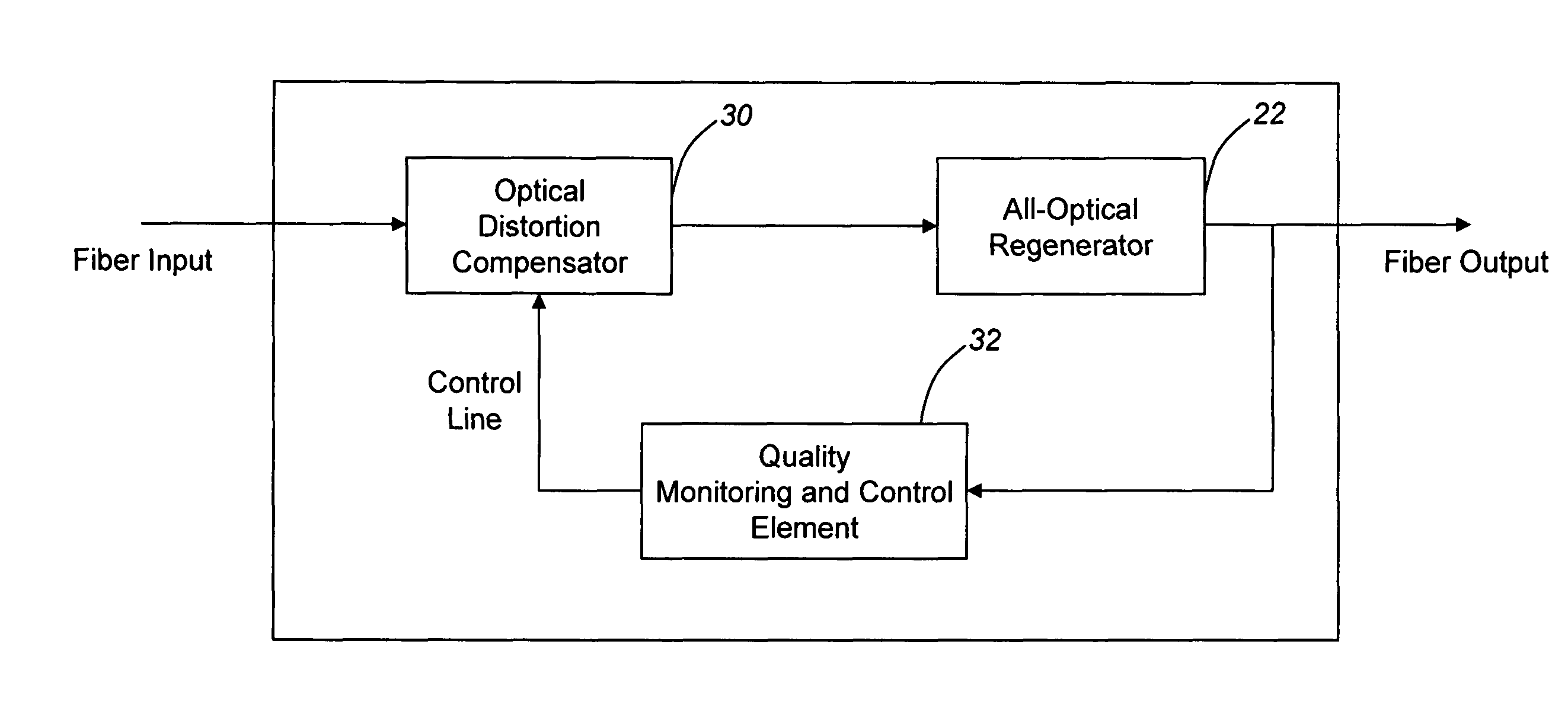
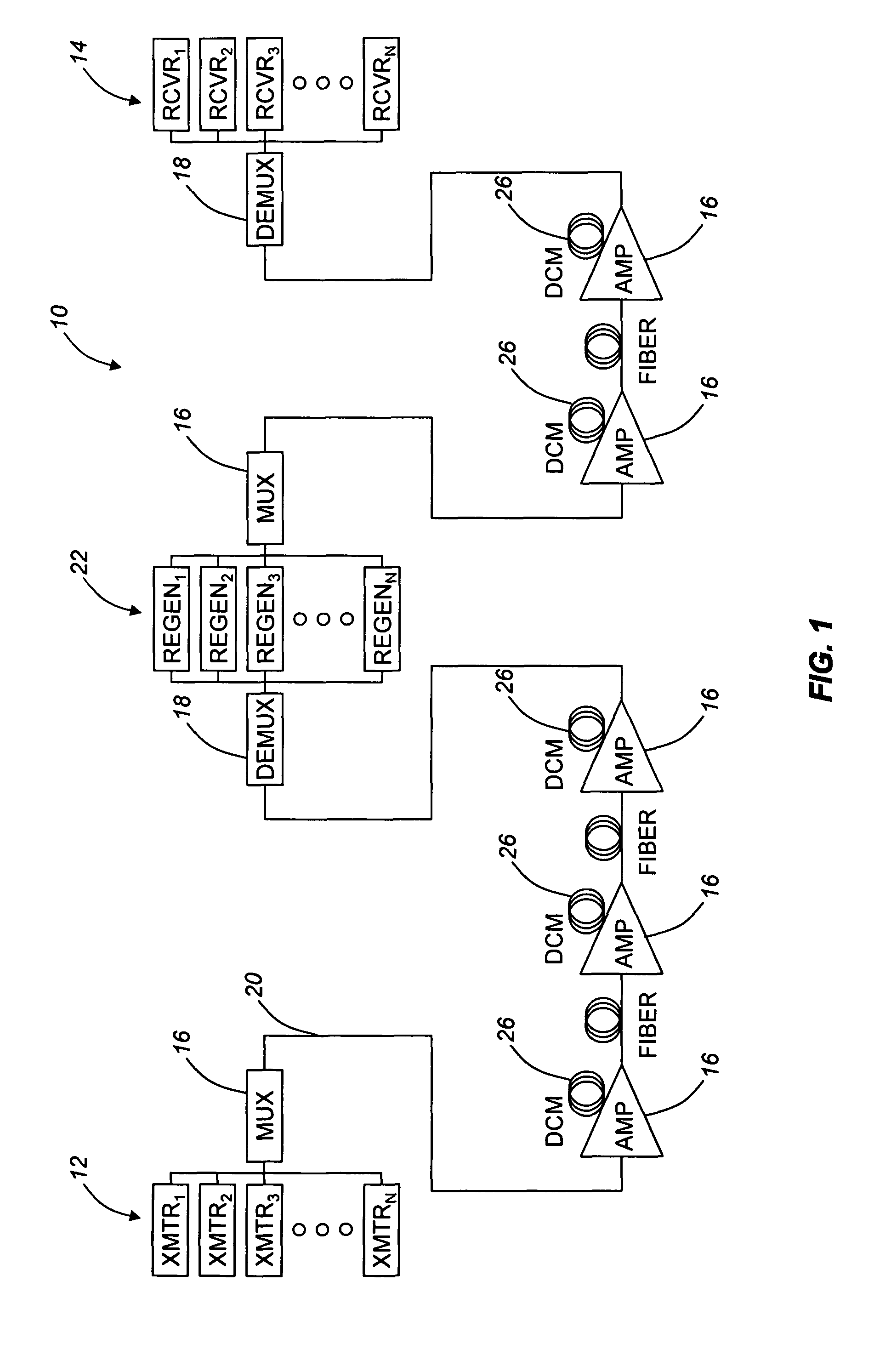
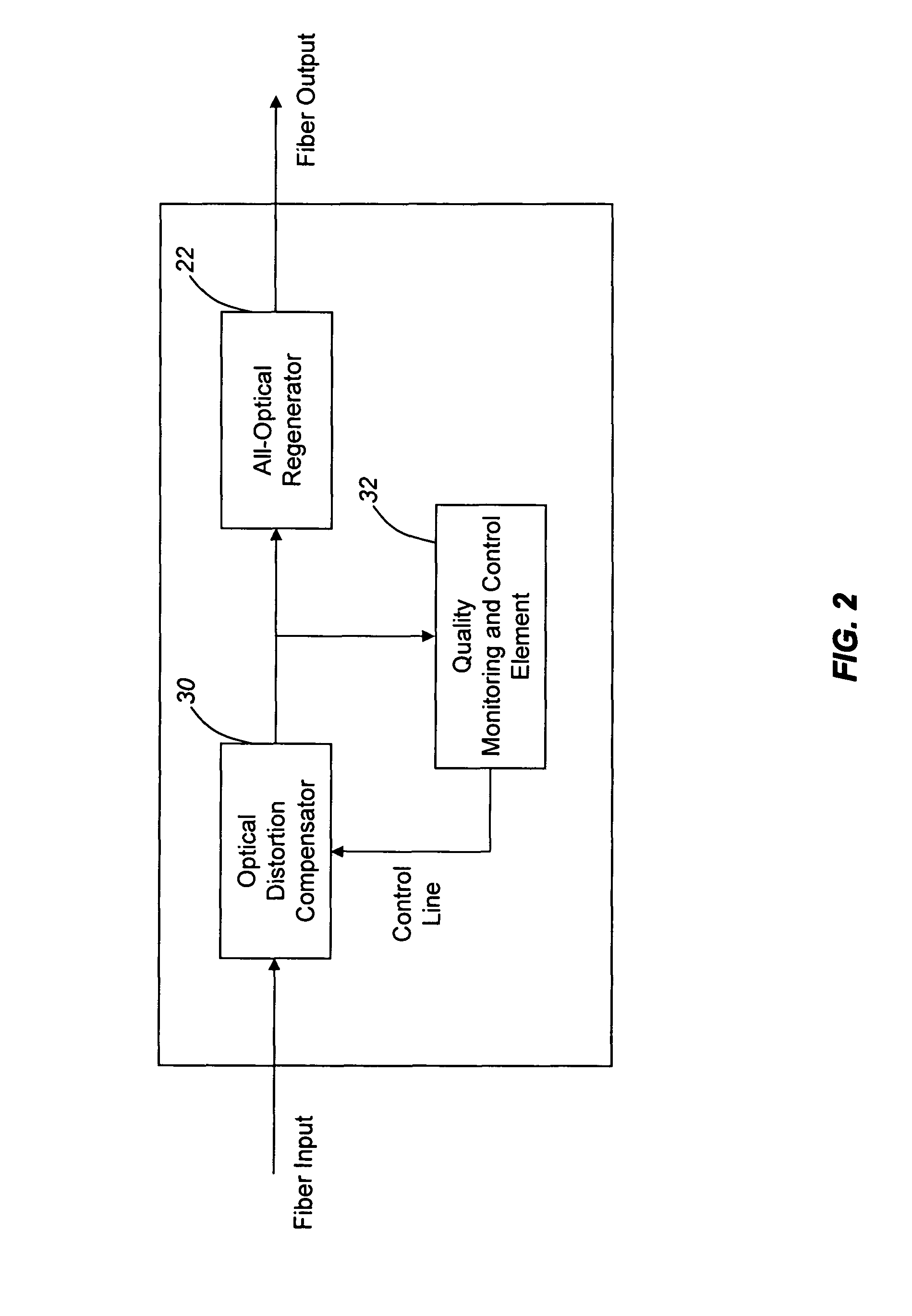
[0017]Typically, a regenerator node must eliminate signal noise and distortion through its re-amplify and re-shape (2R) functionality. Optionally, the regenerator node also provides a re-time (3R) functionality. Preferably, however, the regenerator node further provides a data or signal quality monitoring functionality for tunable distortion compensation, as well as a data or signal quality monitoring functionality for fault isolation and correction switching mechanisms.
[0018]All-optical regenerators may be based on several principles, as described below. For example, all-optical regenerators may be based on cross-gain modulation (XGM), cross-phase modulation (XPM), or four-wave-mixing (FWM) in semiconductor optical amplifiers. Alternatively, all-optical regenerators may be based on nonlinear effects in optical fibers. In general, all-optical regeneration is a process that removes the noise from optical signals and restores the optical signals to well-defined levels for further tran...
PUM
 Login to View More
 Abstract
Description
Claims
Application Information
 Login to View More