With models being some kind of graphs, model merging is a different challenge than the more common (and usually line-wise) merging of text files as it is done, e.g., in version control systems.
However, text-based merge tools are not natural tools for handling the merging of models.
For example, most textual representations are ill-suited for direct use by humans and are only meant as storage formats or for model interchange.
In particular, the structure of the (linear) textual representations usually differs considerably from the non-linear, graph-like structure of the model itself, making it difficult and cumbersome to work directly with these representations.
Second, even small changes of a model can lead to significant changes of its textual representation, making it hard to differentiate between the actual changes on the model level and purely “syntactical” changes implicated by the textual representation.
Text-based tools therefore are not really appropriate for model merging.
These difficulties demonstrate that model merging currently is inevitably a manual task of which only certain trivial tasks can be safely automated.
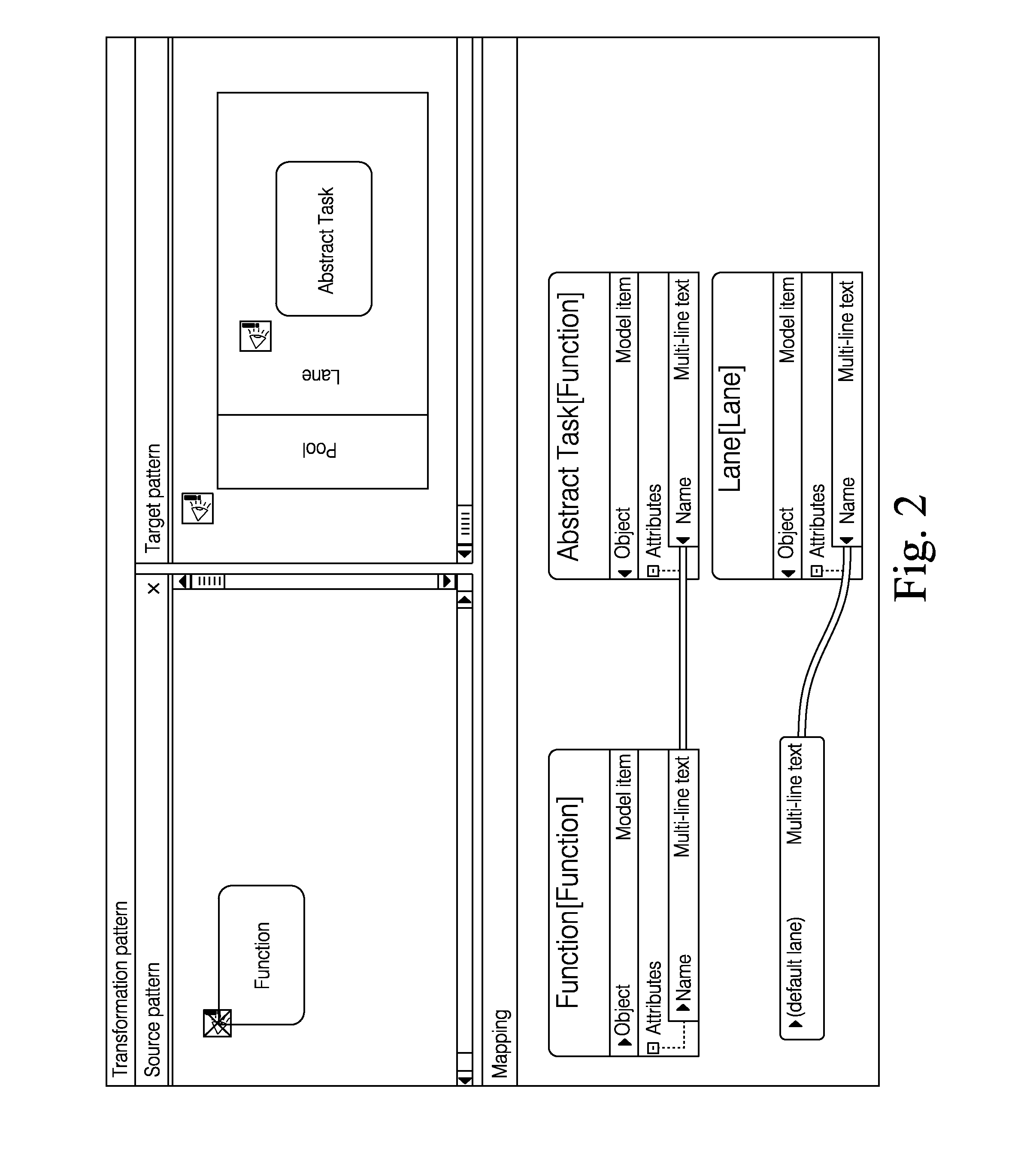
The degree of complexity transformation rules can have can be quite large.
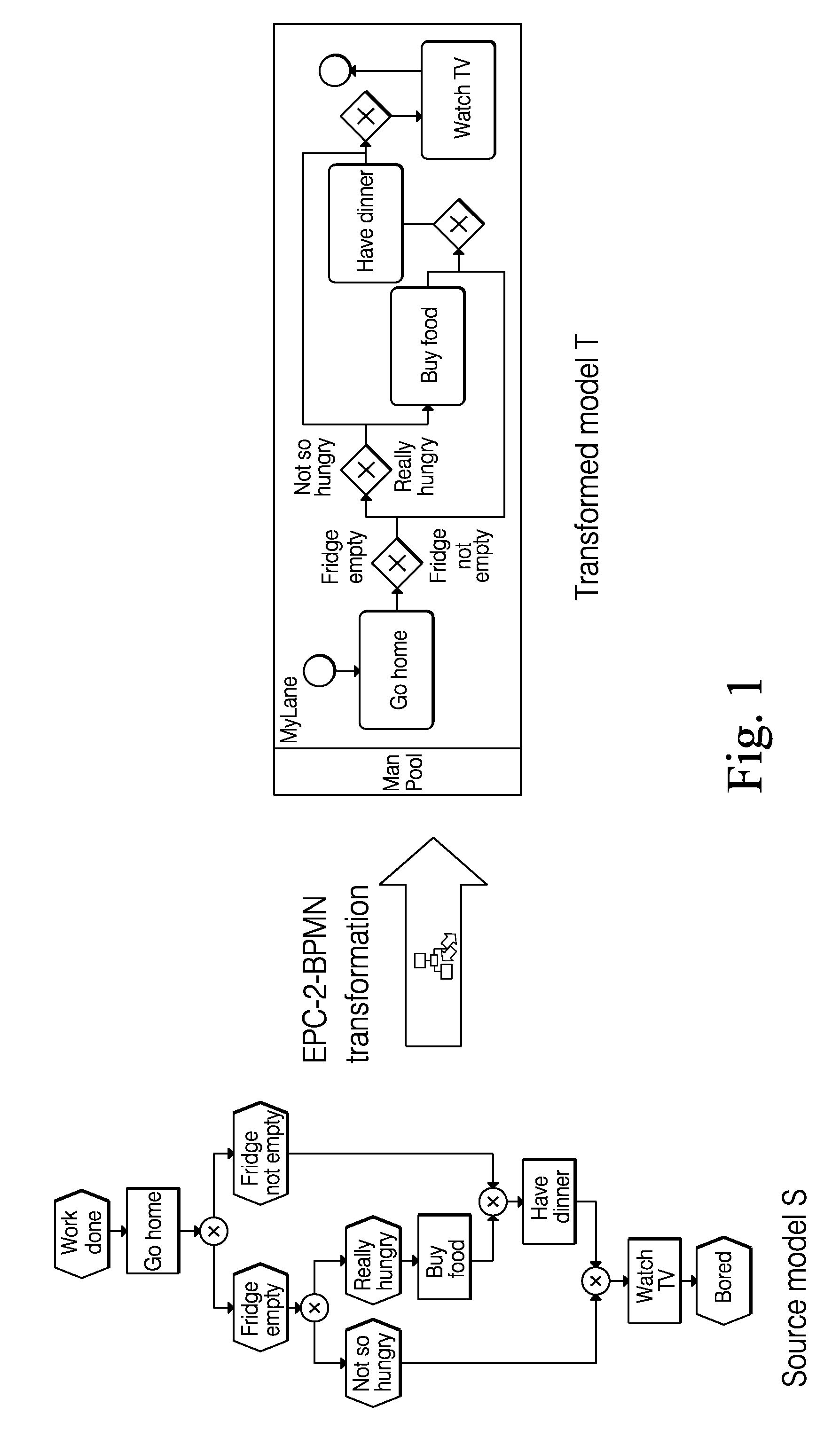
One challenge in the design of the EPC-2-BPMN transformation involved the handling of ambiguities.
Being a fully manual development task, this approach is both slow and costly.
In this case, it is not desirable to simply replace T″ with T′ to get the business-level changes to the technical level, as this would lose all changes by the technical user that yielded T″.
Thus, if the identity of their source model elements were not used as a distinguishing criterion, it might not be possible to disambiguate these equal (but not identical) result model elements and thus it might not be possible to perform proper non-ambiguous merging.
In an ideal scenario, the actual merge state of this connection might have to be “deleted in target.” The merge, however, may not be able to distinguish between these two situations.
To be able to correctly flag this connection as “deleted in target,” it may be necessary to maintain the complete change history of T′, which could be difficult or impossible or simply not worth the tradeoffs between size, space, complexity, possible processing gains, etc.
While it is possible to handle the resolution of merge conflicts by individually accepting or rejecting atomic conflicts, this approach is not very convenient and can sometimes confront the user with internal details of the model representation in ARTS.
Business users may be presented with potentially complicated technical details, technical people may be presented with business aspects that they do not necessarily understand, etc.
However, this merge technique does not offer selective control over how individual conflicts are resolved.
It further does not allow users to bring a selection of changes from model M′ back to M″.
Another issue that arises with roundtrip engineering in software engineering contexts is that many aspects that can be represented explicitly with dedicated model elements (e.g., containment or aggregation associations) are mapped to the same basic elements of the target programming language (e.g., object references).
Therefore, it is often difficult to recognize such aspects of modeling based on the code and properly propagate them back to the model level.
Thus, this current approach does not support the person performing the interactive merge in propagating such changes from the technical BPMN level to the EPC level.
As explained below, however, there are a number of drawbacks to manually solving these issues.
One disadvantage of such a manual approach relates to the effort involved for the user.
While it may seem straightforward in this simple example, once more than a few changes have to be propagated to the EPC, this approach can quickly become a repetitive, time consuming, and error-prone task.
In addition, a correct propagation is not always as simple and obvious as in this example where the creation and connection of only a single object in the EPC was involved.
The problem of correct and consistent model propagation is similarly severe in the above-mentioned systems engineering context.
Such strong interrelations as well as other feature interactions can make the correct and consistent propagation of model elements between different model levels quite difficult.
Even if the manual effort and the required internal knowledge about the transformation were considered acceptable, such manual change propagation may also have technical restrictions.
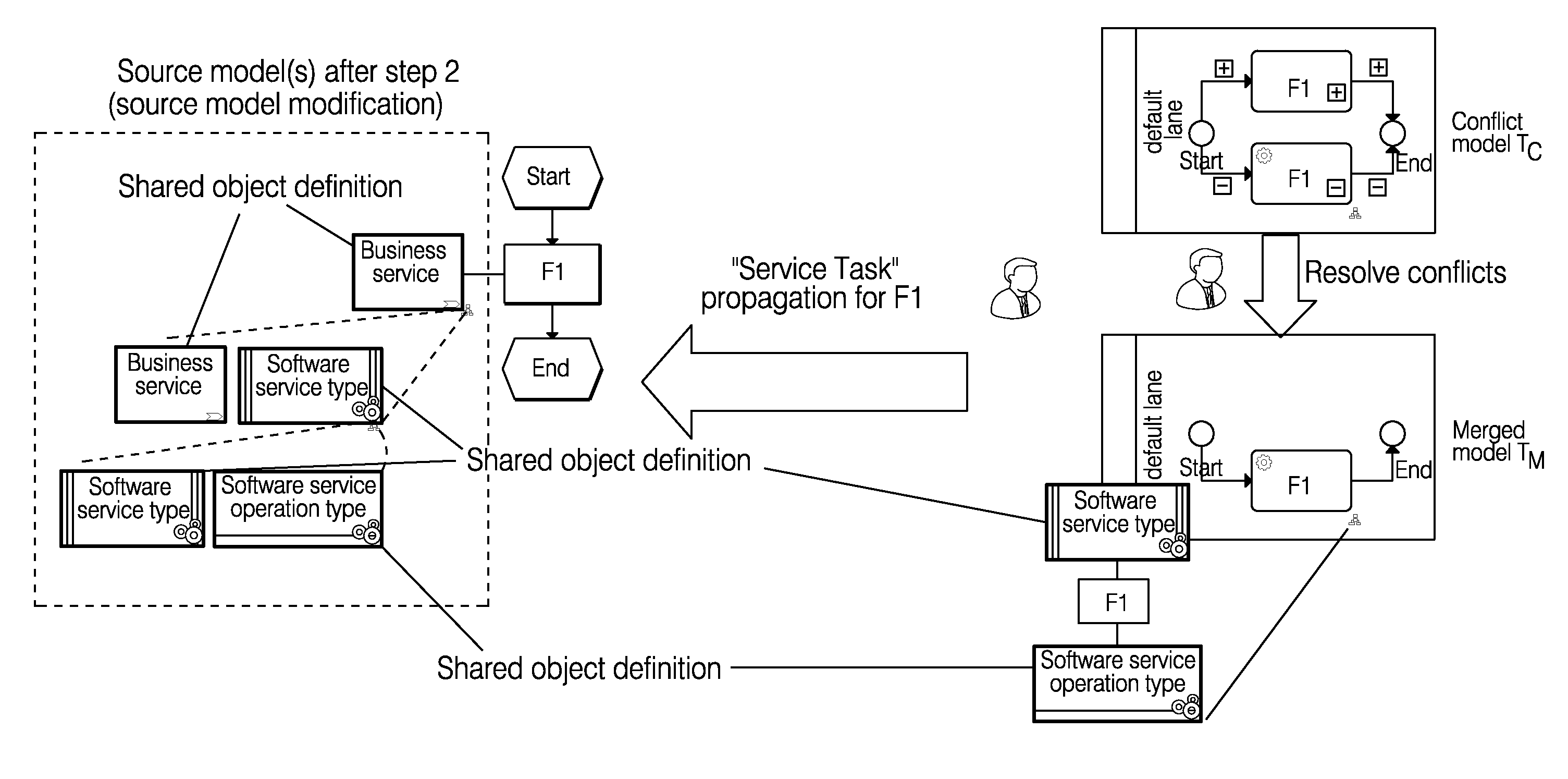
Doing so, however, would still not provide the desired result.
As before, this would come at the cost that any renaming, etc., of F1 in the EPC would not be propagated.
This example helps illustrate that once one tries to propagate a change involving a more complex pattern, the effort involved and the knowledge needed to “get it right” quickly becomes prohibitive in practice.
As shown above, there oftentimes will be a manual effort involved in such a task for anything but the most trivial cases, and limitations of this manual approach that are related to the way the model merge decides whether two objects are mergeable have been described.
If, however, the merge method uses the identity-based mergeability decision discussed above not only for deciding the mergeability of objects, but also for connections, a conflict like the one shown in the lower right of FIG. 16 could arise.
In these situations, as with the addition and modification operations discussed before, a manual propagation of the changes on the technical level to the business level would not be possible, as the user would need to manipulate the internal trace information, etc.


 Login to View More
  Login to View More