Because models are a kind of graphs, model merging is a very different challenge than the more ubiquitous (usually line-wise) merging of text files as it is done, e.g., in version control systems.
However, text-based merge tools are not natural tools for handling the merging of models.
First, most textual representations are ill-suited for direct use by humans, and instead are intended to be used as storage formats and / or to be used in model interchange.
In particular, the structure of (linear) textual representations usually differs considerably from the non-linear, graph-like structure of the model itself, thereby making it cumbersome to work directly with these representations.
Second, even small changes of a model may lead to significant changes of its textual representation, making it hard to differentiate between the actual changes on the model level and purely “syntactical” changes necessitated by the textual representation.
Text-based tools therefore are viewed as being inappropriate for model merging.
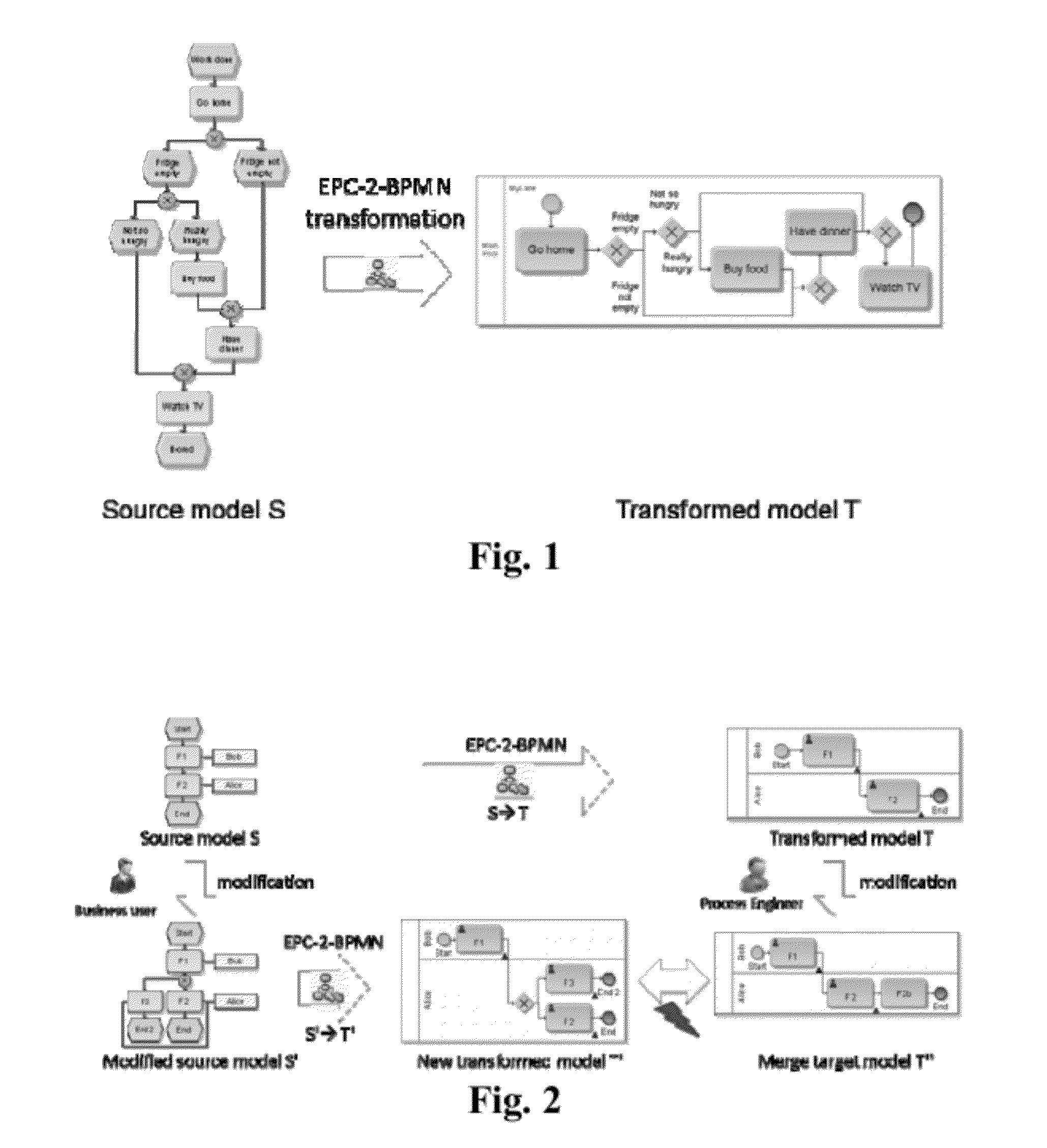
In this case, it might not be possible to simply replace T″ with T′ to get the business-level changes to the technical level, as doing so would risk losing some or all of the changes by the technical user that yielded T″ in the first place.
In a perfect world, the actual merge state of this connection would have to be “deleted in target.” The merge, however, cannot distinguish between these two situations.
However, this merge does not offer
selective control over how individual conflicts are resolved and is not interactive.
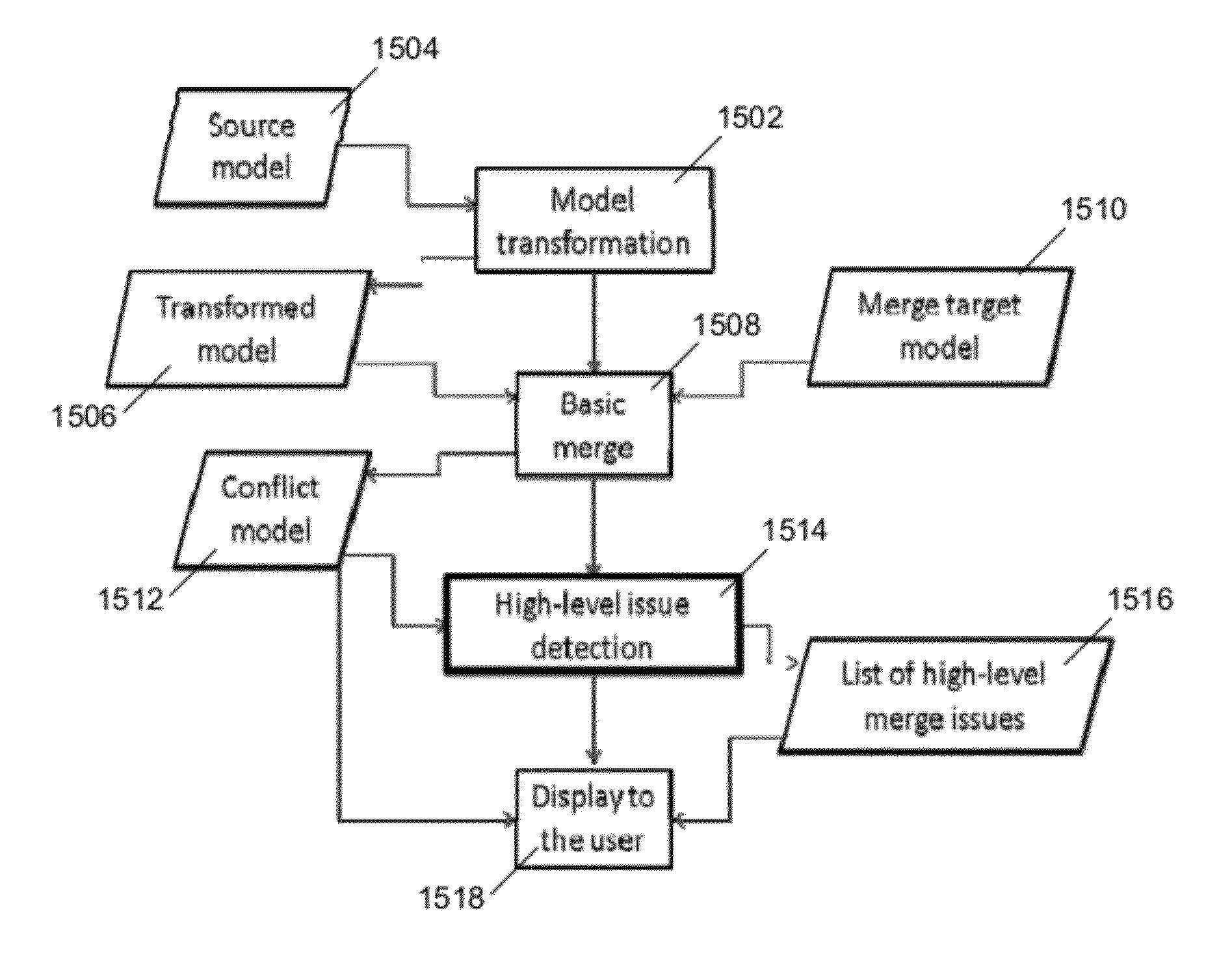
The inventor of the instant application has found the individual selecting and manual accepting or rejecting of the model elements that could not be merged (i.e., that have no corresponding element in the other model and therefore have a merge state) to be very tedious and error prone, especially if the models are large and have many differences.
For example, objects that have different merge states and are actually the result of one large change in A or B can be “far apart” from each other in the partially merged model and are therefore difficult to find and resolve consistently.
However, as discussed above, the comparison of complex design artifacts like models in a text-based representation is generally inadequate for the task at hand.
Any
fully automatic “fire and forget” solution will invariably either have to be optimized for certain use cases where the requirements are well-defined (and can consequently not be generic) or it will yield inadequate results for the majority of usages.
Prior solutions unfortunately are complex, and conflict resolution on the level of atomic conflicts is error prone.
A common drawback of existing interactive merge approaches relates to a limited ability to recognize individual “atomic conflicts” between the two models being merged.
Regardless of the actual paradigm used to present these differences (e.g., an integrated “conflict model” as in the case of the ARIS transformation merge, the “
split screen” provided by
Oracle's BPA suite, etc.), a common problem of these approaches is that even with a relatively modest number of differences between the models being merged, the user is quickly overwhelmed by their sheer number.
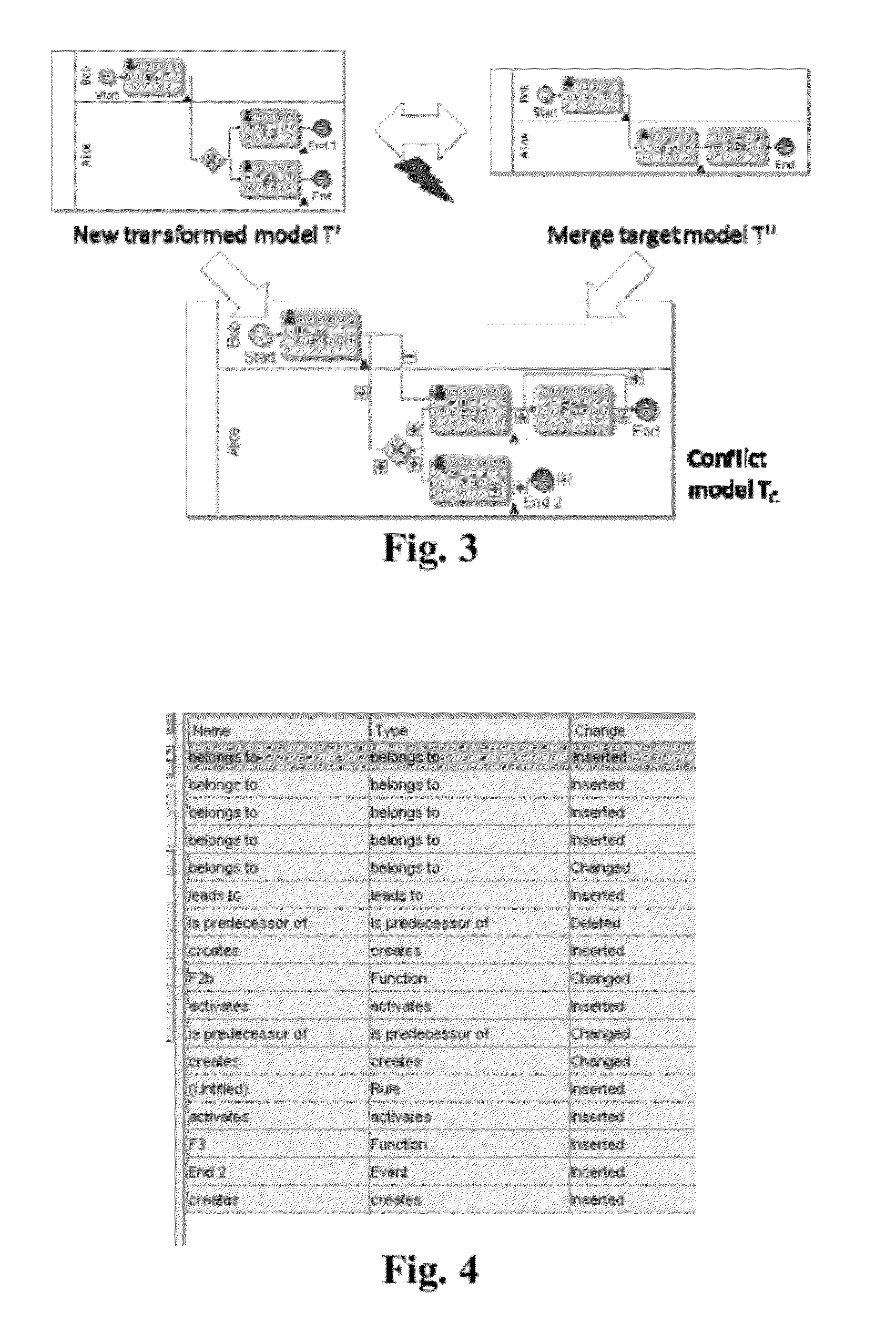
As the conflict model in the FIG. 3 example and the corresponding table of atomic conflicts in FIG. 4 illustrate, even comparatively small changes lead to a large number of atomic conflicts that require individual attention by the user.
For each such element, the user has to decide what to do with it (e.g., remove it, accept it into the merge result, accept it after modification, etc.), requiring a considerable amount of user attention and opening the door to mistakes.
Furthermore, models often have model elements without a direct graphical representation that can be subject of an atomic conflict including, for example, the container connections described above.
While the deficits of IRSA can in part be explained by its different target
user group (
software engineers instead of business analysts), it shows that IRSA does not help in resolving larger, semantically related groups of differences during merging.


 Login to View More
  Login to View More