
Connector and switch
a technology of connecting wires and switches, applied in the direction of coupling devices, two-part coupling devices, electrical equipment, etc., can solve the problem that the connection in which a currently used switch is assembled cannot be used without modification, and achieve the effect of safe supply, better safety and better reliability
- Summary
- Abstract
- Description
- Claims
- Application Information
AI Technical Summary
Benefits of technology
Problems solved by technology
Method used
Image

Examples
first embodiment
(Structure of Connectors)
[0079]The structure of the connector of a first embodiment is described.
[0080]The connector of the first embodiment is connected to another connector being a plug connector illustrated in FIGS. 1 to 5. The connector of the first embodiment corresponds to a jack connector having a structure illustrated in FIGS. 6 to 8. Hereinafter, the plug connector illustrated in FIGS. 1 to 5 and the jack connector illustrated in FIGS. 6 to 8 may be collectively referred to as a connector.
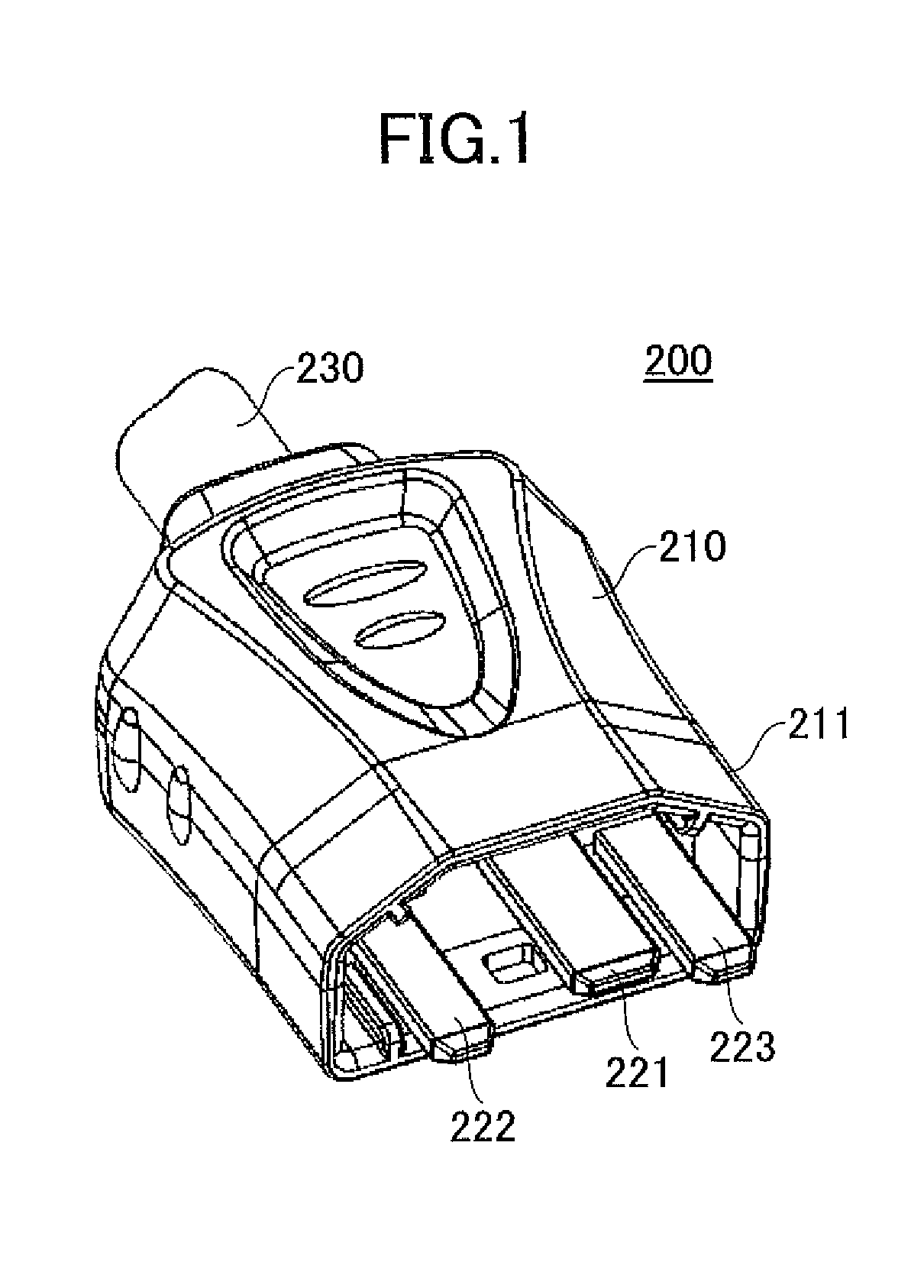
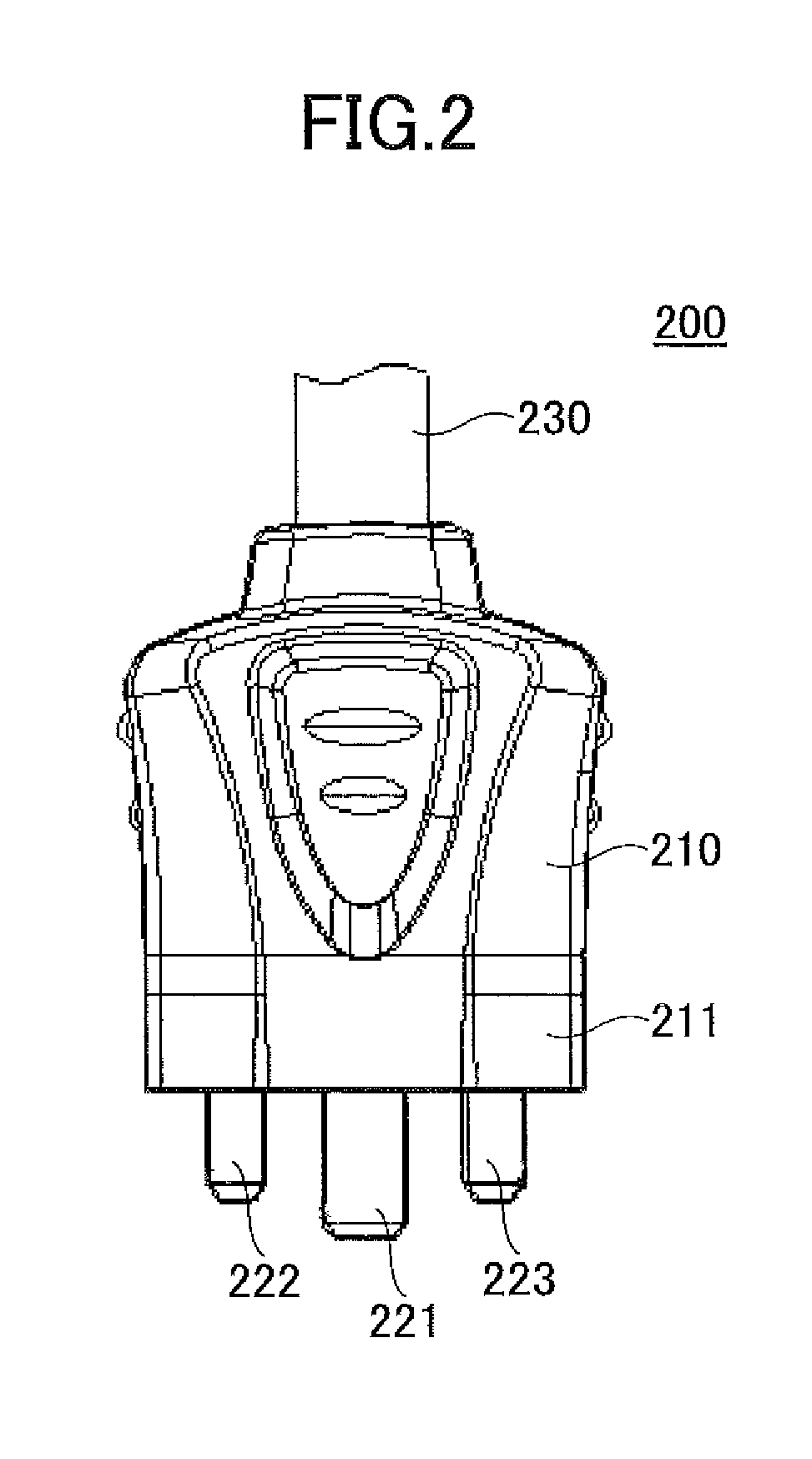
[0081]Firstly, referring to FIGS. 1 to 5, a plug connector 200 is explained. FIG. 1 is a perspective view of the plug connector 200. FIG. 2 is a plan view of the plug connector 200. FIG. 3 is a side view of the plug connector 200. FIG. 4 is a bottom view of the plug connector 200. FIG. 5 is a front view of the plug connector 200. The plug connector 200 includes a cover portion 210 formed by insulating material or the like and three plug terminals 221, 222, and 223, which are examples of ot...
second embodiment
[0107]Next, a switch of a second embodiment is described. The switch of the second embodiment corresponds to the switch portion of the first embodiment. The switch is described in more detail.
[0108]A power source switch used in a case where the voltage supplied from an electric power source is 100 V or greater.
[0109]When the voltage supplied from the electric power source is 100 V or greater, e.g., direct current 400 V, a commercially available switch may not shut down electric power supply. This phenomenon may be caused when contacting contacts are molten by heat caused by any reason because the voltage is high or the direct current is used. If such a phenomenon is caused, the function as the switch is completely lost to influence the electric power supply. Therefore, there occurs a problem in the function of the switch.
(Switch)
[0110]Next, an example of the switch of the second embodiment is described. The switch of the second embodiment is used to control supply of electric power....
third embodiment
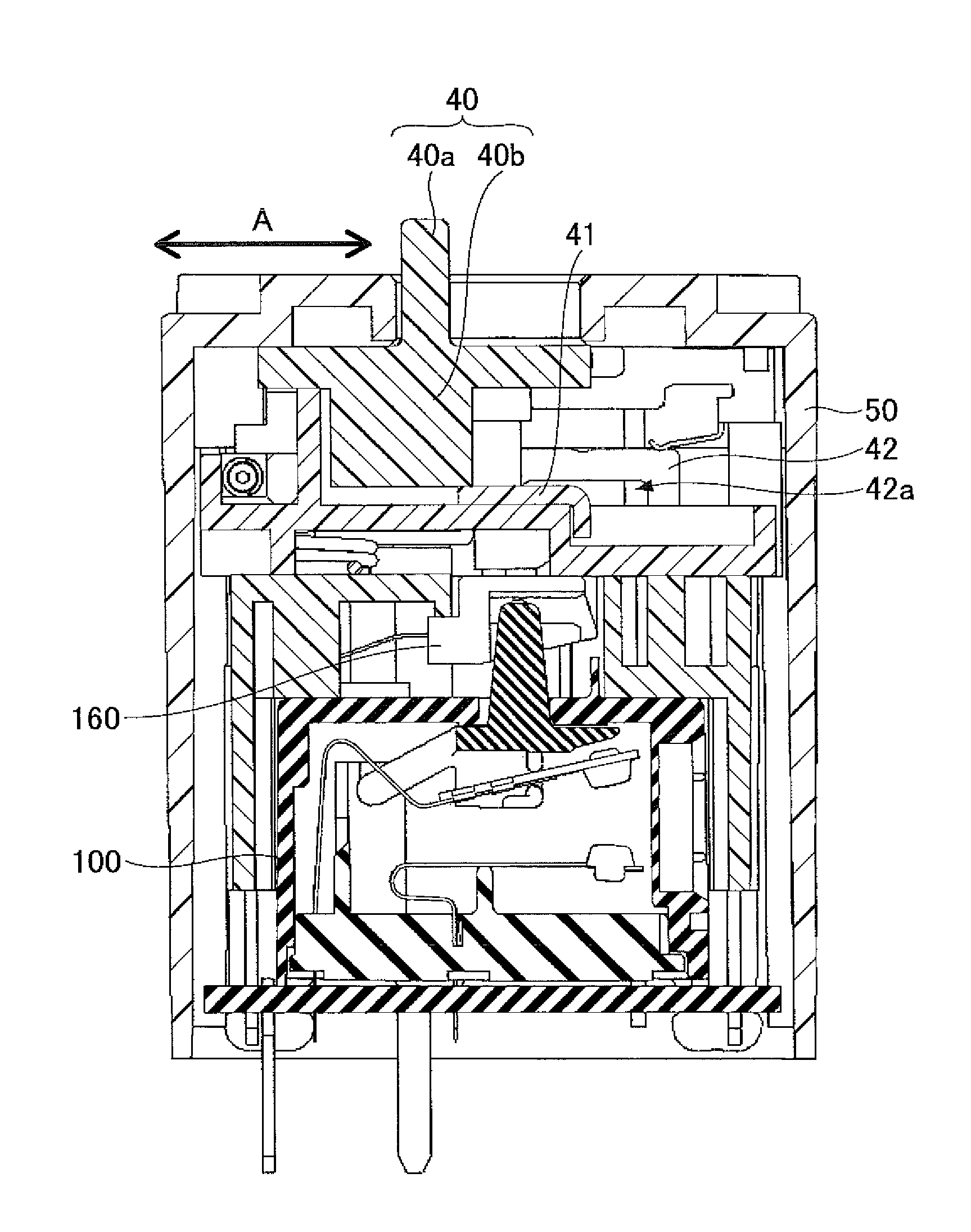
[0128]Next, a switch of a third embodiment is described. In the switch of the third embodiment, the turn-off state is illustrated in FIG. 40 and the turn-on state is illustrated in FIG. 41.
[0129]Referring to FIGS. 40 and 41, the switch of the third embodiment includes a card 340 having no rotating shaft. By pushing the button 160, the card 340 moves up or down to causing the fixed contact 111 of the fixed portion 110 to contact the movable contact 121 of the movable portion 120.
[0130]Specifically, by pressing the button 160, a contact portion 344a in contact with the button inner portion 161 of the button 160 is pushed. Thus, the card 340 moves downwardly. Then, an upper contact part 341 pushes the movable plate 122 downwardly to make the fixed contact 111 contact the movable contact 121. Thus, as illustrated in FIG. 41, the switch becomes the turn-on state. Under this state, in a manner similar to the second embodiment, a turn-on state retaining mechanism or the like (not illustrat...
PUM
 Login to View More
 Abstract
Description
Claims
Application Information
 Login to View More