Check patentability & draft patents in minutes with Patsnap Eureka AI!

Automated fish reader using learning machines

a technology of learning machine and fish reader, applied in the field of automatic fish reader using learning machine, can solve the problems of time-consuming and expensive, tedious dot counting technique, and large number of cells to be examined by a trained cytogeneticist,

Active Publication Date: 2016-06-28
NEOGENOMICS LAB
View PDF12 Cites 6 Cited by
  • Summary
  • Abstract
  • Description
  • Claims
  • Application Information

AI Technical Summary

Benefits of technology

The system significantly reduces the time and subjectivity in FISH data analysis, providing accurate and efficient automated classification and counting of signals, enhancing the reliability of FISH data interpretation by addressing the limitations of existing methods.

Problems solved by technology

A major limitation of the FISH technique for dot counting is the need to examine large numbers of cells.
Visual evaluation by a trained cytogeneticist of large numbers of cells and enumeration of hybridization signals is tedious, time consuming and expensive.
Unfortunately, there are many obstacles to be overcome before automated analysis of FISH images can be implemented on a widespread basis.
Additional obstacles include that the cells are not usually well defined, there are no clear boundaries between cells, overlapping of cells is common, and cells are frequently only partially visible in an image.
It does not address the problems of further analysis, such as separating overlapping nuclei or dot counting.
Overlap among the simple binary classes presented a problem that significantly reduced accuracy.
The reduction of the available patterns for classification leads to a small and heavily imbalanced database.
This imbalance produces biased training in which majority classes dominate the decision boundaries, further reducing the prediction accuracy of the overall method.

Method used

the structure of the environmentally friendly knitted fabric provided by the present invention; figure 2 Flow chart of the yarn wrapping machine for environmentally friendly knitted fabrics and storage devices; image 3 Is the parameter map of the yarn covering machine
View more

Image

Smart Image Click on the blue labels to locate them in the text.
Viewing Examples
Smart Image
  • Automated fish reader using learning machines
  • Automated fish reader using learning machines
  • Automated fish reader using learning machines

Examples

Experimental program
Comparison scheme
Effect test

Embodiment Construction

[0023]For purposes of the description of the invention, the terms “dot” or “spot”, or pluralities thereof, may be used interchangeably to refer to the detected fluorescence signal(s) resulting from hybridization of tagged probes with target sequences for the detection of abnormalities using tissue sections or cell samples.

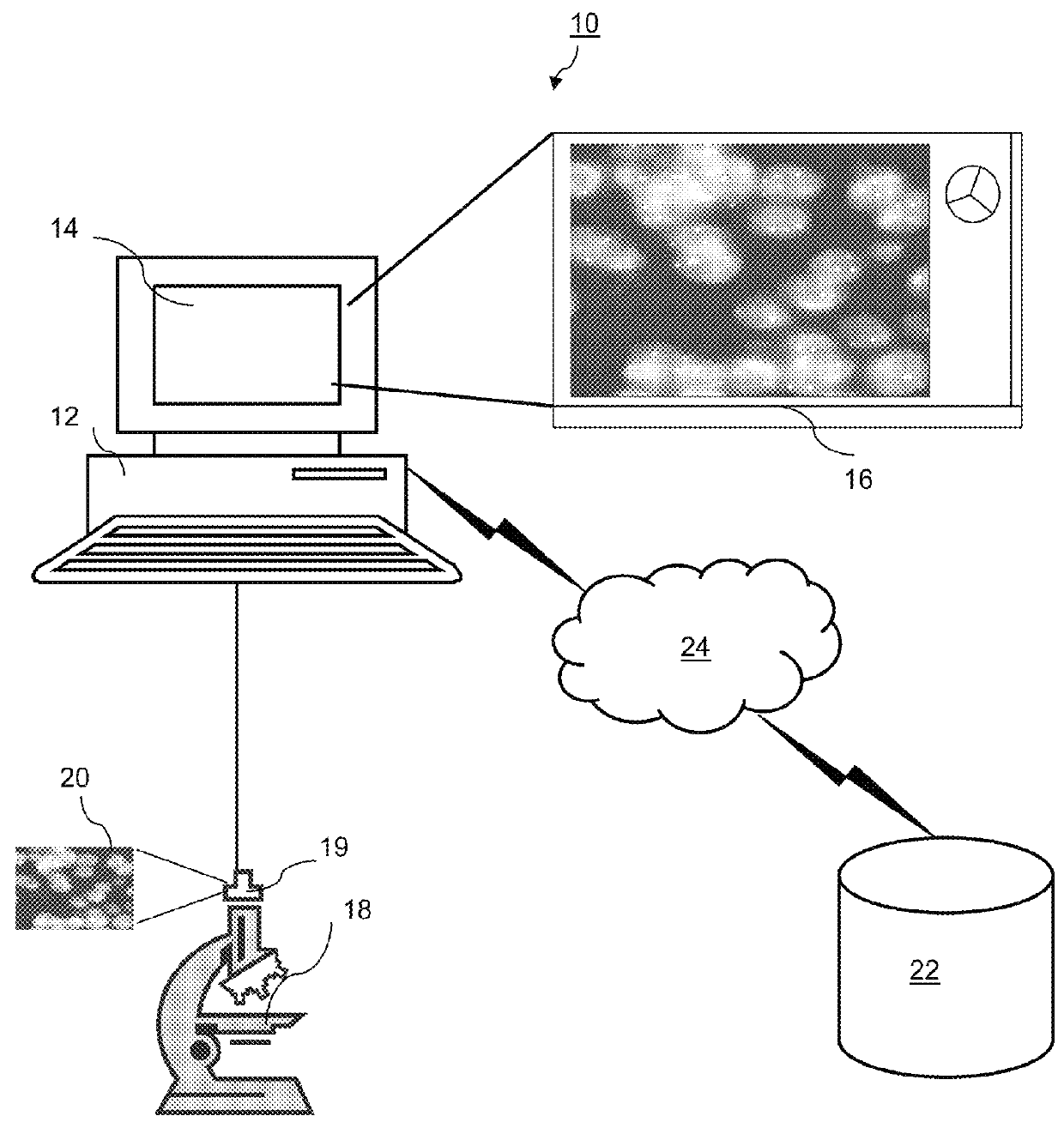
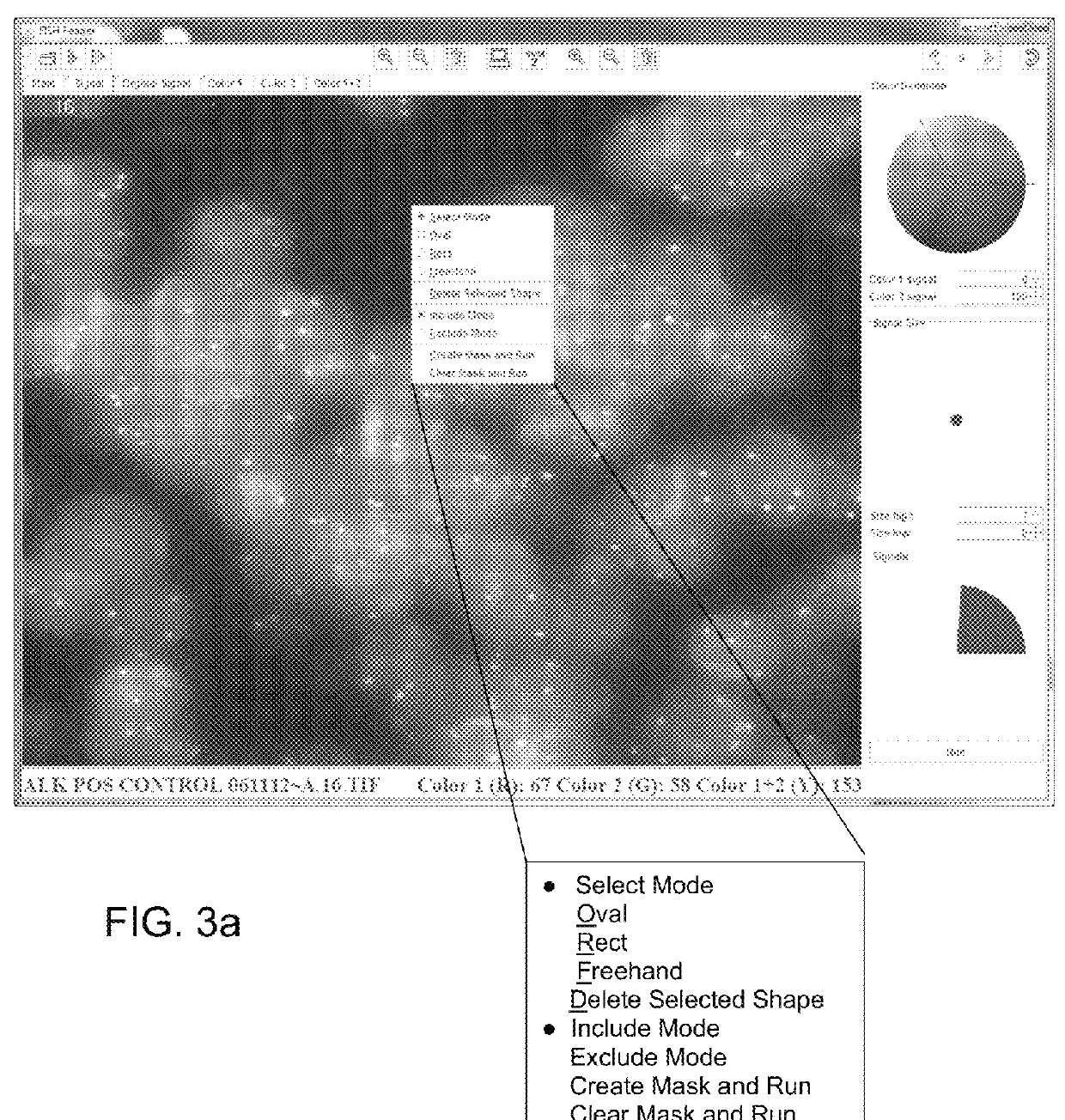
[0024]FIG. 1 is a block diagram illustrating an exemplary automated fluorescence in situ hybridization (FISH) analysis system 10. The exemplary system 10 includes one or more computers 12 with a display 14 (one of which is illustrated). The display 14 presents a windowed graphical user interface (“GUI”) 16 to a user. The display 14 may be a touch screen, allowing entry of selections using the screen, or a user interface in the form of a mouse, stylus, touch pad, trackball, or other device may be connected by cable or wireless link to the computer 12.

[0025]The system 10 further includes a microscope 18 with a digital detector 19 such as a camera or other optical det...

the structure of the environmentally friendly knitted fabric provided by the present invention; figure 2 Flow chart of the yarn wrapping machine for environmentally friendly knitted fabrics and storage devices; image 3 Is the parameter map of the yarn covering machine
Login to View More

PUM

No PUM Login to View More

Abstract

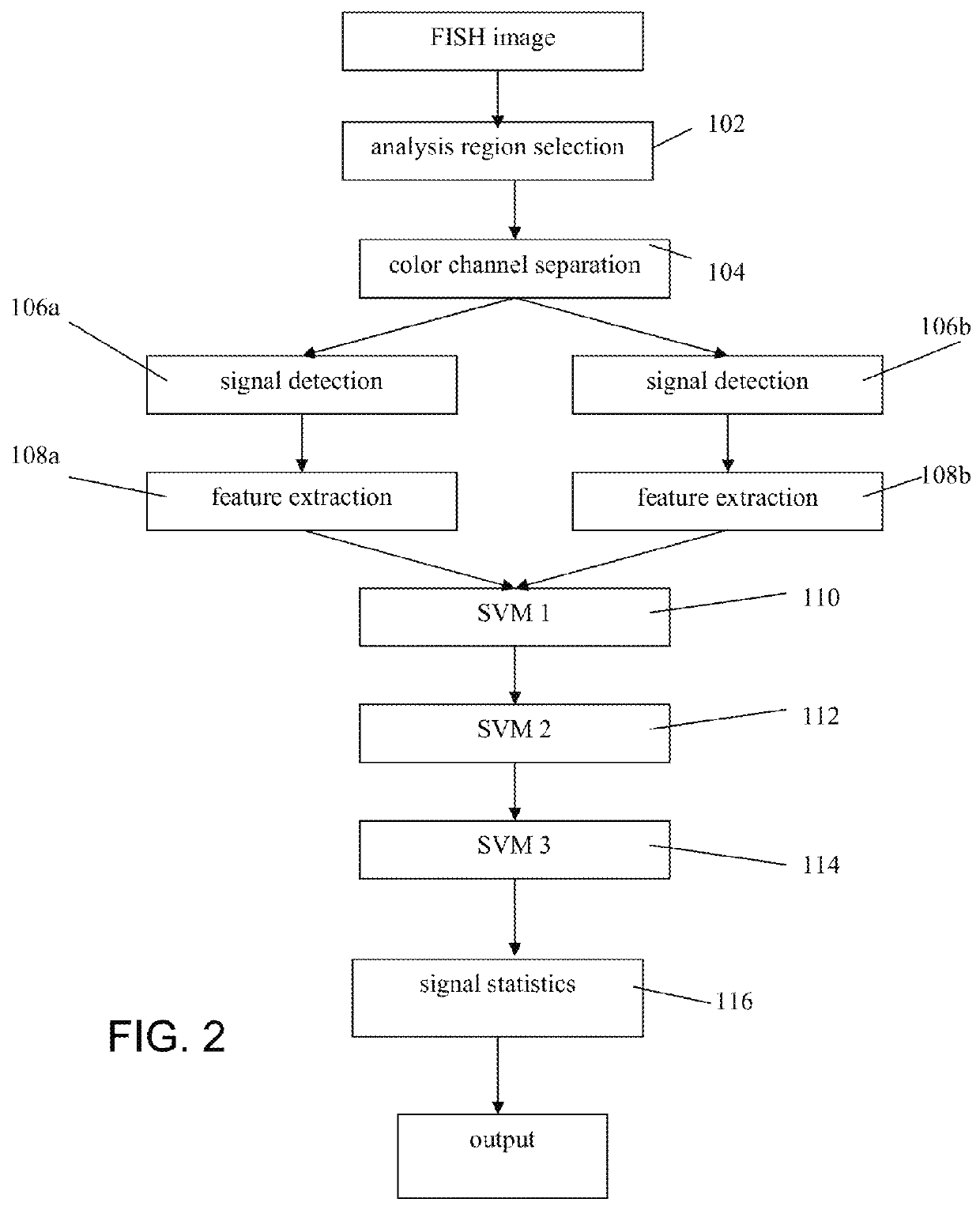
An automated reader for reading fluorescence in-situ hybridization signals includes one or more computer processors for receiving a digitized FISH image and executing the steps of converting colors within the image to a hue value, separately for each color extracting quantitative values to detect the presence of signals corresponding to spots and applying a plurality of algorithms to extract features from the signals to determine cell shapes and segment cells within the FISH image. After recombining the signals, the extracted features for the colors learning machines are used to classify the spots according to the color and separate merged signals of classified spots that are in close proximity to each other within the image. The classified spots are counted to determine relative frequency of colors and a report is generated providing the number of classified spots of each color.

Description

RELATED APPLICATIONS[0001]This application claims the benefit of the priority of U.S. Provisional Application No. 61 / 699,301, filed Sep. 11, 2012.FIELD OF THE INVENTION[0002]The present invention relates to a computer-implemented method for automatically identifying and quantifying cellular structures tagged using fluorescence in-situ hybridization (FISH).BACKGROUND OF THE INVENTION[0003]In recent years, fluorescence in-situ hybridization (FISH) has emerged as one of the most significant new developments in the analysis of human chromosomes. FISH offers numerous advantages compared with conventional cytogenetics techniques because it allows detection of numerical chromosome abnormalities during normal cell interphase.[0004]Historically, FISH and other in situ hybridization results played a primary role in mapping genes on human chromosomes. Results from these experiments were collected and compiled in databases, and this information proved useful during the annotation phase of the H...

Claims

the structure of the environmentally friendly knitted fabric provided by the present invention; figure 2 Flow chart of the yarn wrapping machine for environmentally friendly knitted fabrics and storage devices; image 3 Is the parameter map of the yarn covering machine
Login to View More

Application Information

Patent Timeline
no application Login to View More
Patent Type & Authority Patents(United States)
IPC IPC(8): G06K9/00G06T7/00
CPCG06K9/00147G06K9/0014G06T7/0012G06T2207/10024G06T2207/10056G06T2207/20061G06T2207/20072G06T2207/20076G06T2207/20081G06T2207/30024G06T2207/30242G06V20/695G06V20/698
Inventor ZHANG, HONGALBITAR, MAHER
Owner NEOGENOMICS LAB
Features
  • R&D
  • Intellectual Property
  • Life Sciences
  • Materials
  • Tech Scout
Why Patsnap Eureka
  • Unparalleled Data Quality
  • Higher Quality Content
  • 60% Fewer Hallucinations
Social media
Patsnap Eureka Blog
Learn More