
Backstopping clutch with torque transmission through radial surface of outer race
a technology of torque transmission and outer race, which is applied in the direction of automatic clutches, freewheel clutches, mechanical equipment, etc., can solve the problems of difficult adaptation to various drive trains, and achieve the effects of increasing friction, high heat conductivity, and relatively stable coefficient of friction
- Summary
- Abstract
- Description
- Claims
- Application Information
AI Technical Summary
Benefits of technology
Problems solved by technology
Method used
Image

Examples
Embodiment Construction
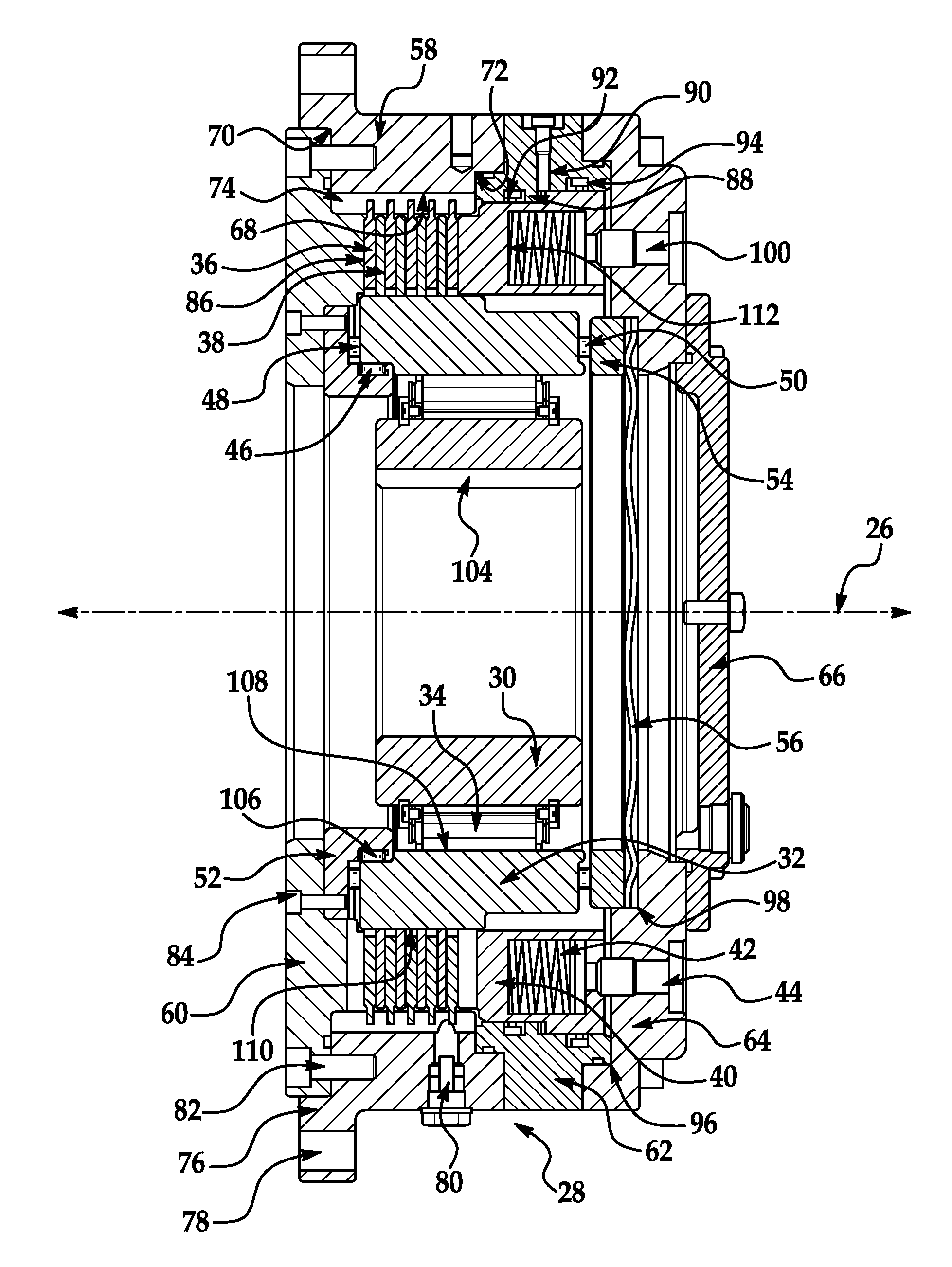
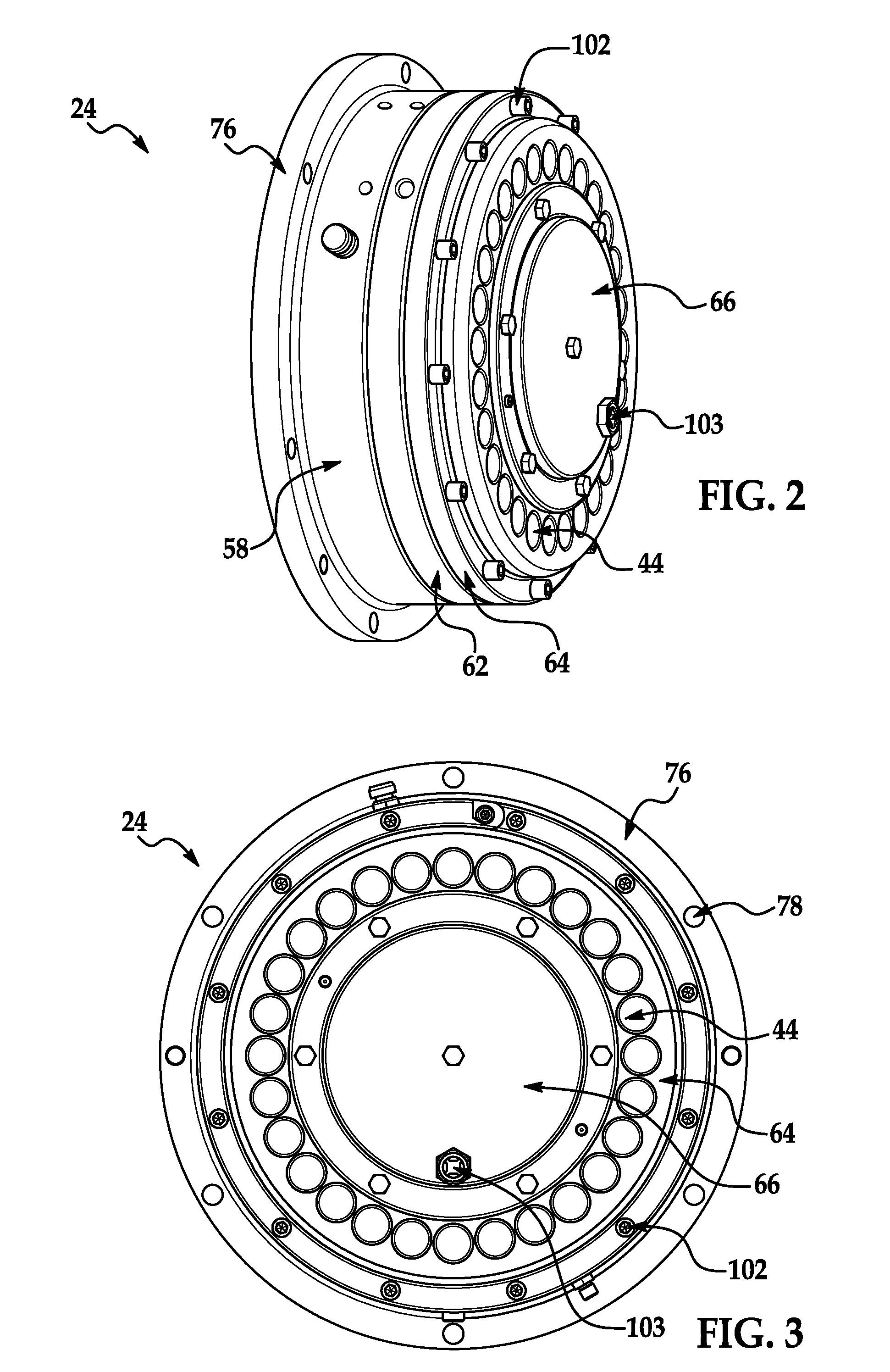
[0016]Referring now to the drawings wherein like reference numerals are used to identify identical components in the various views, FIGS. 2-4 illustrate a backstopping clutch 24 in accordance with one embodiment of the invention. Clutch 24 is provided to inhibit reverse rotation of a driven shaft (not shown) about a rotational axis 26 and damping of longitudinal vibrations in the drive train due to slipping of the brake. Clutch 24 may include a housing 28, inner race 30, outer race 32, torque transmission members 34, friction discs 36, 38, means, such as piston 40 and springs 42, for urging discs 36, 38, into engagement, means, such as adjusters 44, for adjusting the tension on springs 42 and, therefore, the friction force in clutch 24, bearings 46, 48, 50, bearing rings 52, 54, and spring 56.
[0017]Housing 28 provides a path for reacting the torque from engagement of clutch 24. Housing 28 also provides structural support to the other components of clutch 24 and protects those compon...
PUM
 Login to View More
 Abstract
Description
Claims
Application Information
 Login to View More