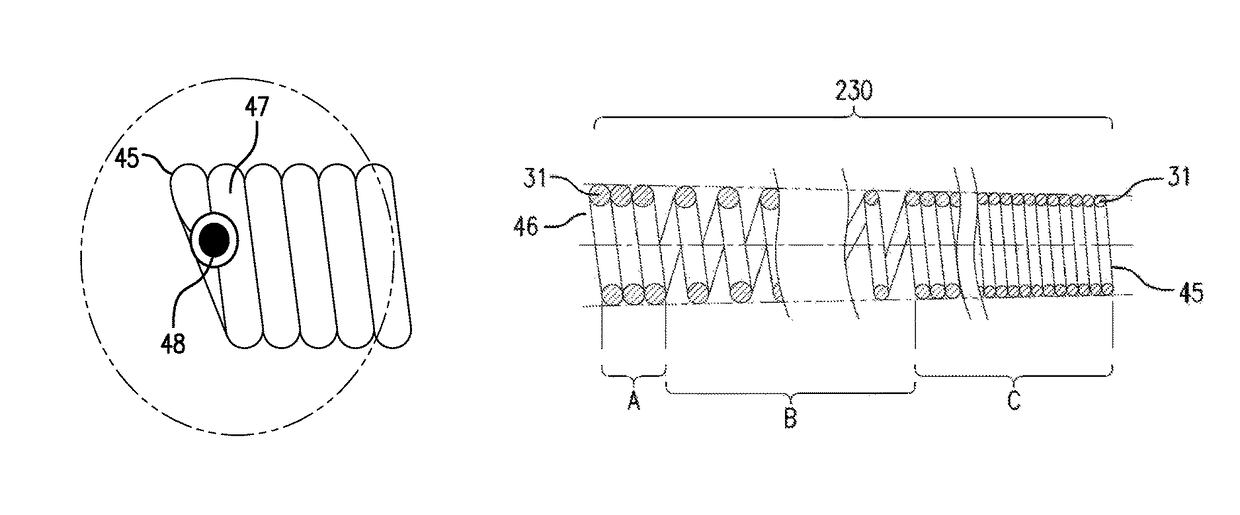
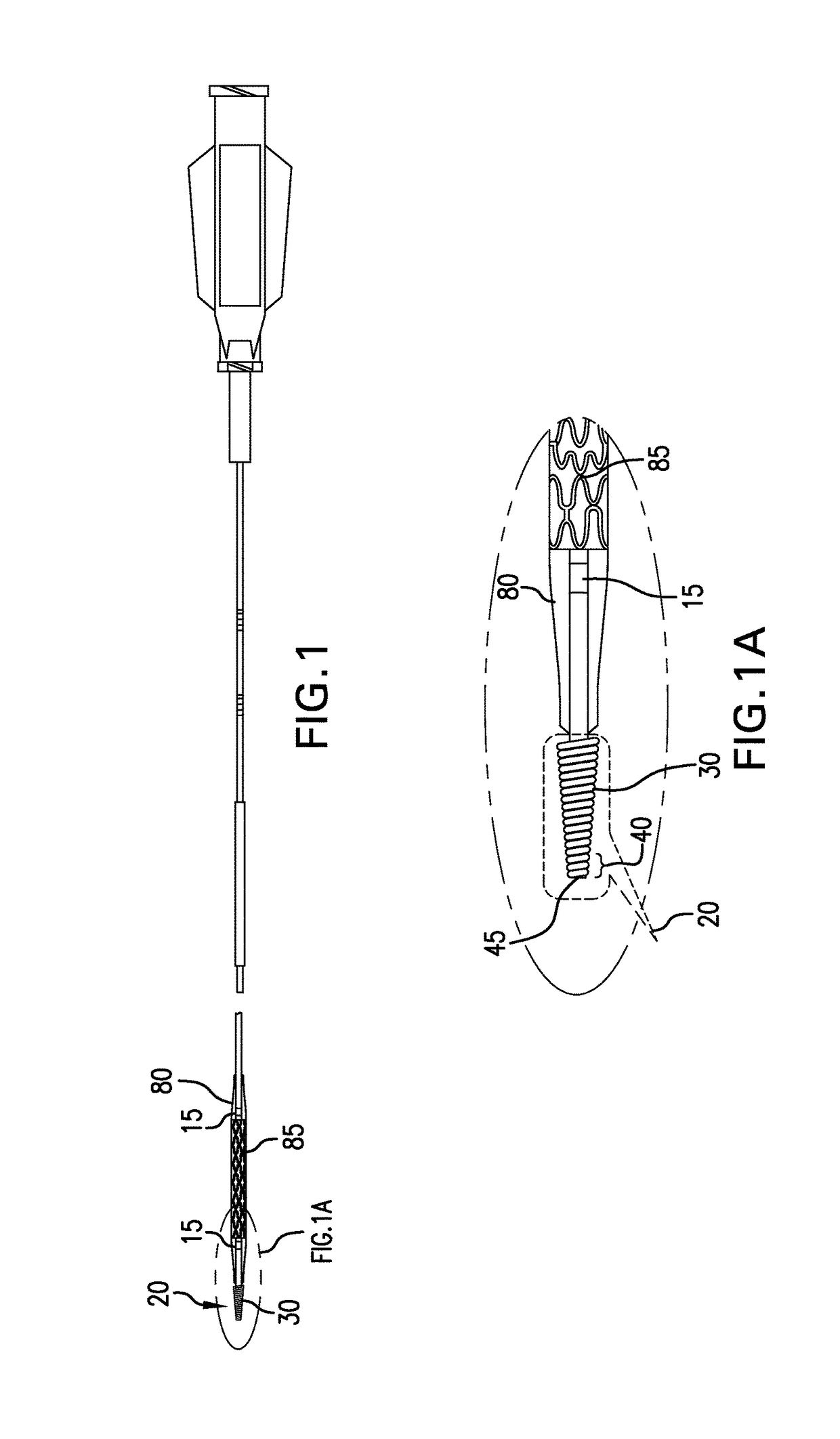
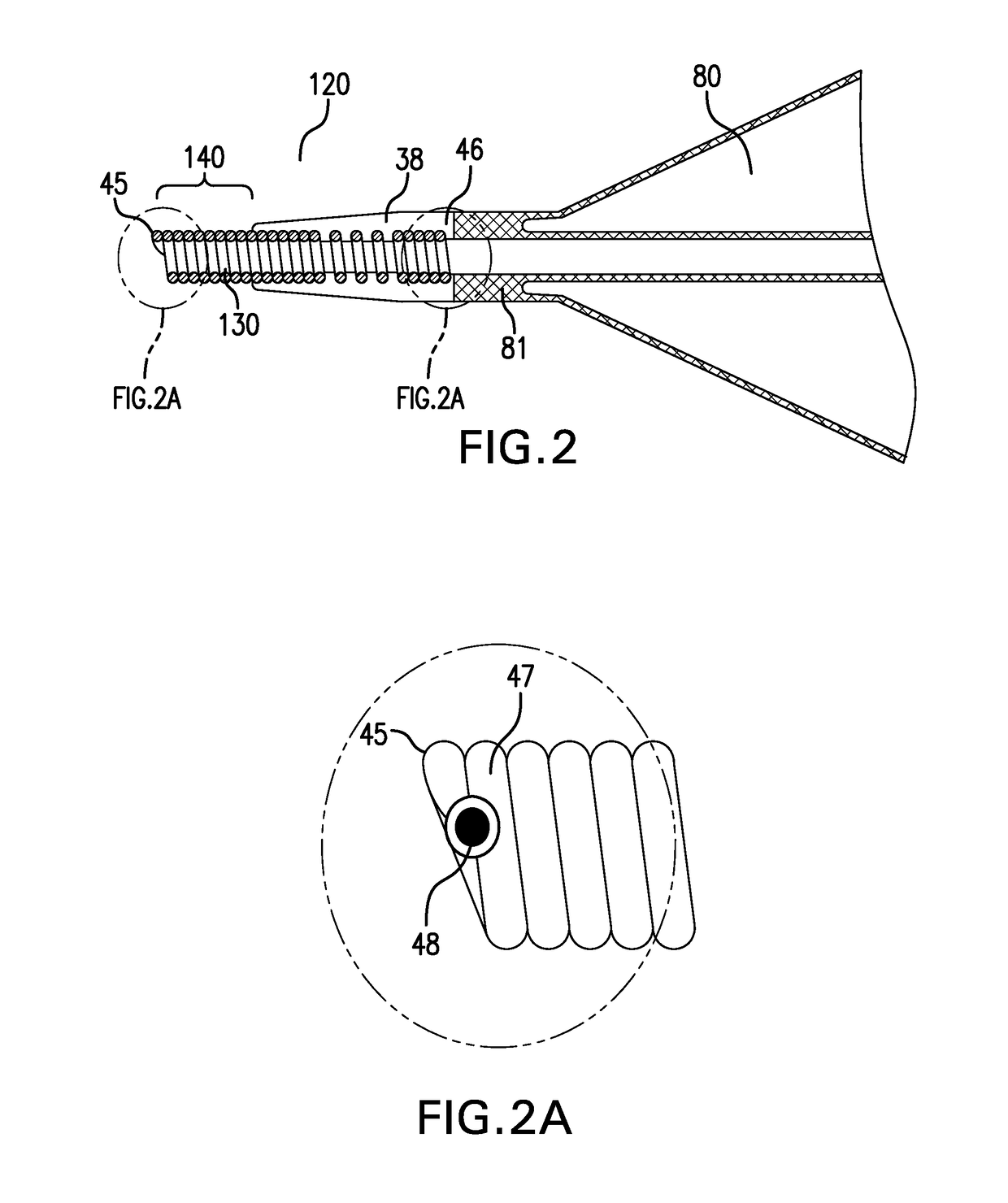
[0007]The present invention provides an endovascular catheter tip having longitudinal flexibility, pushability and radial rigidity at its distal end. By longitudinal flexibility is meant an ability to bend along the longitudinal axis (e.g., to facilitate navigation through tortuous vessels). The catheter tip of the invention includes two features. The first feature of the catheter tip includes a spring-like structure, a spring element, that endows the catheter tip with the desired longitudinal flexibility and pushability. The spring element may be made from any suitable material, for example, metal or plastic, and may be manufactured by any of the methods known in the art. In particular, the spring element may have an external diameter that tapers distally, i.e., the diameter decreases from the proximal end to the distal end. Such tapering may decrease the crossing profile of the spring element thereby improving the catheter's deliverability. When tapered, the spring element may further have an inner diameter (lumen diameter) that is constant from the proximal to distal end or tapers at a lesser rate than the outer diameter. The second feature of the catheter tip—the distal end—provides radial rigidity and is rounded and tapered to prevent the distal edge from flaring and catching on, for example, plaque or the strut of a previously implanted stent as the catheter is moved through the vessel. The spring element may act as the second “distal end” feature of the catheter tip. Thus, the spring element provides longitudinal flexibility, radial rigidity, and pushability in the distal-most portion of the catheter tip. By so combining these two features in one catheter tip, the present invention provides a device having otherwise conflicting structural and functional parameters to facilitate deliverability of the catheter.
[0008]In one embodiment, the catheter tip further includes a flexible spacer portion, contiguous with the distal end of the balloon and attached to or integrated with the spring element that, in conjunction with the spring element, confers longitudinal flexibility to the catheter tip.
[0009]In another embodiment, the spring element may be partially covered by a jacket that connects the balloon shoulder and the spring itself. The jacket may help maintain the natural properties of the spring. In one aspect, the spring element may be embedded in the jacket. Embedding the spring element in the jacket may improve the bond between the spring and the distal fuse section, where the catheter tip connects with the balloon. In a preferred aspect of this embodiment, the jacket covers or embeds a proximal region of the spring element, leaving a distal region, and in particular the distal end, exposed, i.e., uncovered or unembedded. In another aspect of this embodiment the jacket may include a mediating portion similar to the spacer portion that extends proximal of the spring element.
[0011]In still another embodiment, the spring element is a wire coil extending to the distal edge of the catheter tip and the distal edge of the coil is smoothed, for example to minimize damage to the vessel wall. In one aspect of this embodiment the distal edge of the coil is smoothed by having a laser polish / weld applied to it. In another aspect of this embodiment, the distal edge of the coil is smoothed by having a bond applied to it.
[0015]In addition to the advantage of enhanced deliverability parameters, another desirable effect of the catheter tip of the invention is higher radio-opacity, which may provide the operator with valuable feedback regarding position of the catheter tip during insertion of the catheter into the anatomy to be treated.


 Login to View More
  Login to View More