[0011]The embodiments described and claimed herein solve at least some of the problems of the conventional bottle securement devices. The present device permits no tools to be required, is light weight, minimizes bulkiness, allows flexible and temporary installation onto multiple surfaces within a vehicle, is capable of being mounted into a variety of anchorages, and adapts to be able to secure other non-tank objects such as canes, walkers, etc. Also, it is contemplated that alternate versions of the device can be adapted to be permanently mounted to the vehicle floor or wall if the user so desires.
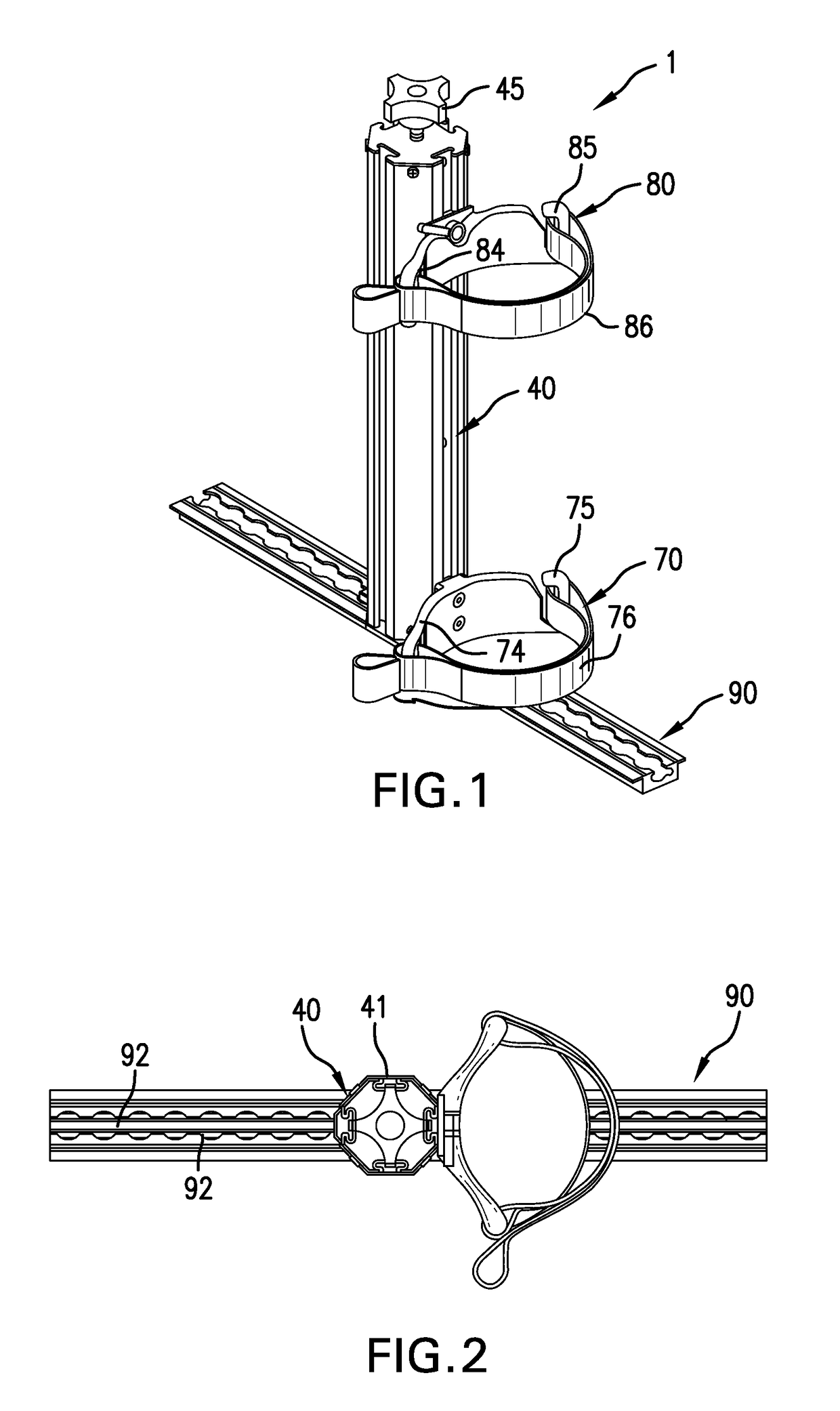
[0012]In particular, the embodiments described herein have a compact and flexible design. They are designed to engage with floor or wall mounted anchorages (e.g. “L-Track”, “L-Pocket” or “Slide 'n Click”; see www.qstraint.com / en_na / products / floor-anchor-systems) as well as fixed and / or direct floor or wall mounts. Because many transit vehicles, such as School Buses, Para-transit and ambulances, are typically provided with track that run the length of the vehicle (to secure seats and wheelchair restraints) or ‘Floor Pockets’ installed at various locations throughout the vehicle, the present embodiments can be mounted in numerous locations. In addition, they secure the bottles more efficiently, take up less space in the vehicle, reduce weight, can be easily removed and stored when not in use, and provide transporters the flexibility to share units between vehicles within their fleets instead of having dedicated units for each vehicle. The present embodiments also minimize potential tripping hazards, de-clutter the floor area of the vehicle and can secure more than one bottle simultaneously.
[0013]The present embodiments also have an open design, although an optional cover may be placed over the entire top of bottle and bottle holder while installed. The open design eliminates at least two steps of the O2 Bus Buddy, i.e., not having to open and close the hinged door; this reduces the number of steps and increases the speed of securing the devices, which reduces vehicle dwell times.
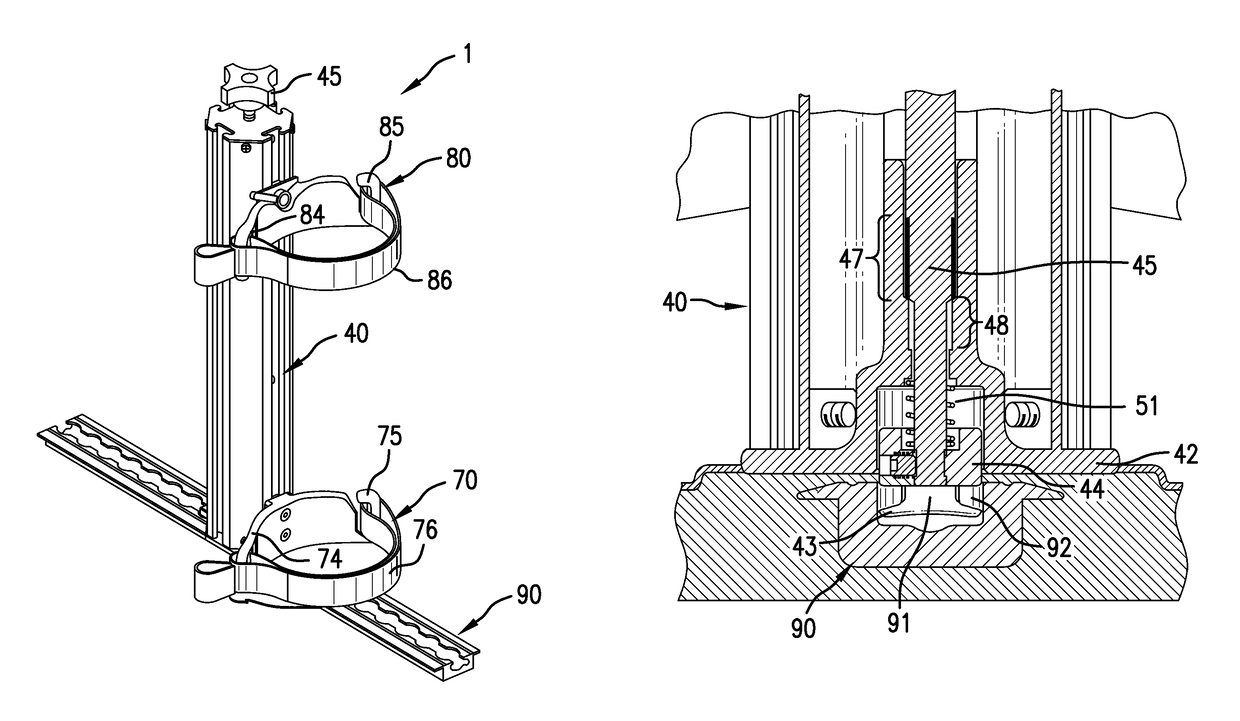
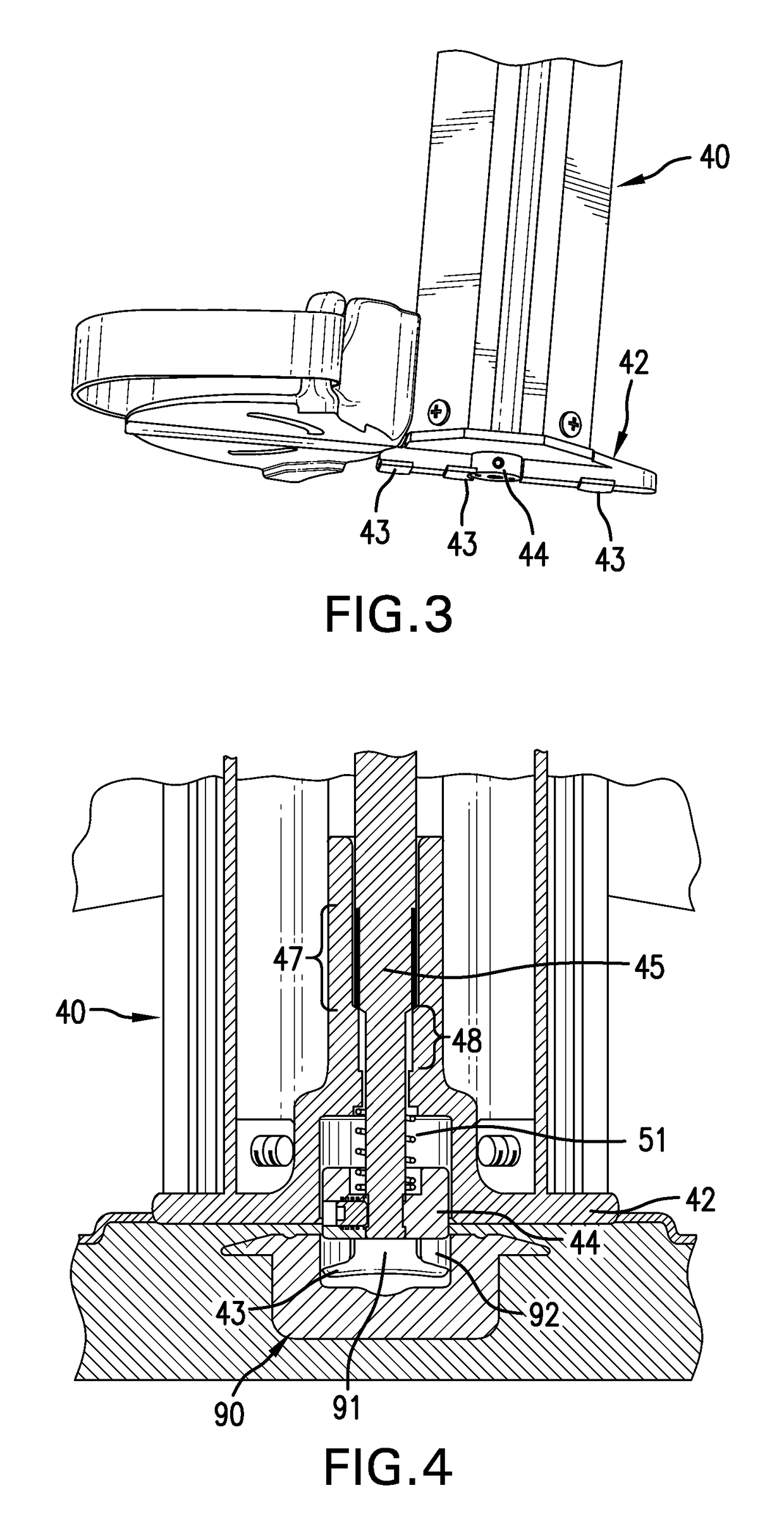
[0015]Further yet, the present embodiments are provided with a convenient and efficient secure / release device, which makes it easy to remove the device from the anchorages without the use of tools, and removal, in is a one-handed operation. In that embodiment, the locking mechanism is manipulated by a single knob located on the top of the structure. The location of the knob, at the top of the structure, also reduces injury, because it minimizes operator bending needed for installation and removal of the device from the vehicle.
[0016]At least one of the present embodiments is provided with bottle brackets that have a flexible design and are adjustable. The bottle brackets (or holders) allow for securement of virtually all popular size oxygen bottles that are currently used in the market (e.g., at least bottle sizes from 2.5″ in diameter to 5.25″ in diameter). The top bottle bracket is adjustable, and can be positioned at various heights to properly enable securement of tall and short oxygen bottles. A quick release lever is provided to allow for easy and rapid adjustment of brackets to accommodate any height bottle. Bottle “straps” are used and extend from one side of the bottle brackets to the other side. The straps make securing and releasing a bottle a “one-handed” operation. At least one side of each bottle bracket is provided with an open J-hook design to allow the straps to be easily connected and released. The bottom bottle bracket is designed to support various size bottles, and keep the bottle off of the floor. As with the top bracket, the bottom bracket can be adjustable to allow the bracket to be positioned at various heights. The bottom bracket could also be provided with a quick release lever. Both the top and bottom mounting brackets contain a material that creates friction against the bottle to prevent the bottle from moving while being transported, and to prevent it from being a projectile in the event of an accident. Various materials can be used on the mounting brackets, including a neoprene rubber with a durometer of 40 A + / −5 (medium soft). A friction-inducing material is also provided on the straps. Various materials can be used on the straps, including a polyester webbing with a urethane coating (e.g., polyester webbing with urethan coating, black gloss finish produced by Bioplastics Inc., Superflex Gold Series, Part No. B1OSF100BL101-0100-A100A.


 Login to View More
  Login to View More