Method for encoding and decoding stereo audio and encoder/decoder
A technology of stereo sound and coding method, applied in instruments, speech analysis, etc., can solve the problems of reduced code rate and distortion of intensity stereo coding method, and achieve the effect of ensuring coding gain and low code rate
- Summary
- Abstract
- Description
- Claims
- Application Information
AI Technical Summary
Problems solved by technology
Method used
Image

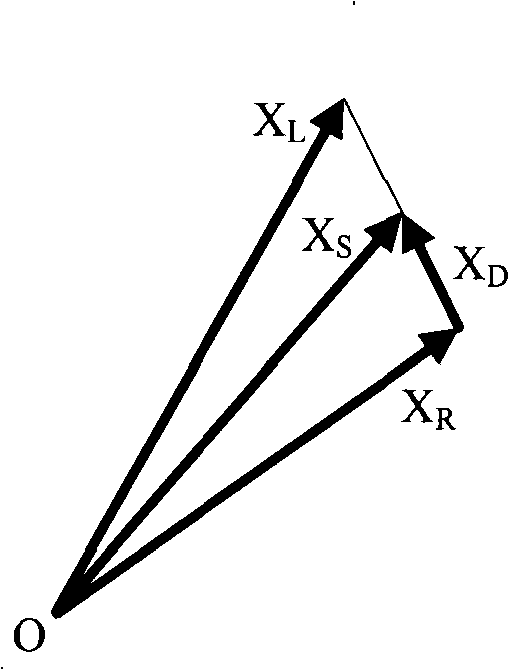


Examples
Embodiment 1
[0032] Embodiment 1. A stereo audio coding method, such as image 3 shown, including:
[0033] A1. Obtain two corresponding vector speech signals belonging to the left sound channel and the right sound channel respectively.
[0034] The acquisition of the vector speech signals of the left and right channels can be carried out by referring to the existing method. Based on the auditory characteristics of the human ear, the left and right channels can be divided into several sub-bands according to frequency, and two vector speech signals belonging to the same sub-band of the left and right channels are obtained as corresponding vector speech signals . The basis for stereo audio processing in units of subbands is:
[0035] Human hearing can be described by a non-uniform bandwidth filter bank, and each filter bank channel is called a subband. The bandwidth of the sub-band matches the characteristics of human hearing. The human ear's sense of space for stereo mainly comes from t...
Embodiment 2
[0070] Embodiment 2. A stereo audio decoding method provides a decoding method corresponding to the encoding method in Embodiment 1. The process is as follows Figure 5 shown, including:
[0071] B1. Obtain a stereo audio encoding stream.
[0072] The coded code stream is the coded code stream obtained by using the coding method in the first embodiment.
[0073] B2. Obtain the information of the rotation angle from the encoded code stream.
[0074] The decoding party can read and decode the rotation angle θ from a certain field according to the agreement adopted by the encoding party.
[0075] B3. Obtain two rotation vector signals from the encoded code stream;
[0076] Decode to get two rotating vector signals Y 0 and Y 1 The process can correspond to Y 0 and Y 1 encoding method.
[0077] B4. Perform inverse orthogonal rotation transformation on the two rotation vector signals according to the rotation angle to obtain two vector speech signals.
[0078] i.e. equivale...
Embodiment 3
[0079] Embodiment 3. A stereo audio coding method. The difference between the method of this embodiment and Embodiment 1 is that before performing the orthogonal rotation transformation, a process of evaluating and judging the coding gain of the transformation is added. The method flow is as follows Figure 6 shown, including:
[0080] C1. Obtain two corresponding vector speech signals belonging to the left sound channel and the right sound channel respectively.
[0081] This step can be performed with reference to step A1 in the first embodiment.
[0082] C2. It is determined that an orthogonal rotation transformation needs to be performed on the two vector speech signals.
[0083] Since the purpose of performing orthogonal rotation transformation is to improve the correlation of the vector, the correlation of the current vector speech signal can be used as the basis for judgment, for example, the correlation of the two vector speech signals can be calculated, and when the ...
PUM
 Login to View More
 Abstract
Description
Claims
Application Information
 Login to View More
 - R&D
- Intellectual Property
- Life Sciences
- Materials
- Tech Scout
- Unparalleled Data Quality
- Higher Quality Content
- 60% Fewer Hallucinations
Browse by: Latest US Patents, China's latest patents, Technical Efficacy Thesaurus, Application Domain, Technology Topic, Popular Technical Reports.
© 2025 PatSnap. All rights reserved.Legal|Privacy policy|Modern Slavery Act Transparency Statement|Sitemap|About US| Contact US: help@patsnap.com