Check patentability & draft patents in minutes with Patsnap Eureka AI!

Natural language level and syntax analytic method based on historical information

A technology of syntactic analysis and natural language, applied in special data processing applications, instruments, electronic digital data processing, etc., can solve problems that restrict the development of Chinese information processing, and achieve the effect of improving performance, improving accuracy, and simple and effective methods

Inactive Publication Date: 2009-06-03
SUZHOU UNIV
View PDF0 Cites 12 Cited by
  • Summary
  • Abstract
  • Description
  • Claims
  • Application Information

AI Technical Summary

Problems solved by technology

The existing Chinese syntax analyzers cannot meet the needs of upper-level applications, and Chinese syntax analysis has become a bottleneck restricting the further development of Chinese information processing

Method used

the structure of the environmentally friendly knitted fabric provided by the present invention; figure 2 Flow chart of the yarn wrapping machine for environmentally friendly knitted fabrics and storage devices; image 3 Is the parameter map of the yarn covering machine
View more

Image

Smart Image Click on the blue labels to locate them in the text.
Viewing Examples
Smart Image
  • Natural language level and syntax analytic method based on historical information
  • Natural language level and syntax analytic method based on historical information
  • Natural language level and syntax analytic method based on historical information

Examples

Experimental program
Comparison scheme
Effect test

Embodiment 1

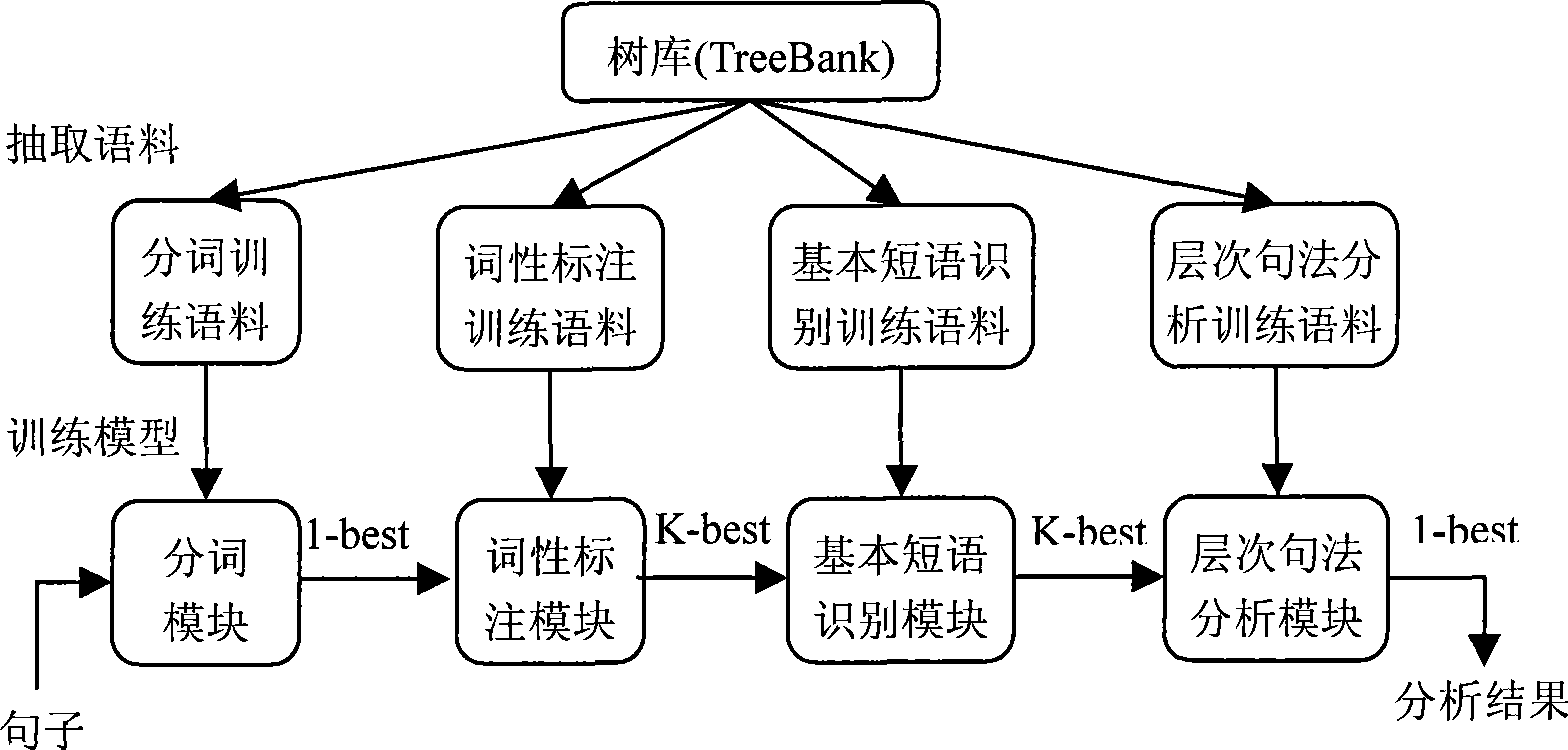
[0047] Embodiment one: see attached figure 1 As shown, a hierarchical syntactic analysis based on historical information, for any sentence that needs to be processed, the following steps are performed:

[0048] ① If the sentence is in Chinese and word segmentation is not performed, call the word segmentation module to segment the sentence; if the sentence is in English or Chinese that has already been divided into words, skip this step;

[0049] ② Call the part-of-speech tagging module, that is, find the part-of-speech for each word in the sentence; keep the top K best tagging results;

[0050] ③ Carry out basic phrase recognition on the top K best part-of-speech tagging results respectively; finally retain the top K best basic phrase recognition results;

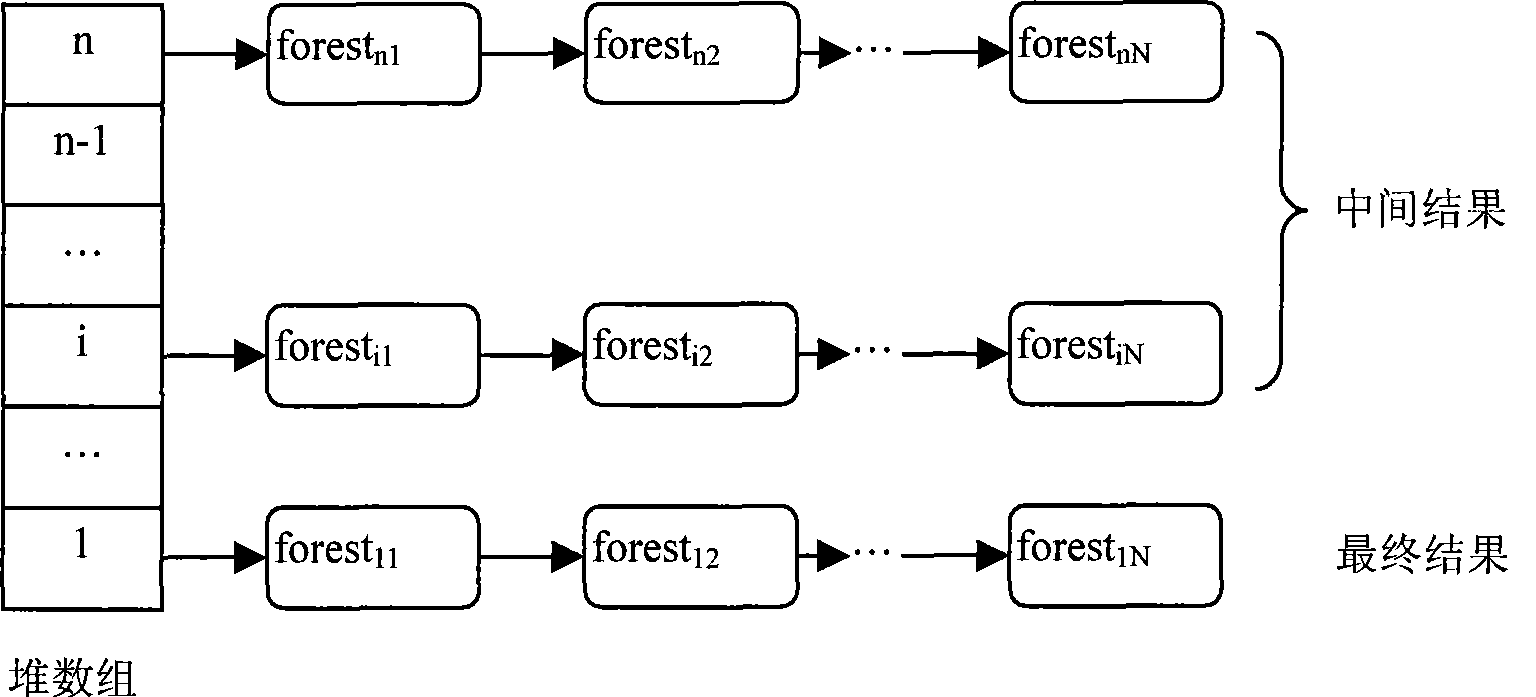
[0051] ④ According to the number of chunks in each basic phrase recognition result, store them in the corresponding array unit, for example, if the basic phrase recognition result contains m chunks, store them in the array...

Embodiment 2

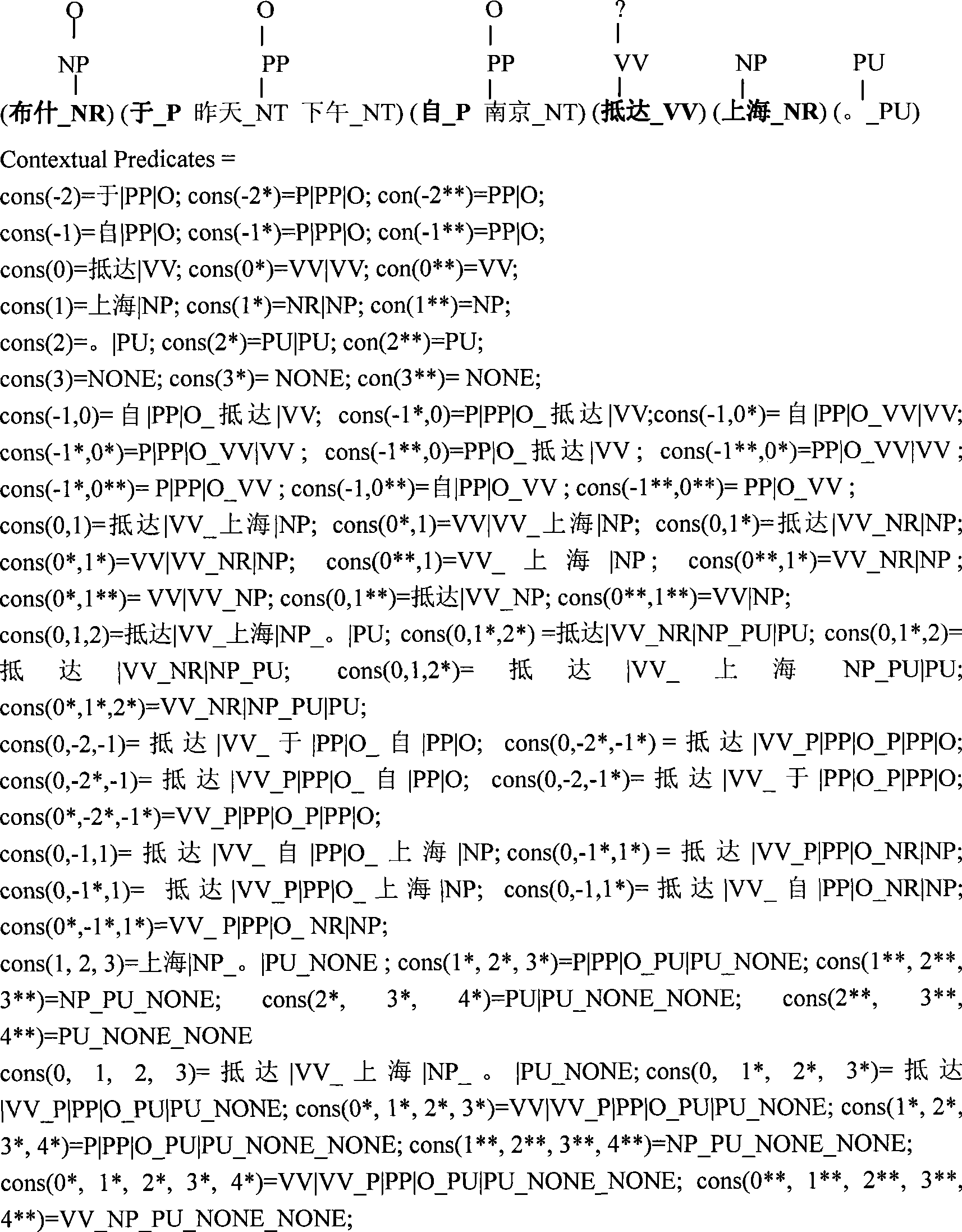
[0060] Embodiment two: see attached figure 2 As shown in , after obtaining an intermediate level analysis result, according to the pre-established feature template, the context features are extracted from left to right for each block unit to predict its label:

[0061] from figure 2 See, the current intermediate result is "(NP(Bush_NR))(PP(at_Pyesterday_NT afternoon_NT))(PP(from_PNanjing_NR))(VV(arrival_VV) )(NP(Shanghai_NR))(PU(._PU))”, wherein the italicized word in brackets is the central word of this group, such as the group “(PP(from_PNanjing_NR))” The central word is "自". And a decision has been made on the first three unit blocks “(NP(Bush_NR))(PP(at_Pyesterday_NT afternoon_NT))(PP(since_PNanjing_NR))”, respectively are "O", "O" and "O"; the next step is to predict the decision for the fourth chunk "(VV(Arrival_VV))". The basis for decision-making prediction is the context information of the current block. Therefore, according to the feature template, features are...

the structure of the environmentally friendly knitted fabric provided by the present invention; figure 2 Flow chart of the yarn wrapping machine for environmentally friendly knitted fabrics and storage devices; image 3 Is the parameter map of the yarn covering machine
Login to View More

PUM

No PUM Login to View More

Abstract

The invention discloses a natural language level and syntax analytic method based on historical information, which is characterized in that the analytic method comprises the following steps: firstly, taking each word as an initial module aiming at a sentence which has completed participle; carrying out block identification by adopting a layered manner according to context information; forming a block which can be combined into a novel block to obtain an intermediate result; and repeatedly carrying out the identification and the combination of the block to the intermediate result according to the context information till one block is contained. The block is the root node of a syntax tree, so that the syntax tree for expressing natural language is obtained. The invention can preferably identify the block which can be identified easily during the processing procedure of each layer, and can provide richer context information to identify the complicated block and improve the decision forecasting correctness, thereby improving the analytic performance of syntax.

Description

technical field [0001] The invention relates to a method for syntactic analysis of natural language, which realizes complex block identification through hierarchical analysis, and belongs to the field of natural language processing in computational linguistics. Background technique [0002] Syntactic parsing is a basic problem in natural language processing, and it is also a recognized research problem. Its task is to automatically deduce the grammatical structure of a sentence according to the given grammar, that is, the syntactic units contained in the sentence and the relationship between these syntactic units. There are two main purposes of syntactic analysis: one is to determine the "pedigree" structure contained in the sentence; the other is to determine the relationship between the components of the sentence. Usually, the input is a single sentence, that is, the linear order between words, and the output is a non-linear data structure, such as a phrase structure tree...

Claims

the structure of the environmentally friendly knitted fabric provided by the present invention; figure 2 Flow chart of the yarn wrapping machine for environmentally friendly knitted fabrics and storage devices; image 3 Is the parameter map of the yarn covering machine
Login to View More

Application Information

Patent Timeline
no application Login to View More
IPC IPC(8): G06F17/27
Inventor 朱巧明周国栋李培峰李军辉钱龙华孔芳王红玲钱培德
Owner SUZHOU UNIV
Features
  • R&D
  • Intellectual Property
  • Life Sciences
  • Materials
  • Tech Scout
Why Patsnap Eureka
  • Unparalleled Data Quality
  • Higher Quality Content
  • 60% Fewer Hallucinations
Social media
Patsnap Eureka Blog
Learn More