
Production method of surface plasma resonance chip
A surface plasmon and chip technology, applied in the direction of material inspection products, phase influence characteristic measurement, scattering characteristic measurement, etc. Eliminate problems such as shedding, and achieve the effects of low preparation cost, reduced experimental cost, and uniform matrix
- Summary
- Abstract
- Description
- Claims
- Application Information
AI Technical Summary
Problems solved by technology
Method used
Image

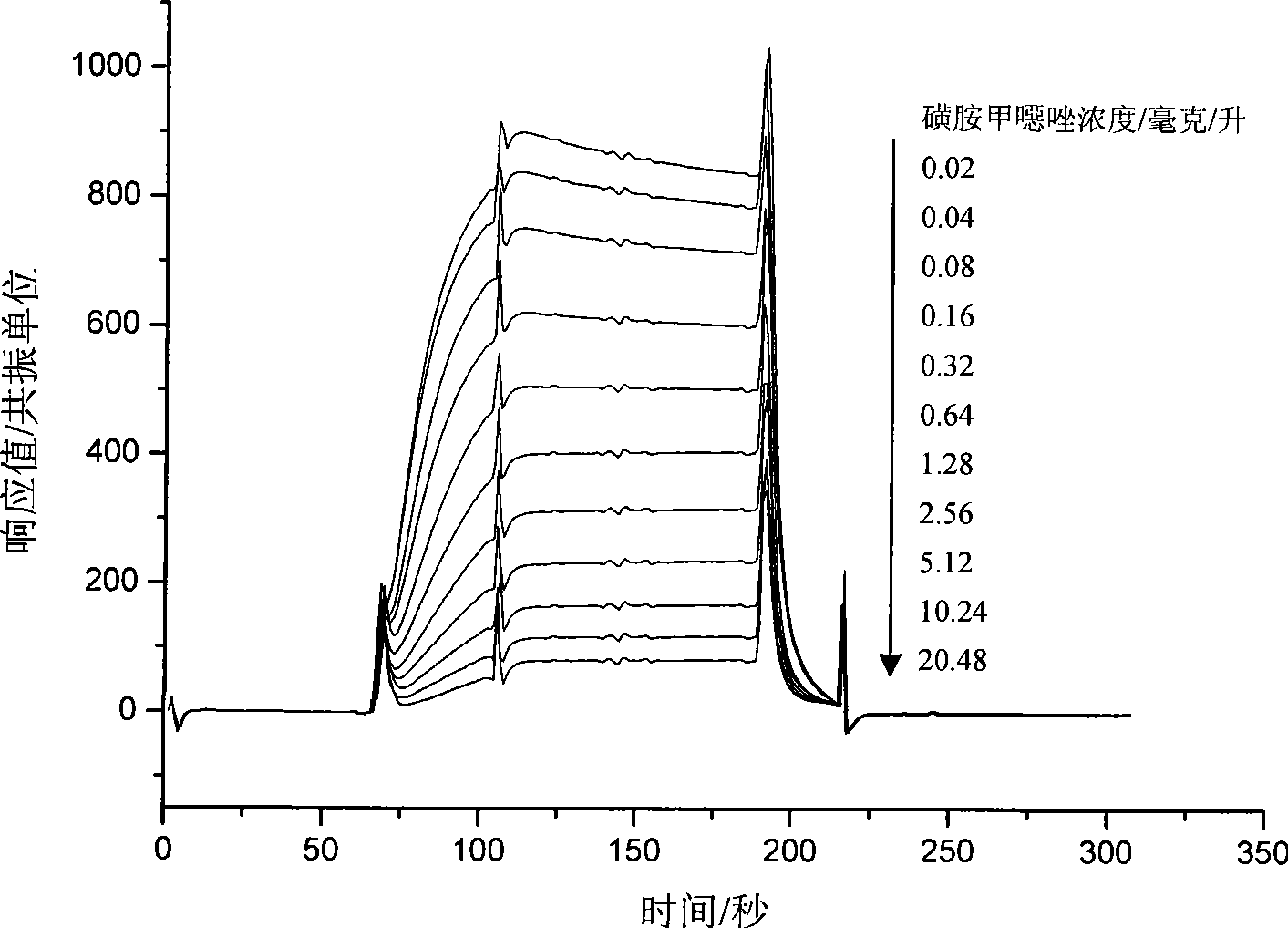
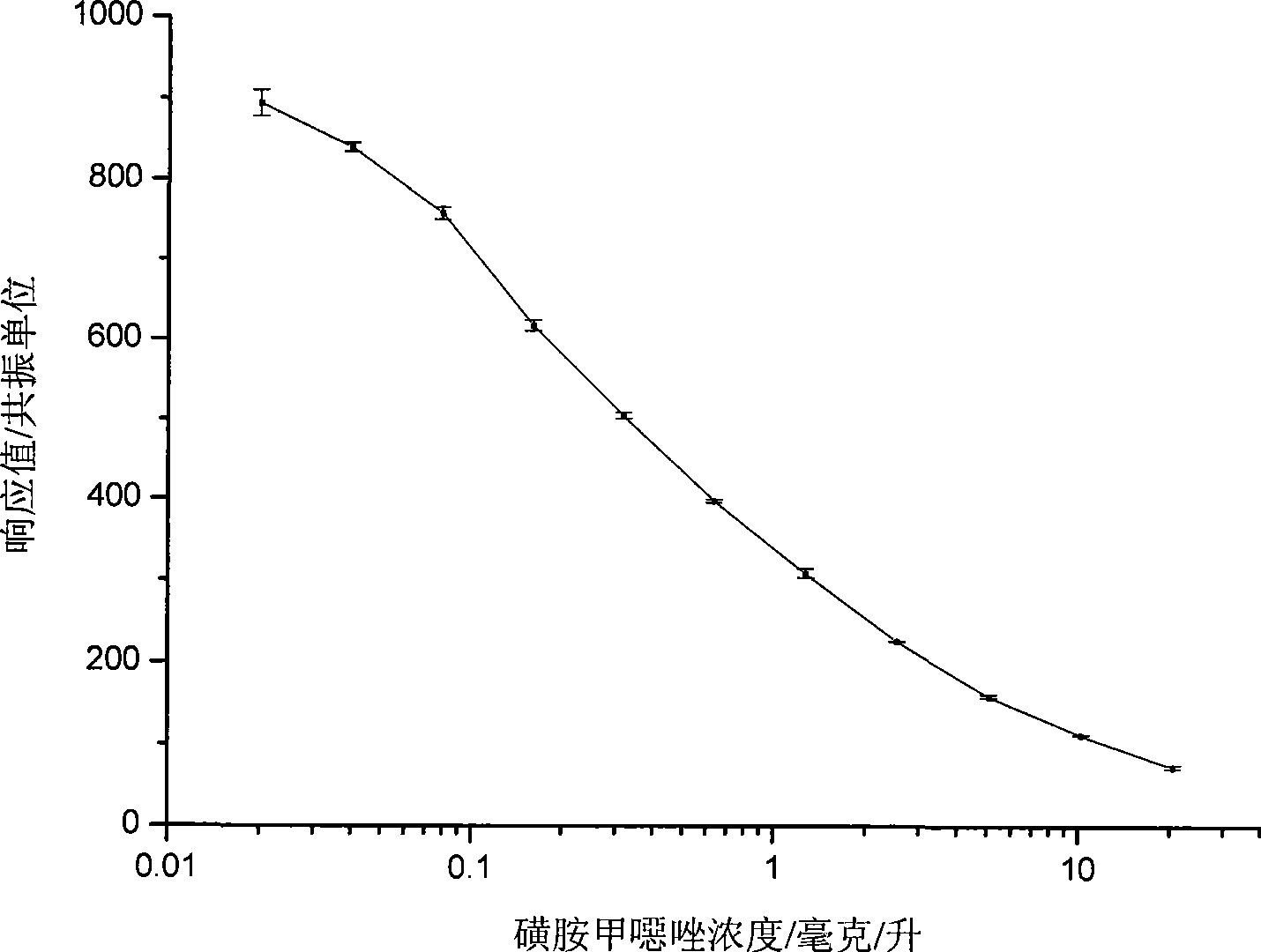
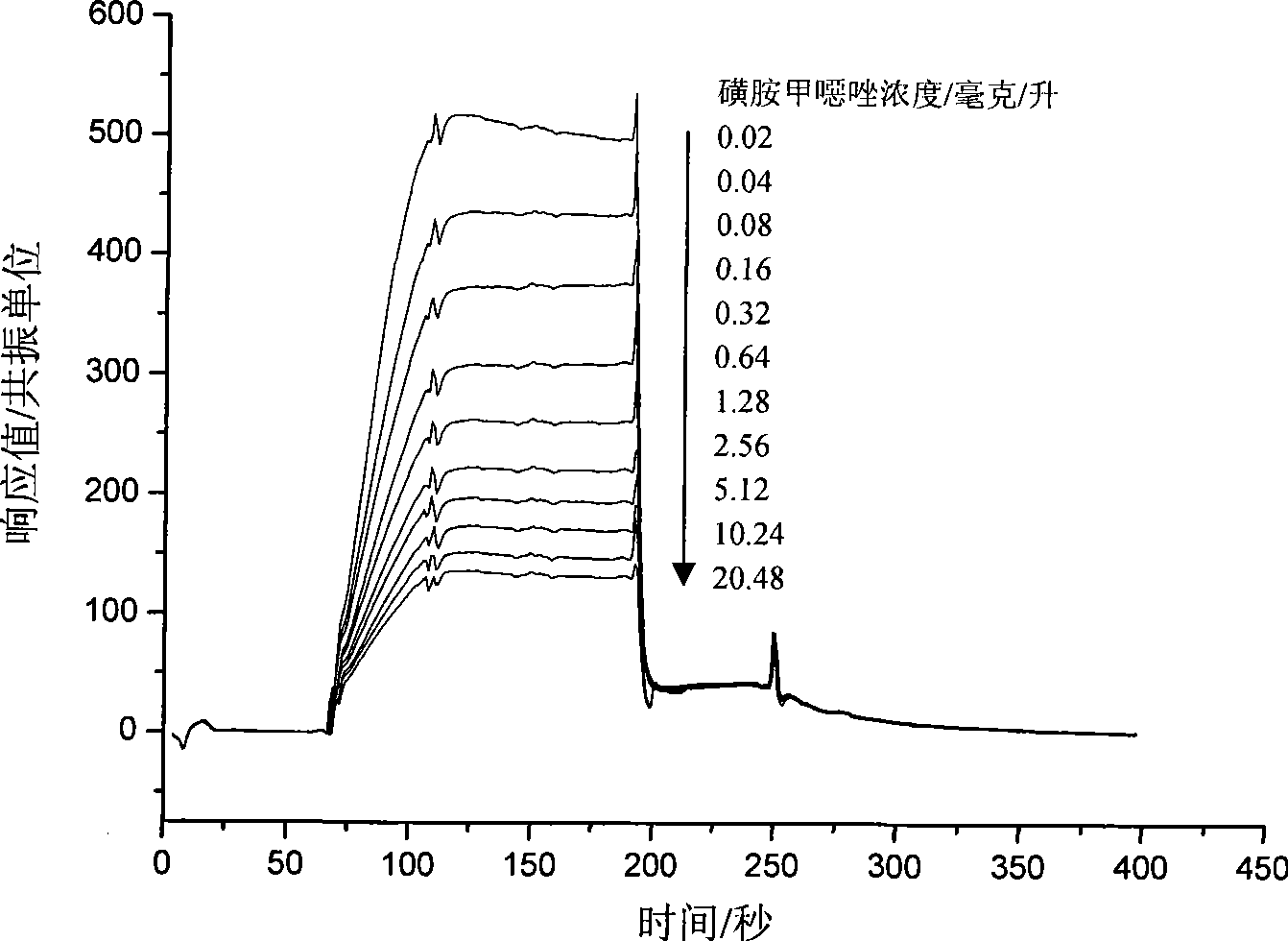
Examples
Embodiment 1
[0025] (1) Pretreatment of biological protein:
[0026] Add tris(2-formylethyl)phosphine hydrochloride to the bovine serum albumin solution, so that the final concentrations of bovine serum albumin and tris(2-formylethyl)phosphine hydrochloride in the mixed solution are respectively 0.5 μM and 100μM, react for 30 minutes to reduce the disulfide bond in the bovine serum albumin molecule;
[0027] (2) Carry out the construction of chip surface matrix:
[0028] a) putting the surface plasmon resonance sensor chip with a pure gold film on its surface into the above-mentioned pretreated bovine serum albumin solution and soaking for 60 minutes to obtain a chip with bovine serum albumin molecules;
[0029] b) Soak the above-obtained chip with bovine serum albumin molecules in a mixed aqueous solution containing 0.4M N-hydroxysuccinimide and 0.5M ethyl-dimethylaminopropyl-carbodiimide for 12 Minutes for surface crosslinking;
[0030] c) Soak the surface-crosslinked chip in an aqueo...
Embodiment 2
[0036] (1) Pretreatment of biological protein:
[0037] Add 2-mercaptoethanol to the ovalbumin solution, so that the final concentrations of ovalbumin and 2-mercaptoethanol in the mixed solution are 20 μM and 2 mM respectively, and react for 60 minutes to reduce the disulfide bond in the ovalbumin molecule;
[0038] (2) Carry out the construction of chip surface matrix:
[0039] a) putting the surface plasmon resonance sensor chip with a pure gold film on the surface into the above-mentioned pretreated ovalbumin solution and soaking for 40 minutes to obtain a chip with ovalbumin molecules;
[0040] b) Soak the above-obtained chip with ovalbumin molecules in a mixed aqueous solution containing 0.01M N-hydroxysuccinimide and 0.01M ethyl-dimethylaminopropyl-carbodiimide for 30 minutes carry out surface cross-linking;
[0041]c) Soak the surface-crosslinked chip in an aqueous solution containing 0.01M bromoacetic acid and 0.01M potassium hydroxide for 300 minutes to carboxymethy...
Embodiment 3
[0043] (1) Pretreatment of biological protein:
[0044] Add 2-mercaptoacetic acid and dithiothreitol to the bovine hemoglobin solution, so that the final concentrations of bovine hemoglobin, 2-mercaptoacetic acid and dithiothreitol in the mixed solution are 1mM, 0.8M and 0.5M respectively, and react for 15 minutes , so that the disulfide bond in the bovine hemoglobin molecule is reduced;
[0045] (2) Carry out the construction of chip surface matrix:
[0046] a) putting the surface plasmon resonance sensing chip with a pure gold film on the surface into the bovine hemoglobin solution pretreated above and soaking for 5 minutes to obtain a chip connected with bovine hemoglobin molecules;
[0047] b) Soak the above-obtained chip with bovine hemoglobin molecules in a mixed aqueous solution containing 2M N-hydroxysuccinimide and 1M ethyl-dimethylaminopropyl-carbodiimide for 8 minutes for surface interaction. couplet;
[0048] c) Soak the surface-crosslinked chip in an aqueous so...
PUM
 Login to View More
 Abstract
Description
Claims
Application Information
 Login to View More